Scientists warn tire-wear chemical threatens Bay Area fish, waters
Trillions of tire particles wash into San Francisco Bay each year, carrying 6PPD-Q toward steelhead and other sensitive fish.
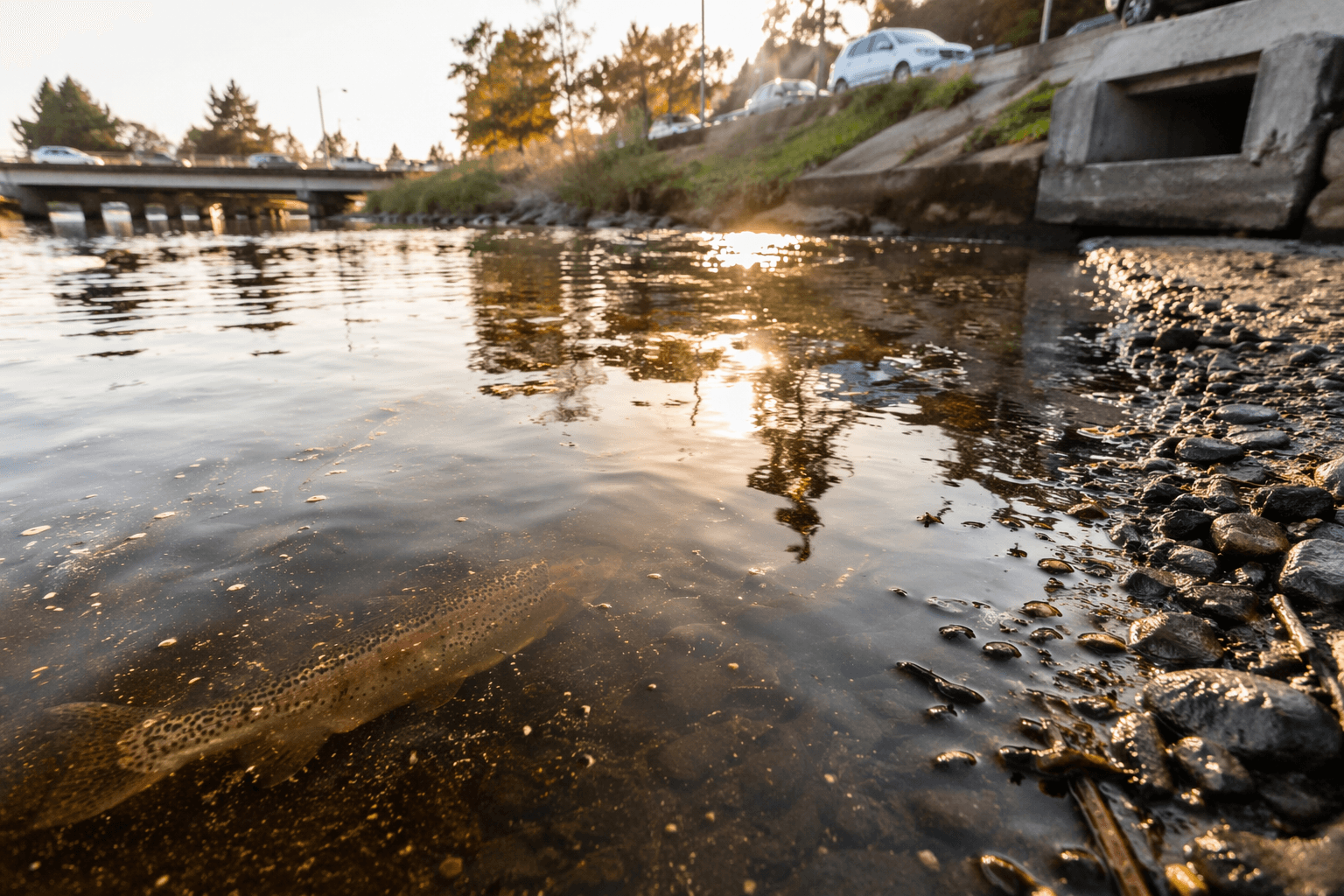
After winter storms, water sliding off San Francisco’s roads and bridges can carry a tire-wear chemical into the Bay, where scientists say it is showing up in shoreline runoff and raising alarms for steelhead, salmon and other sensitive fish. The compound, 6PPD-Q, comes from normal tire wear and is now being tracked as a contaminant with local water-quality and policy consequences.
Scientists at the San Francisco Estuary Institute say their new Bay measurements are among the first of their kind in an estuary. Ezra Miller, a senior scientist with the institute, said the compound was first identified by a team that included his organization about six years ago, and the latest data show buildups around the shoreline after winter storms, right when steelhead return to spawn.
That timing is part of what worries researchers. Stormwater washes trillions of tire particles into San Francisco Bay each year, and those particles can carry 6PPD-Q from roadways into storm drains, creeks and eventually the Bay. The Regional Monitoring Program for Water Quality, which has tracked Bay water quality since 1993 and shifted in 2020 to focus more on emerging contaminants, is now helping document how widespread the problem has become.
The concern is not abstract. A 2021 paper in Science reported 6PPD-Q in roadway runoff and stormwater-affected creeks across the West Coast at concentrations as high as 19 micrograms per liter. The same study found a median lethal concentration for coho salmon of about 0.8 micrograms per liter. In 2020, San Francisco Estuary Institute scientists found the chemical in nine Bay Area streams and storm drains during storm events, with four samples above the concentration that kills half of coho salmon in lab studies.
Coho are already gone from San Francisco Bay, but they still survive in parts of California and the broader West Coast, where NOAA Fisheries says some populations are listed as endangered or threatened under the Endangered Species Act. California Trout’s Charlie Schneider called 6PPD-Q an emerging contaminant that people who care about salmon and steelhead need to watch closely. San Francisco Estuary Institute says steelhead trout, a threatened Bay species, are also sensitive to the chemical.

Regulators are beginning to respond. The California Department of Toxic Substances Control listed motor vehicle tires containing 6PPD as a Priority Product effective October 1, 2023. The agency says tire manufacturers are evaluating alternatives, with final alternative analyses due starting in August 2026. That reflects a larger problem across San Francisco and the Bay Area: the chemical is not coming from one polluter, but from ordinary driving on a crowded road network that keeps sending contamination into local waters.
The issue is also spreading beyond the Bay itself. A 2025 U.S. Geological Survey study of the San Francisco-San Joaquin Delta analyzed 61 archived water samples from 14 sites collected between 2018 and 2024, showing scientists and regulators now see 6PPD-Q as a watershed problem, not just a shoreline one.
This article was produced by Prism’s automated news system from verified source data, official records, and press releases, then run through automated quality and moderation checks before publishing. The system is built and supervised by the people who set the standards it runs under. Read our full AI policy.
Know something we missed? Have a correction or additional information?
Submit a Tip