Sutro Tower gets first full repaint in 30 years, lead removal continues
The black boxes climbing Sutro Tower are part of a 30-year repaint and lead cleanup that could run until 2028, with broadcast and public-safety signals at stake.
Sutro Tower’s black, boxlike equipment has been creeping up the legs of San Francisco’s most recognizable landmark for months, but the devices are not a light show or an art installation. They are part of a long, technical restoration meant to strip away the tower’s original lead paint, replace aging exterior materials and give the 977-foot broadcast structure its first full repaint in 30 years.
The work matters far beyond appearance. Sutro Tower, which began serving the Bay Area in 1973, still carries television and radio signals and public-safety communications across a city that once struggled with poor reception because of its hills. Raul Velez, Sutro Tower Inc.’s vice president and chief operating officer, said the goal is to restore the tower’s signature colors while protecting the structure from weather and handling the hazardous coating carefully.
Built on Mount Sutro and designed by A.C. Martin & Associates with engineer Furman L. Anderson Jr. of Kline Iron & Steel’s tower division, the three-legged steel tower was engineered to withstand strong seismic forces. It went on air on July 4, 1973, converted to all-digital transmissions in 2009 and remained San Francisco’s tallest structure until Salesforce Tower surpassed it in 2017.
The repaint is only one part of the job. Sutro Tower, Inc. held a community meeting on Feb. 12, 2025, tied to Building Permit Application No. 2024.0118.4187 and Planning Project Application No. 2024-004085PRJ, which covered replacement of corrugated steel panels on the exterior faces of the horizontal trusses at the second, third and fourth levels. That means crews are dealing with cladding and structural surfaces, not just fresh coats of paint.
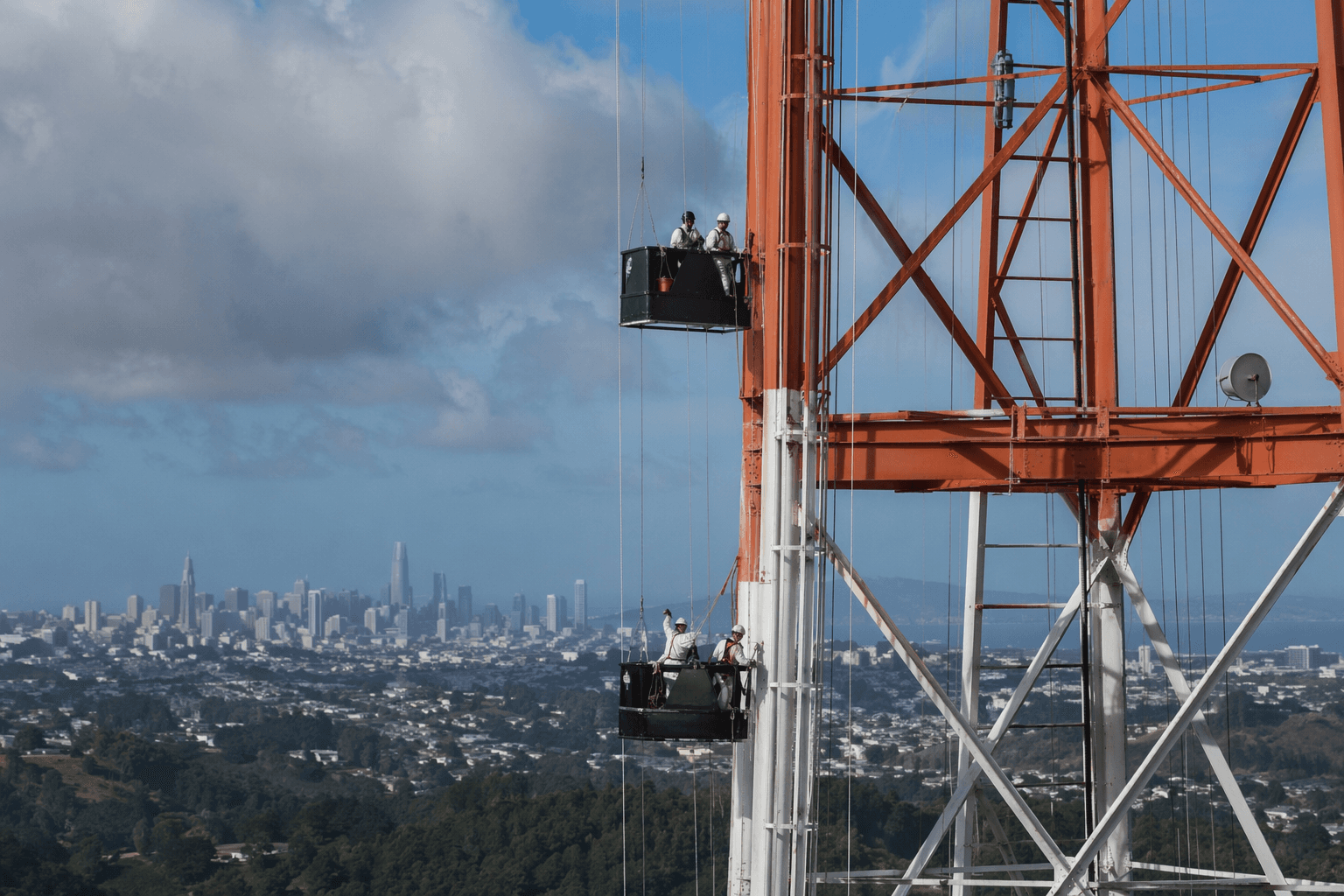
Lead removal is the most sensitive part of the project. San Francisco treats lead disturbance as a serious health risk, and city guidance says buildings built before 1979 are presumed to contain lead-based paint unless proven otherwise. When disturbed, that paint can release harmful dust, which is why containment, lead-safe practices and neighbor notification are standard parts of the city’s approach.
For many San Franciscans, Sutro Tower is part of the daily skyline from Twin Peaks to the western neighborhoods, and it has become a visual shorthand for home. Docomomo US describes the tower as a structure that was once maligned as an eyesore but became a beloved city icon, a status reinforced in neighborhood classrooms and family traditions. In one Glen Park Elementary classroom tradition, students paint the tower, a reminder of how deeply the structure is tied to local identity. As one teacher put it, “When you see Sutro Tower, you always know that you’re home.”
This article was produced by Prism’s automated news system from verified source data, official records, and press releases, then run through automated quality and moderation checks before publishing. The system is built and supervised by the people who set the standards it runs under. Read our full AI policy.
Did this article answer your question?

