UCSF Orthotics and Prosthetics Team Hosts All-Ages Adaptive Climbing Clinic in Presidio
Roughly 28 adaptive climbers, including children as young as five, climbed at 924 Mason Street in the Presidio during UCSF's annual clinic, supported by 35 volunteers.
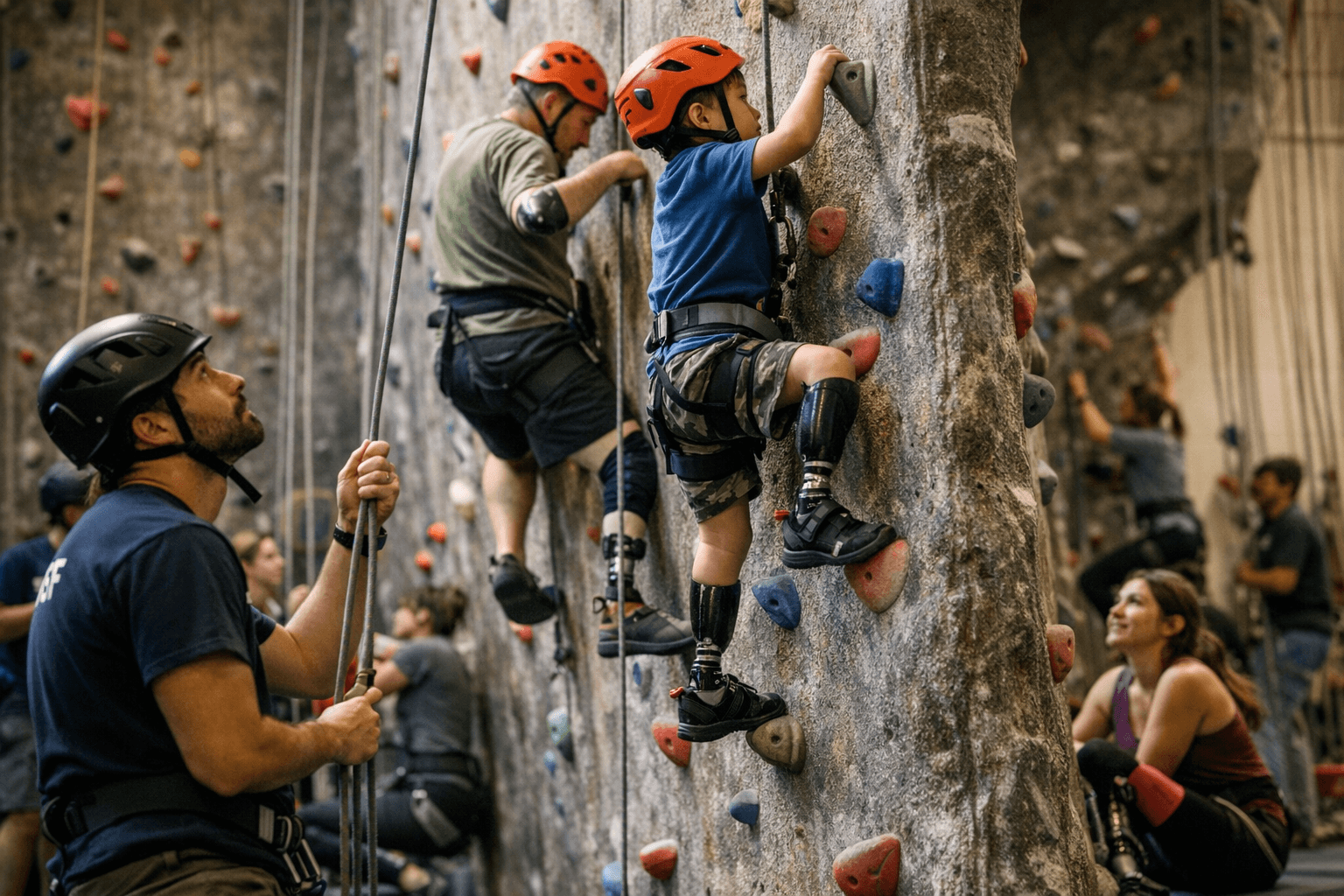
Roughly 28 adaptive climbers, supported by 35 volunteers, took part in an annual adaptive rock-climbing clinic hosted by the UCSF Orthotics and Prosthetics team in partnership with the Challenged Athletes Foundation and Movement Gym San Francisco at 924 Mason Street in the Presidio on Jan. 17, 2026. The one-day clinic welcomed climbers as young as five and provided individualized guidance and specialized equipment for beginners and experienced climbers alike.
Clinicians and residents from UCSF worked alongside volunteer coaches to offer hands-on instruction and adaptive gear; a photo caption credited to Jody Diala notes, "A participant climbs with bilateral AFO braces, receiving personalized guidance and encouragement from a UCSF clinician and resident, highlighting the adaptive support and equipment that make the clinic accessible to climbers of all abilities." Josh Unterman of UCSF summarized the clinical and rehabilitative intent: "Adaptive climbing is about more than just reaching the top of the wall," said Josh Unterman of UCSF. "It’s about confidence, independence and the joy of movement - and we want everyone to have a chance to experience that, no matter their ability level."
Volunteer training and peer interaction were central to the clinic’s operations. Volunteers were taught how to set up pulley systems and other ascension techniques and were encouraged to try simulations of adaptive climbing to better understand adaptive climbers' perspectives, practices outlined in a Touchstoneclimbing account of volunteer work. A Touchstoneclimbing volunteer described how they first became involved and what they learned: "I first got involved in adaptive sports when I was in my last year of physical therapy school when I learned about an adaptive CrossFit program at San Francisco CrossFit run by Max Conserva. I volunteered with the first UCSF Orthotics & Prosthetics Adaptive CrossFit clinic and I was astounded at the ingenuity and determination displayed by the coaches and adaptive athletes."
The clinic also emphasized community support and celebration. Donated raffle prizes from Dynamite Starfish Clothing Co., V12 Resole, the Amputee Coalition and DragMe Climbing added extra excitement and community support, and event photography credited to Jody Diala captured groups of participants and volunteers. An Instagram fragment for the program summarized outreach aims, stating, "Our Adaptive program welcomes climbers with physical disabilities, visual impairments, and mobility differences to train, connect, and push their limits on the", the excerpt is truncated in available material.
Program materials and volunteer accounts grounded the clinic in a broad definition of adaptive sport. "Adaptive climbing means climbing for people with some kind of disability," wrote Touchstoneclimbing, which listed conditions the program has worked with, including upper and lower limb amputations, limb asymmetries, limb salvages, multiple epiphyseal dysplasia, post-stroke, traumatic spinal cord injuries, spina bifida, cerebral palsy, multiple sclerosis, visual impairments and obscure neurological problems that don’t have a formal diagnosis. Those specifics underline the clinic’s role as a clinical-rehabilitation touchpoint as well as a recreational opportunity for San Franciscans across a range of ages and mobility differences.
Organizers framed the Presidio clinic as an annual commitment to accessibility and person-first programming, and volunteers reiterated that aim in program philosophy: "We try to create an environment where adaptive climbers and volunteer climbers interact with each other to a point where the distinction between the two are blurred. In the end, our goal is to make adaptive climbing something that is not special, rather something that is commonplace. We want to treat every individual as a person first.
This article was produced by Prism’s automated news system from verified source data, official records, and press releases, then run through automated quality and moderation checks before publishing. The system is built and supervised by the people who set the standards it runs under. Read our full AI policy.
Did this article answer your question?