Windsurfer Collides with Whale During Outing on San Francisco Bay
Video shows a gray whale launching windsurfer Eric Kramer off his board at Crissy Field, as four gray whales have already died in the Bay in March alone.
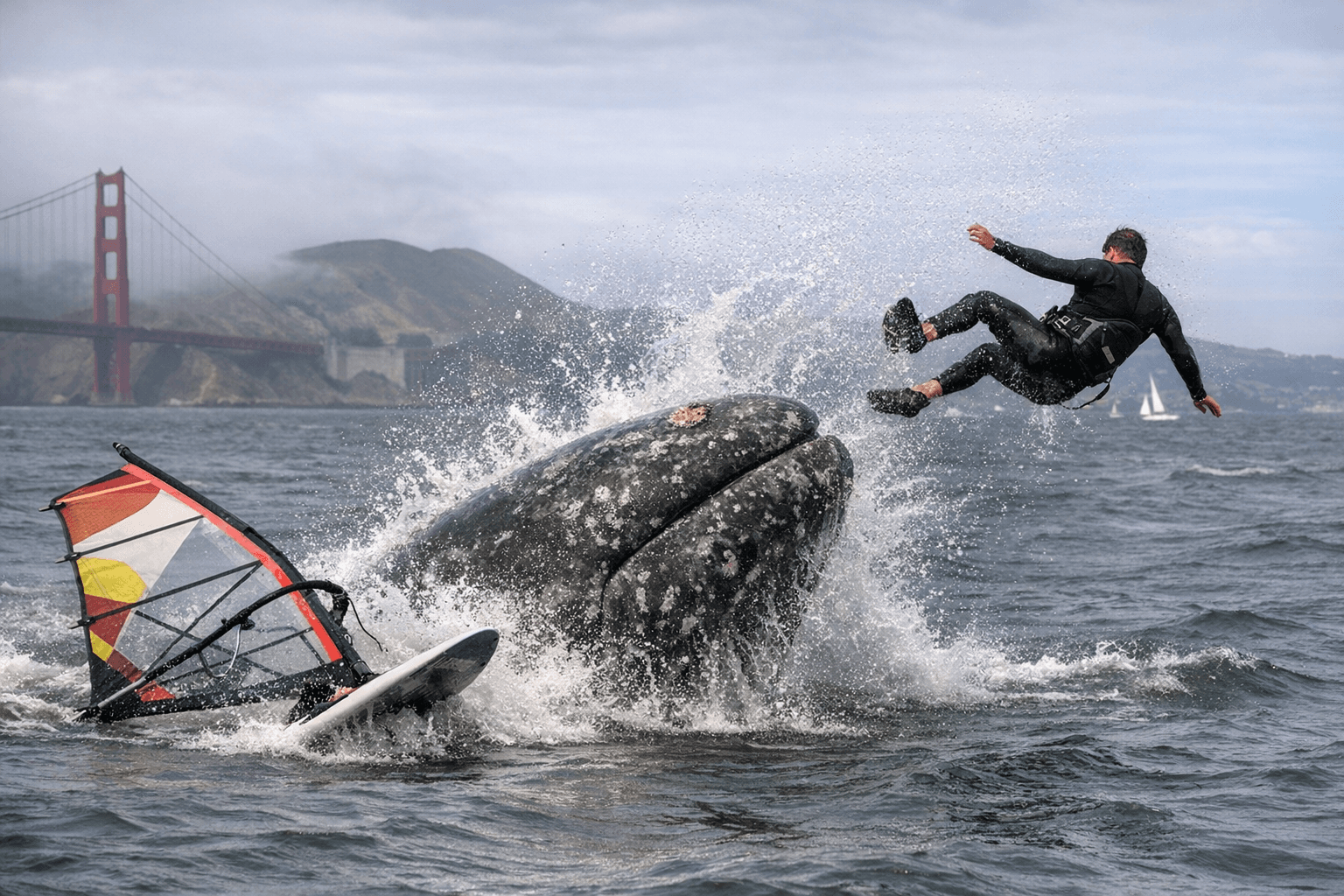
Eric Kramer was making his last run across the water at Crissy Field Beach on Tuesday, March 24, when a gray whale breached directly beneath his windsurf board and sent him airborne into San Francisco Bay. Video obtained by KRON4 captured the sequence in full: a large cargo ship moves slowly through the background, beachgoers take in the sunny afternoon on shore, and then a speeding, wetsuit-clad windsurfer bursts into frame from the right before a gray whale erupts from the surface directly in his path. He went flying off his board.
Kramer surfaced dazed but unharmed, floating alongside his board as the whale, apparently unfazed, disappeared into the deep. A second video posted to social media shows the same collision from a different angle, with the Golden Gate Bridge visible in the background. No injuries were reported.
"It was a 'whale' of a day," Kramer wrote in a post on social media after the encounter. "Please be cautious and respect wildlife, I had reduced my speed greatly bc I had seen a couple whales in the area but on my last run back it just popped up right in front of me. Glad we are both ok."
His account reflects a collision risk that has intensified sharply on the Bay this spring. The Marine Mammal Center confirmed that there have been at least six confirmed sightings of gray whales in San Francisco Bay in 2026, with the first reported by a ferry skipper near the Richmond terminal on January 18 — the earliest known entry of gray whales into the Bay since the center began tracking them, arriving weeks ahead of the typical mid-February window. Researchers believe the whales are stopping to rest or feed as their migration patterns continue to shift. By the final two weeks of March the situation turned grim: four confirmed strandings occurred in a two-week span, including a dead adult female gray whale found floating off Tiburon near the Larkspur Ferry Terminal, and a separate animal found on March 28. Causes of death remain undetermined.
Under the Marine Mammal Protection Act, all watercraft operators are required to maintain at least 100 yards of separation from whales, roughly the length of a football field. NOAA's West Coast Region recommends reducing speed immediately upon spotting a whale, steering away gradually rather than cutting across the animal's path, and never pursuing or approaching a surfacing animal. If a vessel makes contact with a whale, the incident should be reported to the U.S. Coast Guard on VHF Channel 16. Whale sightings, injuries, and strandings can also be reported to the NOAA West Coast Stranding Hotline at 1-866-767-6114.
The Marine Mammal Center is working with the San Francisco Harbor Safety Committee's Marine Mammal Subcommittee to develop Whale Smart, an education and training program for boat operators, with the aim of increasing whale safety. The program's timing reflects the scale of the problem: with a documented collision, six sightings, and four deaths already recorded before April, the Bay's unusually active whale season is pressing the limits of how well recreational users and protected wildlife can share the same water.
Kramer said he had already slowed down when he spotted whales nearby. The animal still surfaced faster than he could stop. That gap between awareness and reaction time is precisely what the federal 100-yard buffer is designed to close.
Know something we missed? Have a correction or additional information?
Submit a Tip