Fossil Bone Found in San Juan County May Be T. rex Ancestor
A shinbone found in San Juan County's Bisti Wilderness in the 1970s may belong to a 4- to 5-ton T. rex ancestor that roamed New Mexico 74 million years ago.
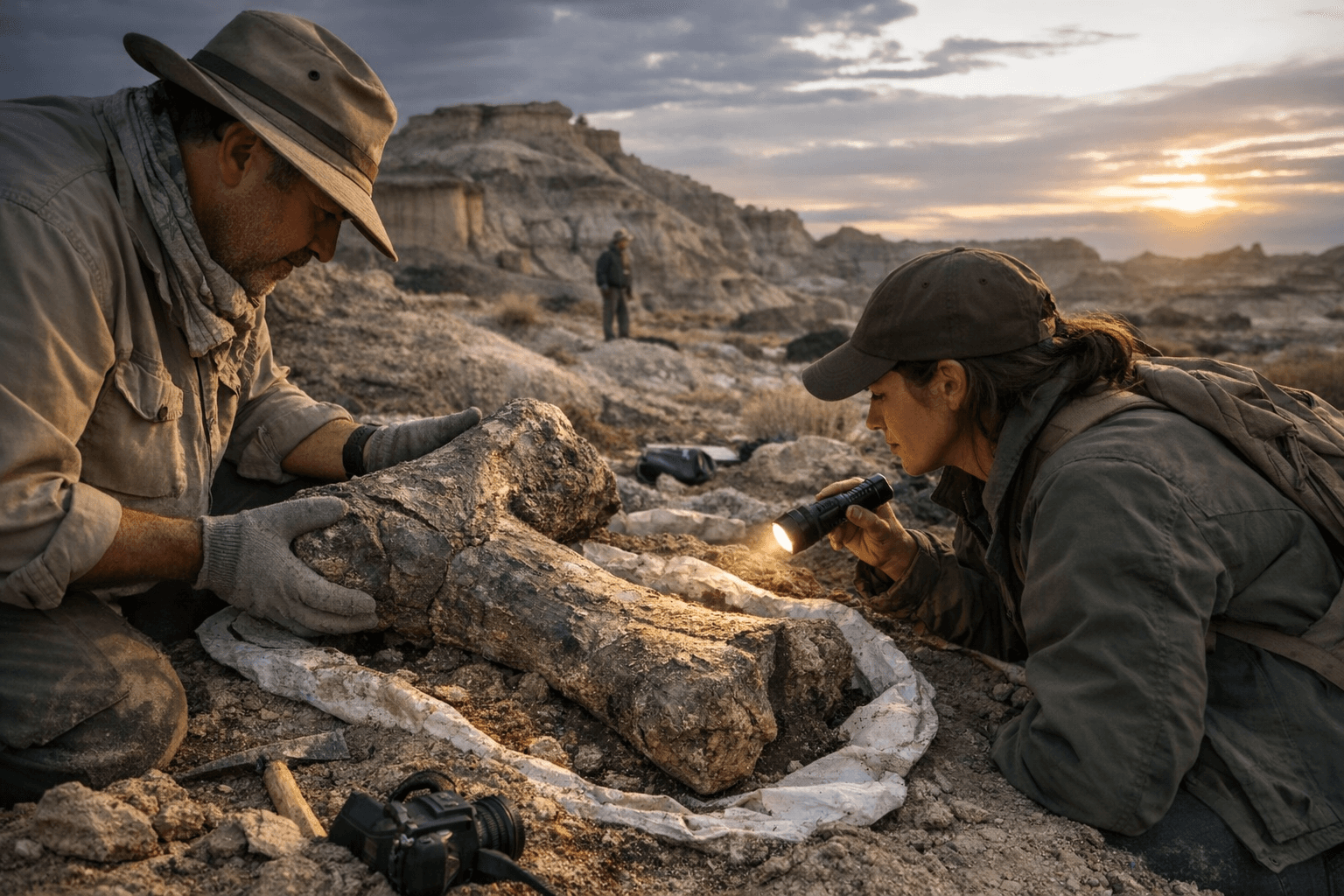
A meter-long shinbone pulled from the Bisti/De-Na-Zin Wilderness in San Juan County nearly five decades ago sat largely unstudied in a museum collection — until a new analysis suggested it may belong to one of the largest tyrannosaurs ever to walk the American Southwest, and possibly a direct ancestor of Tyrannosaurus rex.
The almost-complete tibia, originally unearthed in the late 1970s by University of New Mexico graduate students during a paleontological survey of the Hunter Wash area, was presented Thursday at the New Mexico Museum of Natural History and Science in Albuquerque. Anthony Fiorillo, the museum's executive director, spoke to reporters in a collection hall about the bone's distinctive shape. Spencer Lucas, now a curator at the museum, was among the students who found it. He told reporters he didn't even recall discovering it at the time.
The bone was initially catalogued as belonging to Bistahieversor, nicknamed the "Bisti Beast," a roughly 3-ton bipedal predator once considered the apex tyrannosaur of the region. But reexamination told a different story. Research found the tibia belonged to an animal weighing 4 to 5 tons, with one estimate placing it at 4.7 tons, and its shape described as a perfect match for a T. rex's ankle. Based on the bone's proportions, scientists estimate the dinosaur stretched about 35 feet long, slightly shorter than Sue, the famous T. rex specimen that measures 40.5 feet. That would make it roughly twice the mass of Daspletosaurus and Gorgosaurus, two large tyrannosaurs that lived in North America around the same time.
Using radiometric dating of volcanic ash found at the site, scientists determined the animal walked what is now northwestern New Mexico 74 to 75 million years ago, placing it 8 to 9 million years before T. rex is believed to have existed.
That gap matters. Paleontologists have long debated whether T. rex evolved in Asia, pointing to related fossils found in Mongolia, or whether the lineage developed in North America. The San Juan County specimen pushes back the presence of T. rex-grade tyrannosaurs in the American Southwest and lends weight to the argument that the species may have originated closer to home.
The interpretation remains provisional. Researcher Longrich, quoted in a statement Thursday, framed the find carefully: "New fossils will support this hypothesis or reject it. Either way we'll walk away with a better understanding of how the dinosaurs evolved."
The tibia is held in the museum's collection and is not on public display. Visitors who want to see it will have to wait regardless: the New Mexico Museum of Natural History and Science has been closed since August for renovations and is scheduled to reopen Saturday, April 4.
This article was produced by Prism’s automated news system from verified source data, official records, and press releases, then run through automated quality and moderation checks before publishing. The system is built and supervised by the people who set the standards it runs under. Read our full AI policy.
Did this article answer your question?