New Mexico Magazine spotlights San Juan County farmers’ markets
San Juan County’s farmers’ markets are doing more than selling produce. They now serve as part of the county’s food-access safety net, with benefits accepted at key sites.
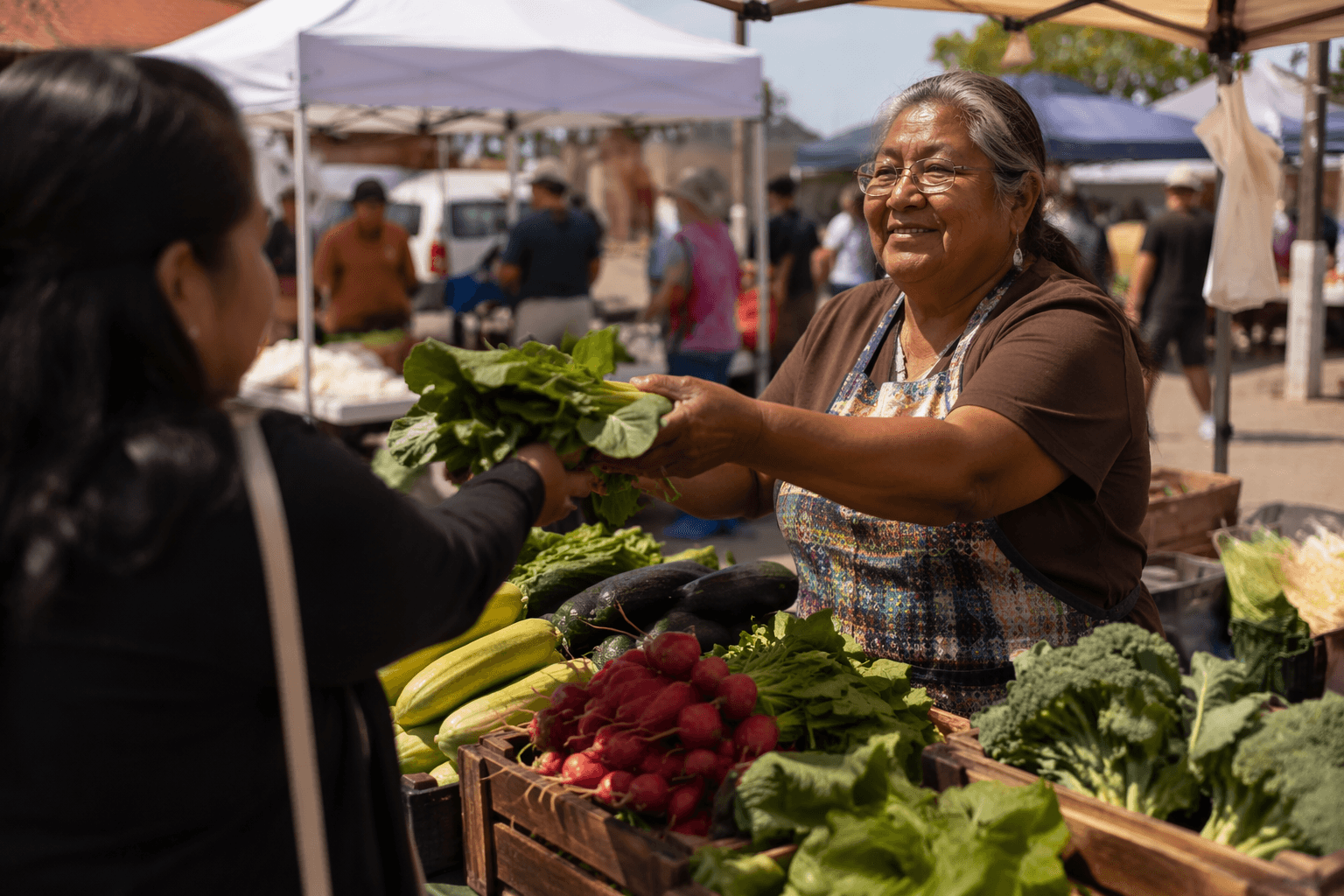
San Juan County’s farmers’ markets are more than weekend stops for peaches, squash and green chile. In a county with 2,877 farms and an estimated 21,760 residents facing food insecurity, the market network sits in the middle of the region’s food economy and household budgets.
New Mexico Magazine recently put a countywide spotlight on that system, highlighting markets in Aztec, Bloomfield, Kirtland, Farmington and Shiprock. The feature also tied those markets to the county’s long agricultural history, tracing it back to the late 1800s, when farmers and ranchers settled the area and called it Farmingtown before the name became Farmington. That history still matters because the county’s pleasant climate and abundant sunshine continue to support the growing season that local markets depend on.
A countywide market map
The value of these markets is not just that they exist, but that they are spread across the county’s communities rather than concentrated in one place. A market in Farmington serves a different household than one in Shiprock or Bloomfield, and that geographic spread is part of what makes the network meaningful for families trying to find fresh food closer to home. The magazine’s photos of local produce and vendors underscore the same point: these are places where the region’s agricultural bounty is visible, seasonal and tied to local growers.
That countywide reach matters in San Juan County because food access is not evenly distributed. The farther a family has to drive for fresh produce, the more a market becomes a practical necessity instead of a pleasant outing. In that sense, the markets function as part retail space, part rural infrastructure.
The alliance holding the market system together
The backbone of that network is the Northwest New Mexico Growers Market Alliance, founded in 2020 as an umbrella organization for seven regional growers markets in San Juan County. Those markets include the Kirtland, Farmington and Bloomfield Growers Markets, the Farmington Makers Market, the Harvest Mobile Farmers Market, and the Aztec and Shiprock Farmers Markets. That structure matters because it shows the county is no longer relying on isolated market days to move local food, but on a coordinated system.
For households, that coordination can mean more consistent access to farm products across the season and across locations. For growers, it means a broader customer base than any one town market could support alone. And for the county, it marks a shift from scattered events to a more organized local food economy.
Where families can buy and pay with benefits
The Farmington Growers’ Market is one of the clearest examples of how that system works in practice. It is listed for 2026 on Saturdays from 8 a.m. to noon, June 20 through October 31, and Tuesdays from 4 to 6 p.m., July 7 through October 28, at the Farmington Museum at Gateway Park. The market accepts SNAP and WIC/Senior FMNP, which makes it especially important for households using nutrition benefits to stretch grocery dollars on fresh food.
Shiprock’s market plays a different but equally important role. It says it serves communities along the San Juan River Basin, including Upper Fruitland, Nenahnezad, San Juan, Hogback, Cudei and Aneth, and it accepts SNAP, WIC/Senior FMNP and DUFB benefits. That matters because Shiprock is not just serving one town center, it is reaching a cluster of nearby communities where transportation, distance and income can all shape whether fresh produce is easy to buy.
That benefit acceptance is not a small detail. For families watching every dollar, the difference between paying cash only and being able to use nutrition support can decide whether fresh fruits and vegetables land in the cart at all. In a county where food insecurity remains high, the markets that accept benefits are doing more than marketing local agriculture, they are helping fill a gap in the household food budget.
The Harvest Food Hub extends the market beyond market day
San Juan College’s Harvest Food Hub pushes the same idea further by connecting growers and food producers with customers across Northwest New Mexico. The hub says it helps buy, sell and distribute fresh, local food and makes it easier for schools, businesses and families to access it. That turns local food into a supply chain, not just a weekly event.
Four Corners Economic Development says the hub grew out of a five-year, $564,000 federal Economic Development Administration grant to the San Juan College Enterprise Center. That is a significant public investment for a regional food system, and it suggests local leaders see fresh food access as both an economic development issue and a public need. The hub gives the county a stronger bridge between farm production and the institutions that buy food in volume, including schools and businesses.
The wider stakes for San Juan County households
The agricultural base behind all of this is substantial. USDA 2022 Census of Agriculture county data shows 2,877 farms in San Juan County, and county-level agricultural data sources report about $127.3 million in commodity sales. That is a large economic footprint for a county where many families still struggle to afford enough nutritious food, and it shows why the farmers’ market story is also an economic story.
The New Mexico State University San Juan County Extension Office adds another layer of support. Its agriculture agent assists farmers, ranchers and community members and helps with local food system development, which gives the county a practical resource for production questions and market growth. That kind of technical help matters because a strong local food system depends on more than good intentions. It depends on growers who can produce reliably, markets that can sell efficiently and institutions that can connect the two.
The clearest expansion story in San Juan County is the network itself: a 2020 alliance, a growing food hub and markets that now cover communities from Farmington to Shiprock. The clearest gap-filling role belongs to the markets that accept benefits and reach river-basin communities where fresh food access can be thinner. What remains is whether that system can continue to grow fast enough to meet the reality behind the numbers, because 21,760 food-insecure residents is not a side issue in a county with this much agricultural capacity.
This article was produced by Prism’s automated news system from verified source data, official records, and press releases, then run through automated quality and moderation checks before publishing. The system is built and supervised by the people who set the standards it runs under. Read our full AI policy.
Did this article answer your question?