San Juan College planetarium offers free astronomy shows in Farmington
San Juan College’s planetarium gives San Juan County a free place to see astronomy up close, with year-round shows, school visits, and public stargazing in Farmington.

San Juan College’s planetarium gives Farmington families, students, and grandparents a no-cost way to step into astronomy without leaving San Juan County. Inside a 24-foot dome with 60 seats, the college pairs a digital star projector with live science programming that is built to teach, not just entertain.
A free local science stop
The biggest draw is simple: admission is free. That matters in a county where affordable hands-on STEM options can be hard to find, especially for families balancing the cost of gas, tickets, and day trips outside the area. The planetarium’s setup makes it a practical stop for school field trips, homeschool groups, community organizations, and anyone looking for an indoor learning activity that does not come with a price barrier.
The experience is intentionally educational. San Juan College describes the planetarium as a learning space for astronomy, and the college’s astronomy program treats it as part of a broader science pathway rather than a stand-alone attraction. That combination of accessibility and instruction gives San Juan County a rare public resource: a place where children and adults can learn astronomy together in a structured setting.
What visitors see inside the dome
The planetarium’s concrete details tell the story of its scale. The 24-foot dome and 60-seat capacity keep the experience intimate enough for small groups while still serving community audiences throughout the year. The college says the dome presentation is powered by a new digital star projector, and the astronomy program identifies it as a Digitarium Zeta model.
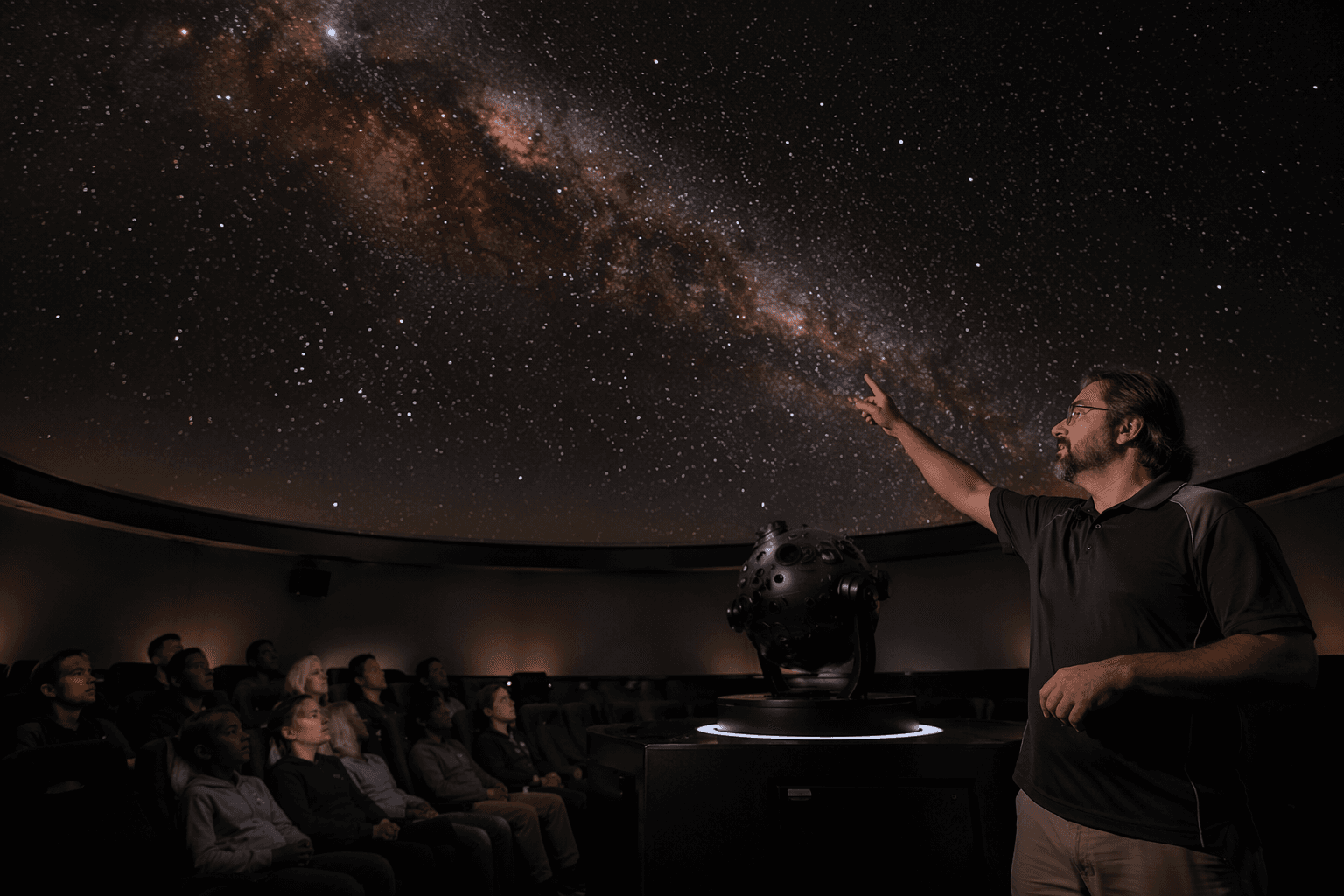
That technology matters because it allows the planetarium to present a wide range of astronomy programming for students and community members. The college also says the facility is used for class instruction and enhancement, which helps explain why the planetarium functions as both a public attraction and an academic tool. When weather and occasion allow, the astronomy program also uses various telescopes for live viewing of the real sky, linking the dome experience to actual observation outdoors.
For local visitors, that means one stop can cover two kinds of science learning: a guided sky show under the dome and, at times, a look through telescopes at the night sky or daytime sun.
When to go
The schedule is built to serve different audiences across the school year. San Juan College offers school shows on Tuesdays, Wednesdays, and Thursdays from September through May, giving teachers a regular weekday option for field trips and classroom enrichment. Summer short classes can also be arranged for children through the Community Learning Center, which extends the planetarium’s reach beyond the academic calendar.
Public programming is more flexible for working families and weekend planners. The college’s event listings show AstroFriday presentations commonly starting at 6:30 p.m. and 7:30 p.m. Those evening shows are free, and seating is first-come, first-served. Late admittance is not allowed, a rule designed to preserve dark adaptation before the presentation begins.
The planetarium also offers daytime filtered telescopic sungazes once per month on Friday mornings. Those sessions widen the audience further by giving families and visitors a daytime science option, not just an evening one. Together, the weekday school schedule, monthly Friday programs, and summer offerings create a year-round calendar that fits students, retirees, and multigenerational groups.
What a public show includes
A public AstroFriday visit can be more than a single fulldome presentation. After some shows, the planetarium offers a free public stargaze with telescopes in the courtyard, weather permitting. That stargaze has no capacity limit and can last up to one hour, which makes it especially useful for larger crowds who want to stay afterward and continue the experience outdoors.
This is where the planetarium fills a local gap in affordable STEM enrichment. A family can come for a theater-style astronomy program, then step outside for live telescope viewing without paying an additional fee. For children, that sequence can turn an abstract lesson into a memory. For grandparents or community groups, it creates an easy outing that mixes entertainment, education, and time together in one place.
How to plan a group visit
Groups that want a tailored visit need to plan ahead. San Juan College asks for reservation requests 14 calendar days in advance. When making the request, the planetarium wants the show topic, preferred date and time, contact information, and group size so staff can shape the presentation to the audience.
That process makes the venue especially useful for teachers, homeschool coordinators, youth programs, and civic groups that want a science outing with a clear structure. Because the planetarium is free, the main barriers are timing and coordination rather than cost. For many local organizations, that is the difference between skipping an outing and building one into the year.
Part of a larger college science mission
The planetarium is also part of San Juan College’s broader academic identity. The college’s School of Science, Math and Engineering oversees the SJC Planetarium, and the same academic structure includes the Sherman Dugan Museum of Geology. That placement matters because it ties the planetarium to an established science mission on campus rather than leaving it as an isolated attraction.
The astronomy program adds another layer. San Juan College offers Intro to Astronomy, ASTR 1115, as an accredited lab science on campus or online. That means the planetarium does not just serve visitors who come for a show; it also sits within a credit-bearing academic path that can carry students from general curiosity into college science coursework.
San Juan College’s long local history helps explain why it can serve the county this way. The institution was founded in 1956 as the Farmington Branch, College of Agriculture and Mechanical Arts, and it now operates campuses in Farmington, Aztec, and Kirtland. That regional footprint gives the planetarium a countywide role, connecting residents across San Juan County to a shared science resource in Farmington.
For a free outing that mixes access, learning, and family-friendly timing, the planetarium stands out as one of the most practical educational stops in the county.
This article was produced by Prism’s automated news system from verified source data, official records, and press releases, then run through automated quality and moderation checks before publishing. The system is built and supervised by the people who set the standards it runs under. Read our full AI policy.
Did this article answer your question?