Sherman Dugan Museum showcases Four Corners fossils in Farmington
Farmington’s Sherman Dugan Museum offers free weekday access to fossils from Albertosaurus to Agujaceratops. San Juan College is adding 3,734 square feet.
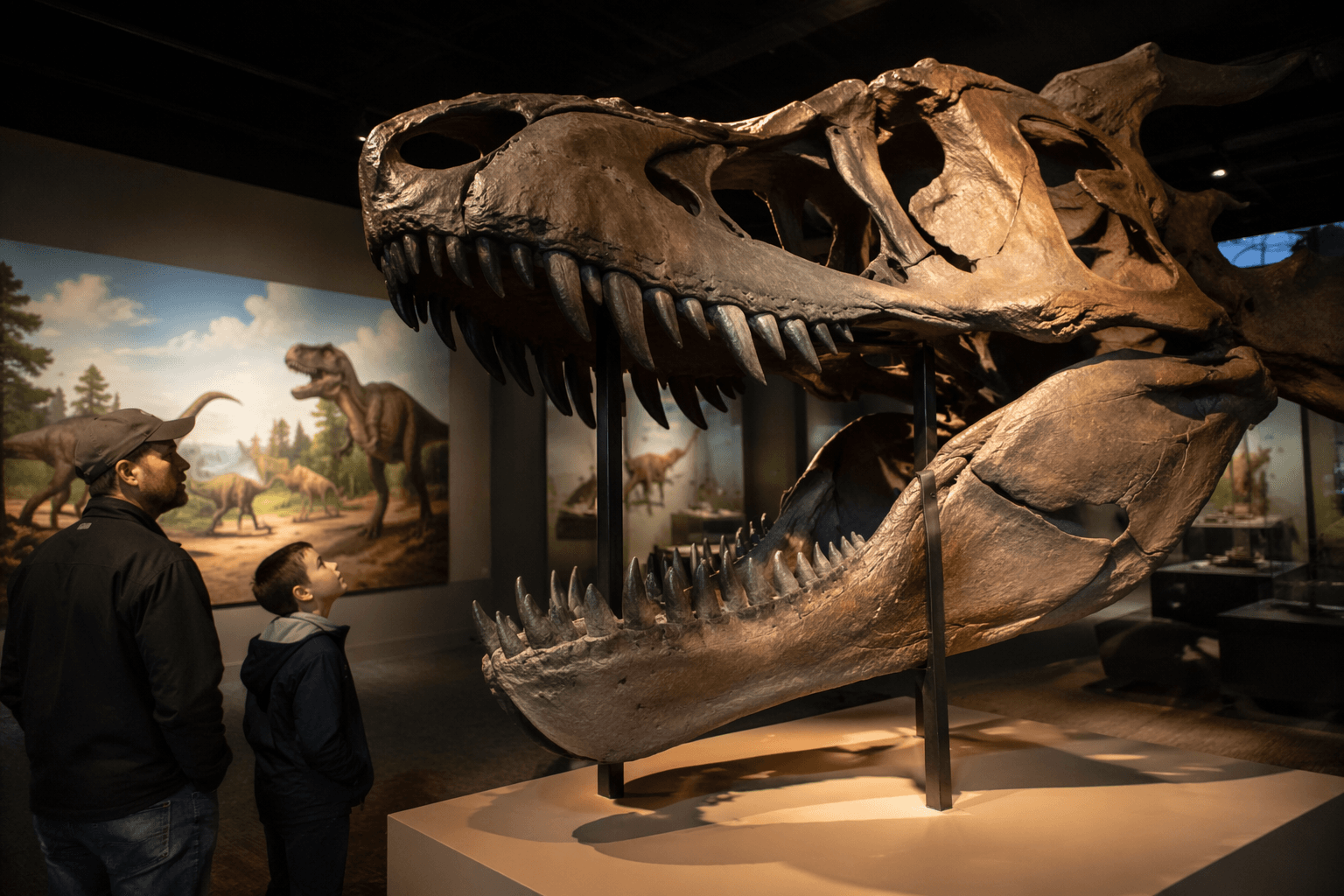
San Juan County residents can walk into the Sherman Dugan Museum of Geology at 5301 College Blvd. in Farmington without paying admission and see San Juan College's most comprehensive collection of minerals and fossils in the Four Corners region. The museum sits inside the School of Energy building, is open Monday through Friday from 7 a.m. to 5 p.m., and includes specimens from the San Juan Basin as well as material from Mexico, Canada and Africa.
The collection grew from the lifetime work of Sherman E. Dugan, a Farmington resident who spent decades assembling rocks, minerals and fossils and built one of the largest private collections in the Southwest. After his death on Dec. 21, 2013, at age 59, his family donated a large portion of the museum-quality material that now anchors the exhibit. The museum continues to expand through donations to Friends of Sherman Dugan under the San Juan College Foundation.
Inside, the museum highlights prehistoric life from the region with fossils including Albertosaurus sarcophagus, Agujaceratops, Nyctosaurus gracilis, Didelphodon vorax, Bambiraptor feinbergi and Anhanguera. The San Juan Basin is one of the most productive dinosaur fossil regions in Western North America. Thomas E. Williamson, curator of paleontology at the museum in Albuquerque, has focused his research on the Late Cretaceous and Paleogene fossil record of that basin.
San Juan College broke ground on an expansion of the museum on April 8, 2026, after early support from the Merrion family and a $4 million gift from the Dugan family. The project will add more than 3,700 square feet, including 3,734 square feet of new interior space, a larger terrace and movable window walls that link indoor and outdoor exhibit areas. The college also plans new mineral and fossil displays, energy industry equipment and interactive learning areas.
This article was produced by Prism’s automated news system from verified source data, official records, and press releases, then run through automated quality and moderation checks before publishing. The system is built and supervised by the people who set the standards it runs under. Read our full AI policy.
Did this article answer your question?