Casa San Ysidro shows how a historic New Mexico rancho worked
Casa San Ysidro turns one Corrales property into a vivid lesson in labor, trade and land use. Its public value runs from school trips to heritage tourism, backed by a rare preservation partnership.
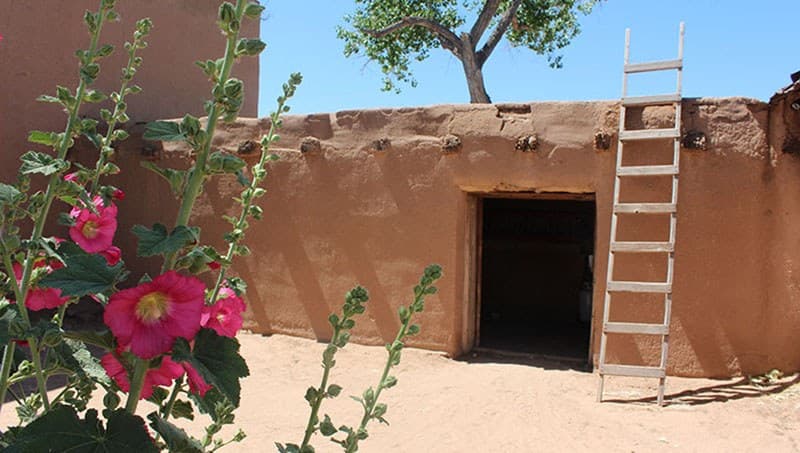
Casa San Ysidro gives Sandoval County something few museums can: a place where the house, the collections and the landscape still tell the same story. At 973 Old Church Road in Corrales, the site combines a renovated Territorial Period Greek Revival house built around 1875 with a speculative recreation of a 19th-century rancho, making it one of the clearest places to see how daily life worked along the Rio Grande Valley.
A rancho you can walk through
The original casa was built by the Gutiérrez family, with provincial Greek Revival detailing that still anchors the site’s identity. Dr. Ward Alan Minge and Shirley Jolly Minge bought the house in 1953 and turned it into the home for their growing collection of New Mexican vernacular art, creating the museum that now operates as a satellite of the Albuquerque Museum.
The property is larger than a single house. Casa San Ysidro includes structural additions from the 17th, 18th and 19th centuries, along with an open courtyard plazuela, a seasonal kitchen garden, a walled corral, a barn, cabins, a stable and a blacksmith shop. That mix matters because it shows a rancho as a working unit, not just a residence: food was grown, animals were kept, tools were repaired and trade goods moved through the household.
The collection deepens that picture. Casa preserves salvaged architecture, furniture, religious art, tools, Hispanic and Pueblo weavings and pottery from the 17th, 18th and 19th centuries. The museum is not just displaying objects behind glass; it is reconstructing the material world that shaped settlement, work and worship in northern New Mexico.
Why the museum has unusual historical weight
Casa San Ysidro stands out even among historic properties because of how completely it ties building and collection together. The National Park Service says it may be the only historic property in New Mexico where both the structures and the collections are listed on the State Register of Cultural Properties. That kind of dual protection is rare, and it helps explain why the site carries more than local interest.
It is also a certified site on El Camino Real de Tierra Adentro National Historic Trail, the long-distance corridor that the National Park Service describes as representing 300 years of conflict, cooperation and cultural exchange. That designation places Casa within a much bigger story of movement between Mexico and what is now northern New Mexico, where travel, religion, trade and family life all crossed paths.

The Albuquerque Museum identifies Casa San Ysidro as the home of the Ward Alan and Shirley Jolly Minge Collection, and it is one of only two historic properties in the museum’s history collection. In 2025, the city marked the site’s 150th anniversary, underscoring that this is not a static relic but a place that has been interpreted, collected and cared for across generations.
What to pay attention to on site
The easiest mistake at Casa San Ysidro is to admire the adobe walls and miss the logic of the whole property. The plazuela, garden, corral, barn, cabins, stable and blacksmith shop are not decorative extras. They show how households in this region organized labor around water, food storage, livestock and repair work, which is exactly what makes the museum useful for students, families and anyone trying to understand the old rancho economy.
The blacksmith shop and tools speak to a self-sustaining world where metalwork, transport and farming equipment had to be maintained close to home. The religious art, weaving and pottery show the cultural mix that defined New Mexico households across the 17th, 18th and 19th centuries. Together, these items let visitors see how domestic space, labor and belief fit together in a way that textbooks often flatten.
Because the museum sits inside Corrales rather than in a detached historic district, the surrounding landscape remains part of the experience. The irrigated Rio Grande Valley still frames the property, reminding visitors that water, not scenery alone, made settlement possible here.
Corrales is the other half of the story
Casa San Ysidro makes the most sense when viewed alongside Corrales itself. The village’s history traces settlement back centuries and points to the old Corrales acequia, dug early in the 18th century to irrigate fields and gardens. The village also describes land as being divided into long, narrow strips stretching from the river to the sand hills, a pattern that shows how settlement followed water and agriculture rather than modern subdivision lines.

That pattern still shapes the community. According to the 2024 Corrales Comprehensive Plan, about two-thirds of the village lies east of the Corrales Main Canal, while land to the west rises toward the escarpment. In practice, that means the village’s physical layout still reflects the same relationship between river-bottom agriculture and higher ground that defined earlier generations.
Corrales also tried to preserve that rural structure through policy. In 1971, the village adopted its first code of ordinances, including Agricultural-1 and Agricultural-2 zoning. Those designations help explain why Corrales has retained open space, farming identity and low-density character even as the rest of the metro area has grown around it.
Who supports the site, and why that matters
Casa San Ysidro is not maintained by one institution alone. The City of Albuquerque says the site is operated jointly with the Village of Corrales, with support from Sandoval County and the State of New Mexico Historic Preservation Division. That shared structure is more than bureaucratic detail: it is the public framework that keeps the museum open as a local asset rather than a private collection.
That matters because the museum’s value is measurable. It serves education by making the history of El Camino Real, rancho life and New Mexican material culture tangible for visitors who need more than labels and photographs. It serves tourism by giving Sandoval County a destination with regional significance, not just a scenic stop in Corrales. And it serves preservation by keeping together a rare combination of architecture, collections and landscape that would be difficult to reconstruct if it were ever dispersed.
For Sandoval County, Casa San Ysidro is a reminder that historic preservation is not only about memory. It is about keeping a working record of how people used land, water, tools and architecture to survive in the Rio Grande Valley, and about making sure that record stays available for the next generation of students, residents and visitors.
This article was produced by Prism’s automated news system from verified source data, official records, and press releases, then run through automated quality and moderation checks before publishing. The system is built and supervised by the people who set the standards it runs under. Read our full AI policy.
Did this article answer your question?