Corrales father and son turn fallen trees into custom furniture
A Corrales father and son are turning fallen trees into furniture, creating a local business that keeps useful wood out of the chip pile and landfill.

From lost sycamores to a working shop
What started as frustration in Corrales has become a business with a clear local purpose: Rick Thaler and his son Jacob are salvaging fallen and removed trees and turning them into custom furniture through Dendro Technology. The company grew after Rick watched two giant sycamores come down at his daughter’s Corrales home, a moment that pushed him to buy a portable sawmill and begin rethinking what a discarded tree could become.
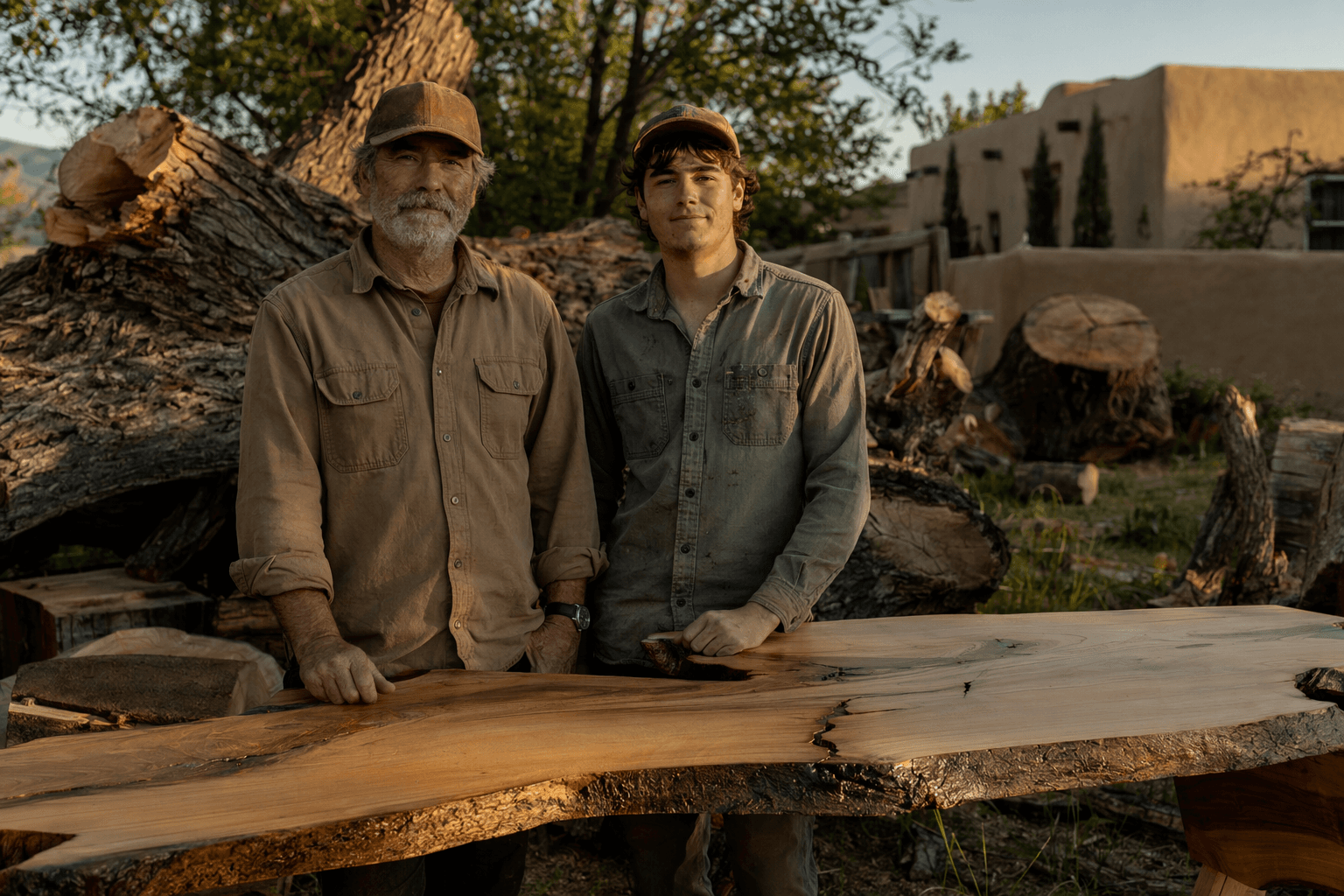
That decision set off a slow transformation from one tool to a full operation. Rick brought roughly 50 years of woodworking experience into the work, and Jacob is now a co-owner, making the business a true family enterprise rather than a side project. The shop now pairs a studio with larger equipment, but the core idea remains simple: rescue wood that would otherwise be chipped, burned or dumped and give it a new life as something useful and visible.
How a tree becomes a table in Corrales
The path from downed tree to finished furniture is not quick. Once the wood is cut, it can take up to a year to dry before it is ready for the final furniture work, which means every piece carries a built-in waiting period. That patience is part of the business model, and it is one reason the Thalers can turn rescue wood into objects that feel substantial rather than mass-produced.
A single tree can move through several stages before it reaches a home. First it is removed or recovered, then milled, then dried, then cut and shaped into a finished piece. Along the way, the wood’s flaws become part of the design rather than reasons to discard it, whether that means stabilizing rot, working around knots or turning old weather damage into character. The result can be a table, bench, kitchen island or another custom piece with the history of the original tree still visible in the grain.
The process is especially hands-on because no two trunks behave the same way. Jacob’s view of the work captures that uncertainty: every cut reveals something new inside the wood. In practical terms, that means the final product is shaped as much by the tree itself as by the maker.
Why invasive trees matter in the Rio Grande bosque
The Thalers’ work connects to a much larger environmental story in Sandoval County and the Albuquerque area. Russian olive is listed as a noxious weed in New Mexico, and the U.S. Forest Service says it is widespread in the United States and a management concern in Southwestern woodlands, rangelands and riparian areas. Salt cedar has an even longer history of spread, introduced to western North America in the mid-1800s and naturalized in the late 1800s.
That history matters because the Rio Grande bosque is not just a scenic backdrop. City of Albuquerque bosque-restoration materials say invasive species such as Russian olive and salt cedar can outcompete native plants and reduce biodiversity, water availability and soil health. In a region where every drop and every patch of habitat matters, the removal of these trees is both an ecological necessity and a management challenge.
The city’s restoration and fire-prevention work also removes invasive tree species and dead and downed woody material. That creates a practical opportunity for businesses like Dendro Technology, which can work with material that would otherwise leave the landscape as waste. In that sense, the Thalers are not only making furniture. They are participating in a larger regional effort to manage an invasive riparian landscape and reuse what is cut away.
Why Russian olive becomes beautiful in their hands
The Thalers seem drawn to wood that other people would write off. Russian olive and salt cedar, both considered invasive in the bosque, offer the kind of challenge that rewards curiosity and craft. Rick has said Russian olive is a favorite species to work with because it is humble and unpredictable, and that attitude shapes the company’s identity as much as any saw or planer.
That approach also explains why the shop can surprise customers. The notes from their work include a rotten section of a tree that revealed lizards inside, a reminder that salvage wood often carries the messy history of where it grew. In another case, holes in a plank were filled with coffee beans for a customer, turning a defect into a feature and making the final piece feel personal rather than standardized.
For buyers, that matters because the furniture is not just functional. It is tied to place, memory and material scarcity. A kitchen island or bench made from Corrales wood has a different value than something assembled from anonymous stock lumber because it comes with a known origin and a visible story.
A business rooted in Corrales identity
Corrales is the kind of village where local character still matters, and Dendro Technology fits that identity well. The business takes a familiar landscape problem, fallen trees in neighborhoods and along the bosque, and turns it into a product residents can bring into their homes. That gives the shop a dual role: it is both a woodworking business and a local recycling system for valuable timber.
The story also resonates because it blends sustainability with economics. Salvaging usable wood keeps material in circulation longer, reduces waste and creates a higher-value product from trees that might otherwise be disposed of at little benefit to the community. At the same time, the labor-intensive drying, milling and finishing process creates a slower, more specialized kind of local enterprise, one that depends on skill, patience and a steady stream of workable wood.
In a county where bosque restoration, invasive-species control and water conservation are part of the broader conversation, that kind of business feels especially relevant. Dendro Technology shows how a cleanup job can become an enterprise, how an environmental burden can become material for design, and how one fallen tree can end up as something built to last.
This article was produced by Prism’s automated news system from verified source data, official records, and press releases, then run through automated quality and moderation checks before publishing. The system is built and supervised by the people who set the standards it runs under. Read our full AI policy.
Did this article answer your question?