Jemez Springs reveals layers of Indigenous and colonial history
Jemez Springs is more than a village name: Guisewa, Gisewa and San José de los Jémez map Indigenous survival, colonial rule and how the past is seen today.
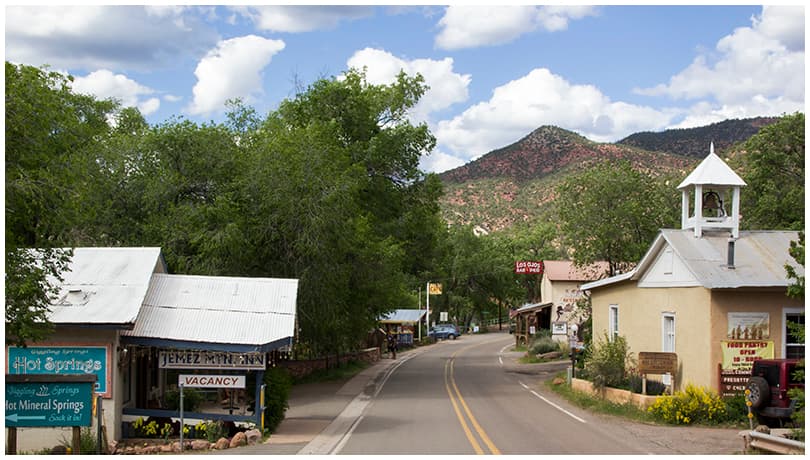
Jemez Springs is not one place with one story. The village sits on land where Guisewa, Gisewa, a Franciscan mission, and the modern municipality all overlap, and each name points to a different power, a different memory, and a different public face. For Sandoval County, that makes the town a case study in how history survives in signs, sites, and official records.
A village built on an older village
The first residential area in what is now Jemez Springs was the large pueblo of Guisewa, occupied until the late 1500s. Jemez Valley History says people were drawn there for the same reasons the Ancestral Puebloans were: healing mineral hot springs and a reliable water source on the Jemez River. That geography matters because it explains why the area kept attracting settlement long before the present village was incorporated.
The Hemish people called the ancestral village Gisewa, pronounced Gee-say-wah. That name is more than a label in a history book. It identifies the Indigenous place that existed before the Spanish mission period and before the village acquired its modern civic boundaries. In a county where tourism often flattens places into roadside stops, that name restores depth to the landscape.
What the ground still holds
New Mexico Historic Sites protects the ancient village of Gisewa and the San José de los Jémez mission church at the Jemez Historic Site. The site’s history places the first mission there in 1600 under Fray Alonzo de Lugo, followed by a second mission in 1621. The mission church was partially destroyed by fire in 1623, another reminder that the landscape records conflict as well as continuity.
The site is not just symbolic. New Mexico Historic Sites describes Gisewa as an ancestral 14th-century village of the present-day Jemez Pueblo, a sovereign nation of 3,400 members, about 60 percent of whom live on tribal land. That makes the ruins and mission church part of a living tribal history, not an abandoned relic. The distinction matters whenever the place is interpreted for visitors, marked on maps, or taught in public programs.
Jemez Valley History adds another physical detail that changes how the village should be read: the eastern section of the old pueblo became Jemez Historic Site, while other portions were buried beneath later development, including State Highway 4 and Via Coeli. A short drive through Jemez Springs therefore crosses layers of occupation and infrastructure at once. The road network does not erase the older story so much as sit on top of it.
Why the names keep changing in public view
The naming history is still active, not frozen. In 2023, the holiday event long known as Light Among the Ruins was renamed Lights of Gisewa. That shift moved the Hemish place-name into a more visible public role and made the event’s identity more closely match the Indigenous history of the site.
The change matters because names shape what residents and visitors notice first. A title centered on ruins can emphasize loss; a title centered on Gisewa restores the ancestral village to the foreground. The Museum Foundation of New Mexico framed the event as a celebration of resistance and resilience, and that framing shows how naming can direct attention toward survival rather than disappearance.
This is where tourism, signage, and public memory intersect. The state historic-site materials identify the Jemez Historic Site as the place where visitors can learn about the Franciscan mission, the Pueblo Revolt of 1680, and New Mexico as it exists today. The village’s naming history is therefore not abstract background. It shapes the story handed to visitors at the site, the language used in public interpretation, and the way the place is presented beyond the village limits.
The modern village behind the historic site
The Village of Jemez Springs says it was established in 1955 and is an incorporated municipality of Sandoval County, New Mexico. It is governed by a mayor and trustees elected every two years in March. The village’s own comprehensive plan was adopted by the Village Council on Aug. 12, 2015, showing that even the official record of the town rests on modern civic structures layered over a much older place.
The community itself is small. A Census-derived profile puts the population at 318, with a median age of 56.4 and average individual income of $46,752. Data USA lists 92.3 percent of residents as U.S. citizens, a 2024 median property value of $248,700, and an 89.2 percent homeownership rate. Those numbers help explain why identity and heritage carry so much weight here: in a village this small, the story told about the place is inseparable from how it is lived and marketed.
That is especially true in a community where the historic site and the village share a name but not a single history. Jemez Springs sits beside the Jemez River, the hot springs, the state historic site, and the inherited traces of Guisewa and Gisewa. The village’s present-day civic identity depends on that layered past, even when the names on signs, event banners, and official documents choose one era over another.
How to read Jemez Springs on the ground
The clearest way to understand Jemez Springs is to read it as a place where public memory is selective but still visible. One layer is Indigenous, centered on Guisewa and Gisewa. Another is colonial, marked by San José de los Jémez and the mission history tied to Fray Alonzo de Lugo. A third is modern, reflected in the village’s incorporation, its comprehensive plan, and the way it now presents itself to visitors.
That is why the place remains so revealing. In Jemez Springs, names are not decoration. They are evidence of who lived there first, who renamed the land, and who now decides which past gets placed on the sign, in the program, and in the public record.
This article was produced by Prism’s automated news system from verified source data, official records, and press releases, then run through automated quality and moderation checks before publishing. The system is built and supervised by the people who set the standards it runs under. Read our full AI policy.
Did this article answer your question?