Sen. Martin Heinrich advances bills to secure Placitas, Río Grande public access
Sen. Martin Heinrich urged a Senate subcommittee to back two bills that would withdraw mineral rights on four Placitas parcels to block gravel mining and designate Cerro de la Olla wilderness.
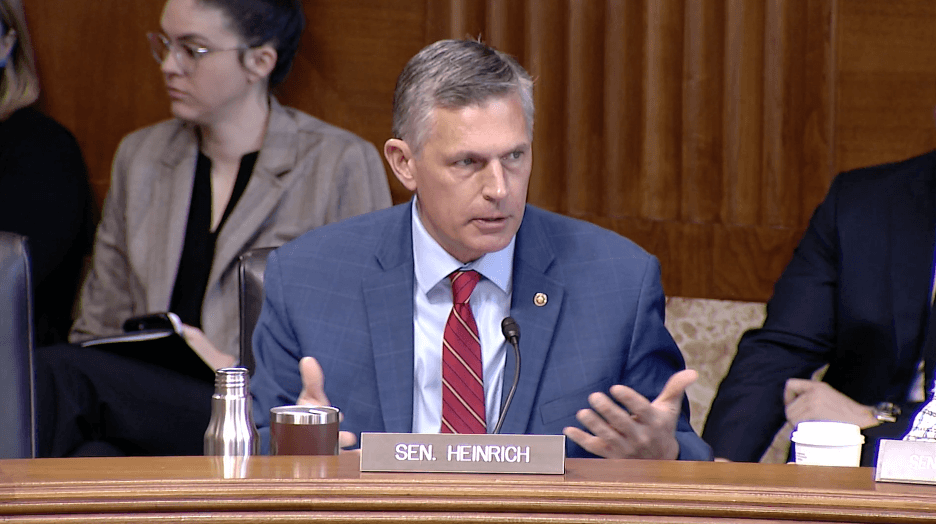
Sen. Martin Heinrich told the U.S. Senate Energy and Natural Resources Committee subcommittee that he wants two bills to protect public access and block commercial development near Placitas and in the Río Grande del Norte region. Heinrich said the Buffalo Tract Protection Act would “implement a mineral withdrawal for four small parcels in the Placitas area, just north of Albuquerque,” a move he framed as necessary to stop gravel mining adjacent to a neighborhood and community.
Heinrich delivered his remarks as Ranking Member of the full Committee during the Public Lands, Forests, and Mining Subcommittee hearing convened to consider conservation measures. “Thank you, Mr. Chairman, and I want to thank both you and Ranking Member Cortez Masto for convening this subcommittee hearing today,” he said at the outset, and he added that “This hearing will add to the significant number of conservation bills ready for markup and I look forward to working both with you– and Chairman Lee – to get them marked up, passed, and frankly signed into law, most importantly.”
On the Buffalo Tract, Heinrich described local values at stake: “The Buffalo Tract is valued for hiking, outdoor recreation, but also serves as an important wildlife corridor between the Sandia Mountains to the south and the Sangre de Cristo Mountains to the north. These parcels are adjacent to a neighborhood and a community. There’s literally several gravel mines only a few miles from the Buffalo Tract that are not controversial in this [...]” He characterized the effort as long-running and broadly supported, saying, “This has been literally a decade-long effort, and I appreciate the support that the community as a whole has provided for this bill in past congresses, from the local municipality to the county, to the local tribes, the neighborhood association. It goes on and on because this is not a controversial bill in my state.”
Heinrich also highlighted the Cerro de la Olla Wilderness Establishment Act, which he said “would establish the Cerro de la Olla Wilderness within the Río Grande del Norte National Monument” and would adjust monument boundaries to include recent Land and Water Conservation Fund acquisitions. On those acquisitions he said, “LWCF acquisitions such as these are great examples of a community coming together to build economic development opportunities, unlock access for pristine hunting, hiking, and recreation opportunities, and provide an opportunity for protecting fragile and valuable landscapes.” He told the subcommittee the measures would “allow new public access to the monument and increase opportunities for both recreation and traditional uses.”

Heinrich emphasized tribal and local backing for the Río Grande del Norte proposal, saying that “the lands in this withdrawal proposal are culturally and ecologically significant to two Pueblos, two Native American Tribes in New Mexico, who support this effort.” He also called the Cerro de la Olla measure “a major priority for the Taos community, including both the county, the Pueblo of Taos City, and I’m proud to be able to offer this bill for consideration today.”
Federal reporting and summaries accompanying Heinrich’s remarks note that both the Buffalo Tract Protection Act and the Cerro de la Olla Wilderness Establishment Act have been reviewed in past Congresses and carry strong community and bipartisan support. Heinrich’s office posted related materials on Feb. 20, 2026, and his appearance that day underlined an explicit push to move the bills toward markup, committee approval, and eventual enactment to protect viewsheds, recreation access, and lands neighboring Placitas and Río Grande del Norte.
This article was produced by Prism’s automated news system from verified source data, official records, and press releases, then run through automated quality and moderation checks before publishing. The system is built and supervised by the people who set the standards it runs under. Read our full AI policy.
Did this article answer your question?