Santa Fe Plaza reflects centuries of layered local history
Santa Fe Plaza is still the county’s civic stage, where Indigenous history, colonial planning, tourism, and public gatherings meet on one square block.
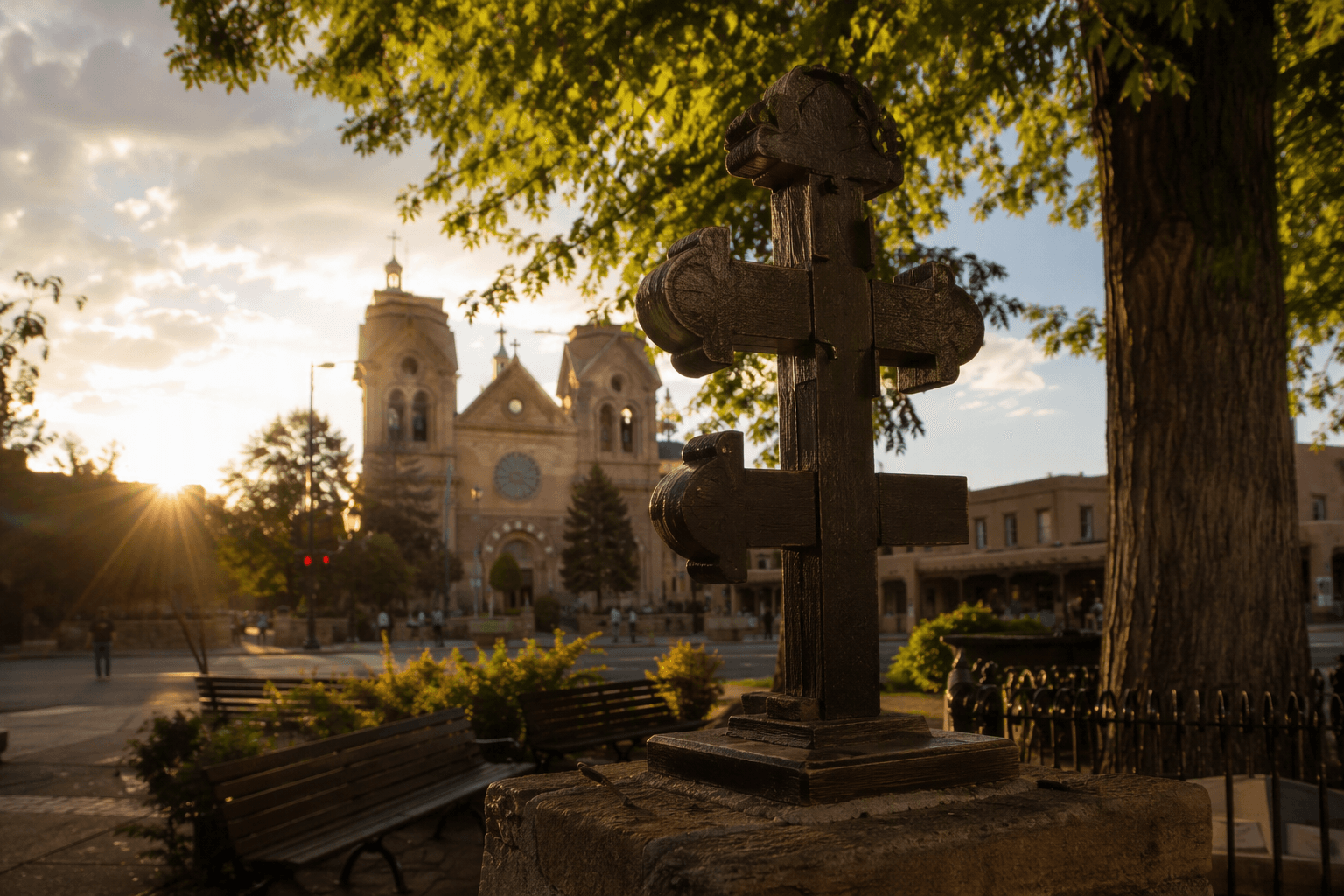
Santa Fe Plaza is where Santa Fe County’s past and present still share the same pavement. The square block, bordered by San Francisco Street, Washington Avenue, Palace Avenue, and Lincoln Avenue, sits in the Santa Fe Historic District and carries National Historic Landmark status. Its real importance is how often it still functions as the county’s public front porch, where preservation, tourism, and local identity collide in plain view.
A square block at the center of downtown
The plaza sits directly south of the Palace of the Governors in downtown Santa Fe, and that geography is part of the story. The National Park Service identifies the Palace at Palace Avenue at the Santa Fe Plaza, placing the square at the center of the city’s historic core rather than off to the side as a preserved exhibit. Because the plaza occupies just one block, every closure, event setup, or pedestrian surge changes the feel of downtown immediately.
That compact footprint also helps explain why the plaza matters far beyond the immediate neighborhood. Santa Fe has grown into Tesuque, Pojoaque, Eldorado, and the Southside neighborhoods, yet the plaza remains the place where the city’s oldest layers are still visible in one place. It is not only scenic; it is the reference point for how Santa Fe organizes itself.
Before the plaza was a landmark, it was a home
The city sits on Oga Pogeh Owingeh, home to the Northern and Southern Tewa people for thousands of years before Spanish colonization. The City of Santa Fe’s plaza-evolution material says the lived experiences and historical stories of Oga Pogeh continue through oral tradition, including through the people of Taytsúgeh Owingeh and Tewa communities. That makes the plaza more than a town square: it is a public site built on Indigenous continuity, not just colonial-era planning.
Santa Fe Plaza was established in 1610, the same year Santa Fe became the seat of Spanish colonial government in New Mexico. SAH Archipedia describes the plaza as dating from 1610 to the present, a range that captures how few places in the state have remained so central for so long. The date matters because it explains why the plaza is still treated as the heart of Santa Fe, even as the city has spread outward in every direction.
The Palace of the Governors still defines the north side
On the north side of the historic plaza stands the Palace of the Governors, a building that dates back to 1610. The New Mexico History Museum calls it the oldest public building in continuous use constructed by European settlers in the continental United States, a claim that shows how deeply the plaza and the palace are linked. The palace is not a separate attraction from the plaza; it is one of the reasons the square carries so much civic weight.
It is also a place where that history stays active. Condé Nast Traveler notes that Native American artisans sell pottery and jewelry under the portal on a rotating basis from 23 federally recognized Native American tribes and nations in New Mexico. That detail turns the area outside the palace into a working cultural marketplace, where art, commerce, and public life overlap instead of staying in separate lanes.
A public square that still has to work
The plaza is not frozen in one era, and Santa Fe still uses it as an active event space. City and tourism materials say it hosts Indian Market, Spanish Market, live demonstrations, and public holiday celebrations, and city material says the Traditional Spanish Market takes over the Plaza for the last weekend in July. Those events do more than draw visitors; they reset how the square functions, from foot traffic to street access to vendor placement.
A city traffic advisory has pointed to closures around the plaza during Spanish Market, including the Plaza itself, East San Francisco Street, and Lincoln Avenue. That is a reminder that the square is not just a symbol to admire. It is also a piece of infrastructure that has to absorb crowds, vehicle detours, and the needs of merchants, residents, and event organizers all at once.
Why the city keeps studying the plaza
The plaza has also been treated as a serious cultural landscape, not only a downtown backdrop. A City of Santa Fe cultural landscape report was prepared in October 2005 for the City of Santa Fe Engineering Division, with Morrow Reardon Wilkinson Miller, Ltd. leading the design work and Chris Wilson involved as consulting historian. That report matters because it reflects the city’s recognition that the plaza’s shape, edges, and uses have all been layered over time.
Seen that way, the plaza is not a museum piece. It is a studied historic landscape that still absorbs daily life, ceremonial use, and tourism pressure in the same block. The city’s growth into surrounding neighborhoods has not displaced its importance; it has made the plaza even more symbolic as the place where Santa Fe still presents itself to itself.
The plaza endures because it keeps carrying multiple roles at once. It is an Indigenous place, a colonial center, a tourist destination, a market ground, and a civic stage. In Santa Fe County, few spaces make the argument for public history as visibly as this one block at the city’s core.
This article was produced by Prism’s automated news system from verified source data, official records, and press releases, then run through automated quality and moderation checks before publishing. The system is built and supervised by the people who set the standards it runs under. Read our full AI policy.
Did this article answer your question?