Big Tree Park offers history, trails and a glimpse of old cypresses
Big Tree Park packs Seminole County history, a trailhead and Lady Liberty into one compact stop. The park also shows how the county turned the loss of The Senator into a preservation story.
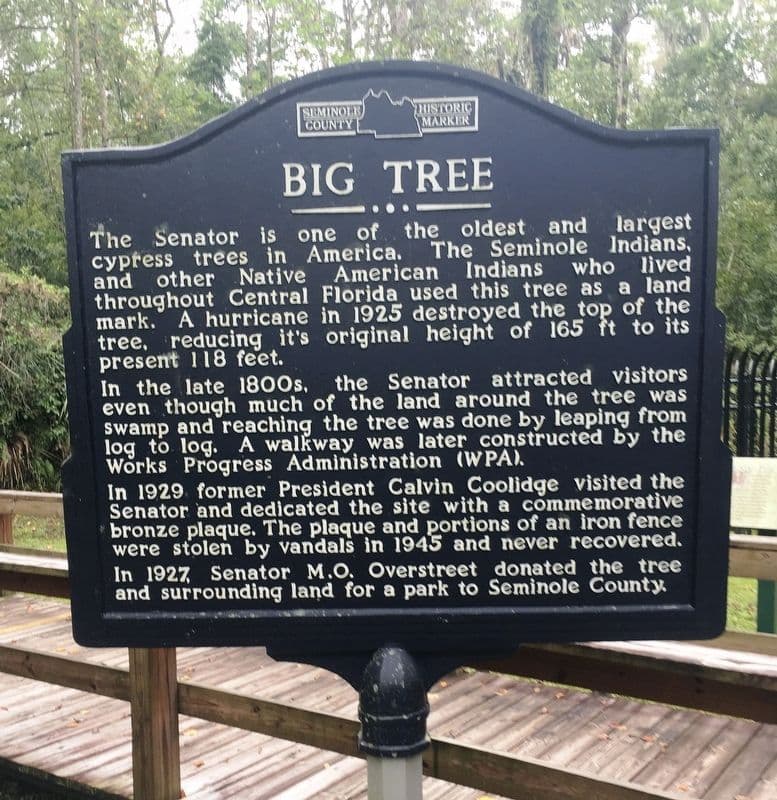
Big Tree Park is one of Seminole County’s most unusual public spaces because it is not just a place to walk, it is a place to read the county’s natural and civic history in one stop. Set on General Hutchinson Parkway in Longwood, between U.S. 17-92 and State Road 427, the park also serves as a trailhead for the Cross Seminole Trail, making it a practical link between local recreation and one of Central Florida’s best-known trail systems.
A park with a civic backstory
The county says the property was donated by Senator M.O. Overstreet and dedicated by President Calvin Coolidge in 1929, which gives Big Tree Park a formal place in Seminole County’s public story. That history matters because the park is not an afterthought green space tucked into development, but a parcel that was set aside and preserved long before the county grew into the suburban and trail-connected landscape it has today.
That civic origin still shapes the way the site is used. Visitors come for the boardwalk and the trees, but the park also functions as a visible marker of how Seminole County has tried to keep pieces of its older identity intact while the surrounding region fills in around it.
The Senator and the story that made the park famous
Big Tree Park is best known as the former home of The Senator, the legendary bald cypress that was thought to be more than 3,500 years old before it burned on January 16, 2012. Before the fire, it was widely described as one of the largest and oldest bald cypress trees in the world, which is why the site drew attention far beyond Seminole County.
The Longwood Historic Society says the fire was the result of a deliberate and thoughtless act, while fire officials ruled out arson as the legal cause of the blaze. However the event is described, the result was the same: a tree that had stood for millennia was reduced to a stump in a matter of hours, turning Big Tree Park into a place of memory as much as a place of scenery.

That loss still gives the park its strongest narrative hook. The Senator was not just a tree in a preserve; it was a landmark that helped define the county’s identity, and its destruction became a reminder of how fragile even the most durable-looking pieces of natural heritage can be.
Lady Liberty keeps the old-forest feeling alive
The surviving draw is Lady Liberty, the Senator’s sister tree, which Seminole County describes as an approximately 2,000-year-old bald cypress. A historical marker says Lady Liberty stands about 89 feet tall, has a trunk 10 feet in diameter, and grows about 40 feet from the former site of The Senator, close enough to make the relationship between the two trees impossible to miss.
Lady Liberty also carries a community story. Geneva Elementary School students named the tree in 2005, giving the park a connection to a younger generation that has helped keep the site relevant after The Senator’s loss. For visitors, that detail matters because it shows Big Tree Park is not frozen in the past, it is still being interpreted, named and understood by people in Seminole County today.
The effect on the ground is simple but powerful. You walk a short distance and move from a county park into the remains of an ecosystem that was already ancient when the first European ships crossed the Atlantic. That is part of why the site still resonates with residents and out-of-town visitors alike.
Spring Hammock Preserve gives the park its scale
Big Tree Park sits inside Spring Hammock Preserve, an approximately 1,500-acre property that also includes Soldiers Creek Park, part of the Cross Seminole Trail and part of the Florida National Scenic Trail. Seminole County says about 446 acres of the hammock were acquired by the state and subleased to the county for management, a reminder that this landscape is not only scenic but administratively protected.

The preserve also sits in the St. Johns River watershed, which gives the site broader environmental significance. This is not just a stand of trees on the edge of Longwood; it is part of a larger water and wetland system that helps explain why the area still holds a dense, swampy character despite the development around it.
The boardwalk experience reinforces that setting. The county describes the walk as a route through a natural hydric hammock swamp to the former site of The Senator, and that framing matters because it keeps the focus on the habitat itself, not just the famous tree that once stood there. Visitors get a sense of wetland structure, canopy shade and old-growth atmosphere without needing to hike deep into the preserve.
A public asset that was rebuilt, then reinterpreted
Big Tree Park reopened to the public on March 2, 2014, after boardwalk redevelopment, and that reopening turned the site from a memorial into an active destination again. Seminole County later planted cloned Senator trees at Big Tree Park and Reiter Park in Longwood, extending the story beyond the original trunk and giving the county a living way to interpret what was lost.
The park’s interpretation did not stop there. More recent local coverage says pieces of The Senator are now preserved as artwork at the Museum of Seminole County History, which adds another layer to the county’s response: destruction became an artifact, and an artifact became part of a public collection.
That approach explains why Big Tree Park still matters now. It is easy to reach, it connects directly to regional trails, and it lets Seminole County show how preservation, recreation and memory can coexist in the same small footprint. In a county that keeps growing, the park remains one of the clearest places where old Florida is still visible and publicly accessible.
This article was produced by Prism’s automated news system from verified source data, official records, and press releases, then run through automated quality and moderation checks before publishing. The system is built and supervised by the people who set the standards it runs under. Read our full AI policy.
Did this article answer your question?