Goldsboro and Westside Sanford Tours Highlight African American Heritage
Goldsboro became the second Black-incorporated city in the U.S. on Dec. 1, 1891. Tours now bring that layered history back to life across West Sanford.

Few neighborhoods in Central Florida carry a historical weight quite like Goldsboro. Tucked into the western edge of Sanford, this community holds a distinction that most Seminole County residents have never been taught in school: on December 1, 1891, the town of Goldsboro was the second Black-incorporated city in the United States. That single fact anchors an entire landscape of heritage tourism that has quietly grown around West Sanford, drawing visitors who want to understand what was built here, what was lost, and what is being reclaimed.
A Founding Rooted in Resistance and Ambition
The Goldsboro Museum, operated by the Goldsboro West Side Community Historical Association, Inc., places the incorporation date at December 1, 1891, making it second only to Eatonville, the other all-Black incorporated township in Central Florida. According to tour listings on Fun4SeminoleKids, Goldsboro was established by Mr. William Clark, while Eatonville was founded by his brother, Joe Clark. That fraternal pairing of two self-governing Black communities within the same region of Florida is remarkable on its own terms, though researchers and visitors who want primary documentation should contact the museum directly, as that founder attribution appears in promotional sources and warrants verification against archival records.
What is not in dispute is the community's scope and ambition. Goldsboro built institutions, businesses, and a civic identity during an era when that required extraordinary collective will. The Goldsboro Museum frames its mission simply: "The Goldsboro Museum showcases and preserves the history, heritage, livelihood, and culture of Goldsboro, Florida." That statement, spare as it is, covers more than a century of material.
The Goldsboro Museum: Where the Archive Lives
The museum's physical collection moves across timelines with intention. Exhibited items include a Yo-yo Quilt, catalogued under tags spanning Art, Decoration, Home Life, and Living in Goldsboro 1800s-early 1900s, and a dedicated exhibit on Charles Merritt, contextualized within the American South and the community life of late 19th and early 20th century Goldsboro. The museum also maintains a searchable archive, and the Goldsboro Archives are open for public viewing through the museum's website.
Publications documenting Goldsboro's history are available for purchase while supplies last, offering readers a deeper dive than any single tour can provide. Recent "In the news" items on the museum's site include a striking personal account titled "Goldsboro: A Letter From The Past," which opens with the voice of Catherine B. Bostic, born January 31, 1900, and a piece called "History of Bokey," which notes that "This History is important because 'It Is Black History'" and references the migration of Black residents from 14 states between 1910 and 1970.
Coming exhibitions give visitors a reason to plan ahead. The Goldsboro Museum and Museum of Seminole County History are jointly presenting "Seminole Community and Legacy" across February 26, 27, and 28, 2026. A separate special event, the Goldsboro Arts Square, is scheduled for March 16, 2026. The museum has also partnered with Bethune-Cookman University on a Goldsboro Heritage Film and Discussion Series, which pairs visual storytelling with structured conversation about what the archive holds.
All museum tours must be pre-scheduled. The museum's current instruction reads: "Due to COVID-19 all tours must be pre-scheduled through our website or send an email to visitgoldsboro@goldsboromuseum.com." Visitors should contact the museum to confirm current hours, pricing, and scheduling procedures before making the trip.
The 90-Minute Goldsboro History Tour
For those who prefer a guided, narrative-driven experience, a private and customized 90-minute Goldsboro history tour is available through local tour operators. The tour frames Goldsboro's story in three acts: the rise of a thriving community during segregation; the eventual demise that sent the neighborhood into a downward spiral and stripped it of its civic identity; and the ongoing rebirth now taking shape.
The tour covers the legacy of Goldsboro's trailblazers and the many celebrities who visited or stayed in the community, including Jackie Robinson, whose presence here is part of a broader memorabilia collection that, according to tour descriptions, showcases "the story of hope, freedom, and independence endured over many years." The full celebrity list extends beyond Robinson, though those additional names were not available in the excerpts reviewed for this piece.
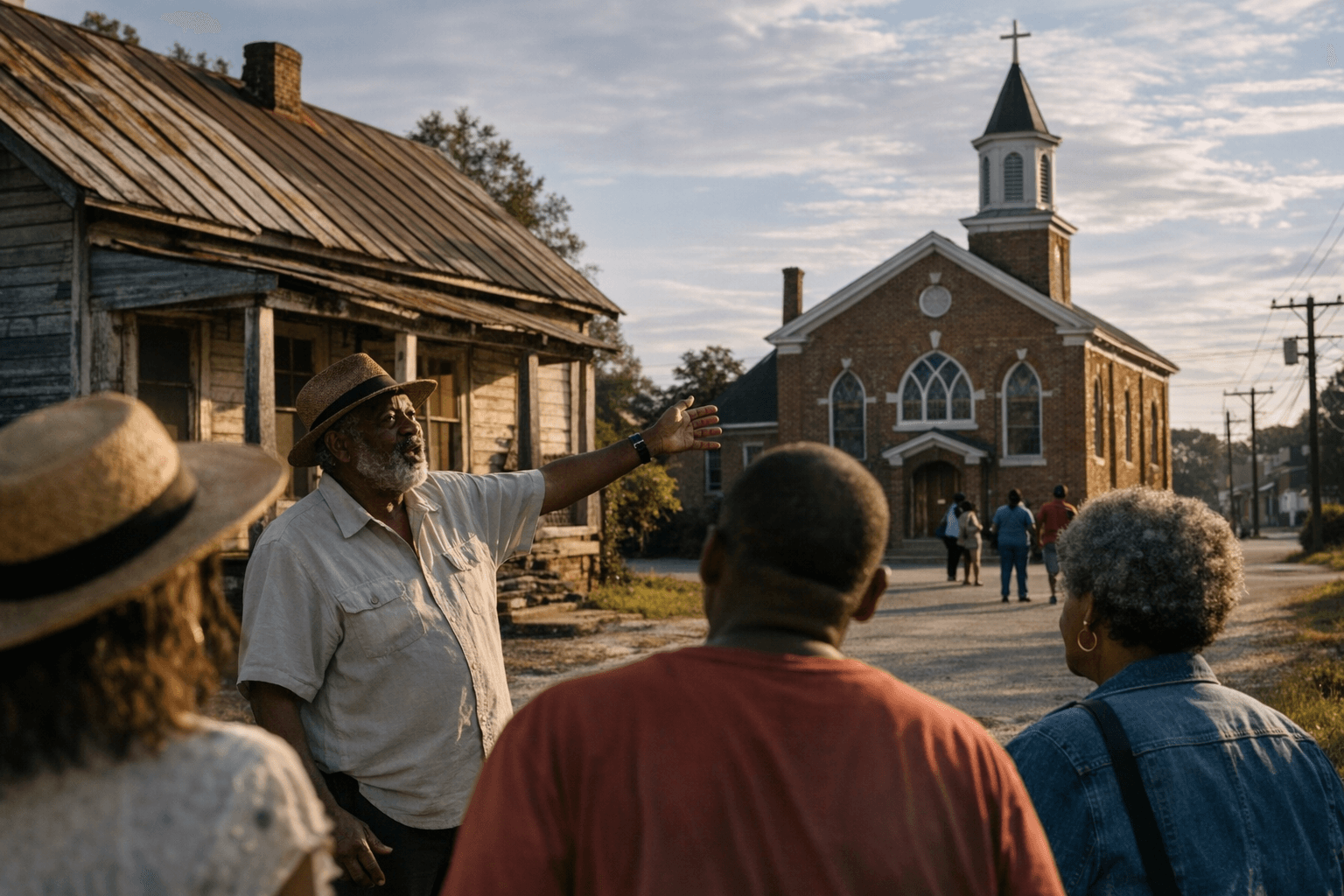
This format works especially well for small groups and for families who want to approach the history with a guide who can answer questions in real time. Contact the Goldsboro Museum at visitgoldsboro@goldsboromuseum.com for referrals and to coordinate access.
Pathways to History: Sanford's City-Run Walking Tours
The City of Sanford offers its own entry point into this history through the Pathways to History walking tour program. These tours cover residential and historic districts, parks, the waterfront, and Sanford's military legacy, and they specifically spotlight the African-American communities of Historic Goldsboro and Georgetown. For visitors who want to connect Goldsboro's story to the broader arc of Sanford's development, the Pathways to History program bridges those neighborhoods into a single coherent walking route.
Detailed route maps and scheduling information are available through the City of Sanford.
The Sanford Museum: Context for the Whole Region
No heritage tour of this area is complete without time at the Sanford Museum, which documents how this city shaped the Central Florida region and beyond. Items from Henry Shelton Sanford, the city's founding father, anchor the collection, alongside exhibits on agriculture, business, education, local celebrities, and the Naval Air Station. One exhibit makes the case for celery: Sanford was once such a dominant celery producer that it earned the designation of "celery-growing mecca," and the museum explains how that single crop defined the local economy for generations. That agricultural story also intersects directly with Black labor history in the region, making the Sanford Museum a meaningful complement to any Goldsboro tour.
Beyond the Tour: River Cruises and Culinary Walks
Visitors who want to extend their day in Sanford have options that weave history into leisure. The Rivership Barbara-Lee, operated by St. Johns Rivership Co., is the only authentic sternwheeler still sailing the St. Johns River. Lunch and dinner cruises offer fine cuisine and live entertainment in a climate-controlled dining room, with the option to stand on deck and take in the river landscape. It is a slower, more contemplative way to close a day spent inside Goldsboro's archive.
Sanford Food Tours runs a walking culinary adventure that stops at five eateries while threading in the history and culture of Downtown Sanford. For visitors who arrived for the heritage and stayed for the neighborhood, it is a practical and enjoyable way to absorb more of what makes this part of Seminole County distinct.
Goldsboro's story has never been a quiet one. What was incorporated in 1891 as an act of collective self-determination, sustained through segregation, and tested by decades of decline is now the subject of museum exhibitions, film series, walking tours, and a growing archive. The history was always here. The infrastructure to share it is finally catching up.
This article was produced by Prism’s automated news system from verified source data, official records, and press releases, then run through automated quality and moderation checks before publishing. The system is built and supervised by the people who set the standards it runs under. Read our full AI policy.
Did this article answer your question?