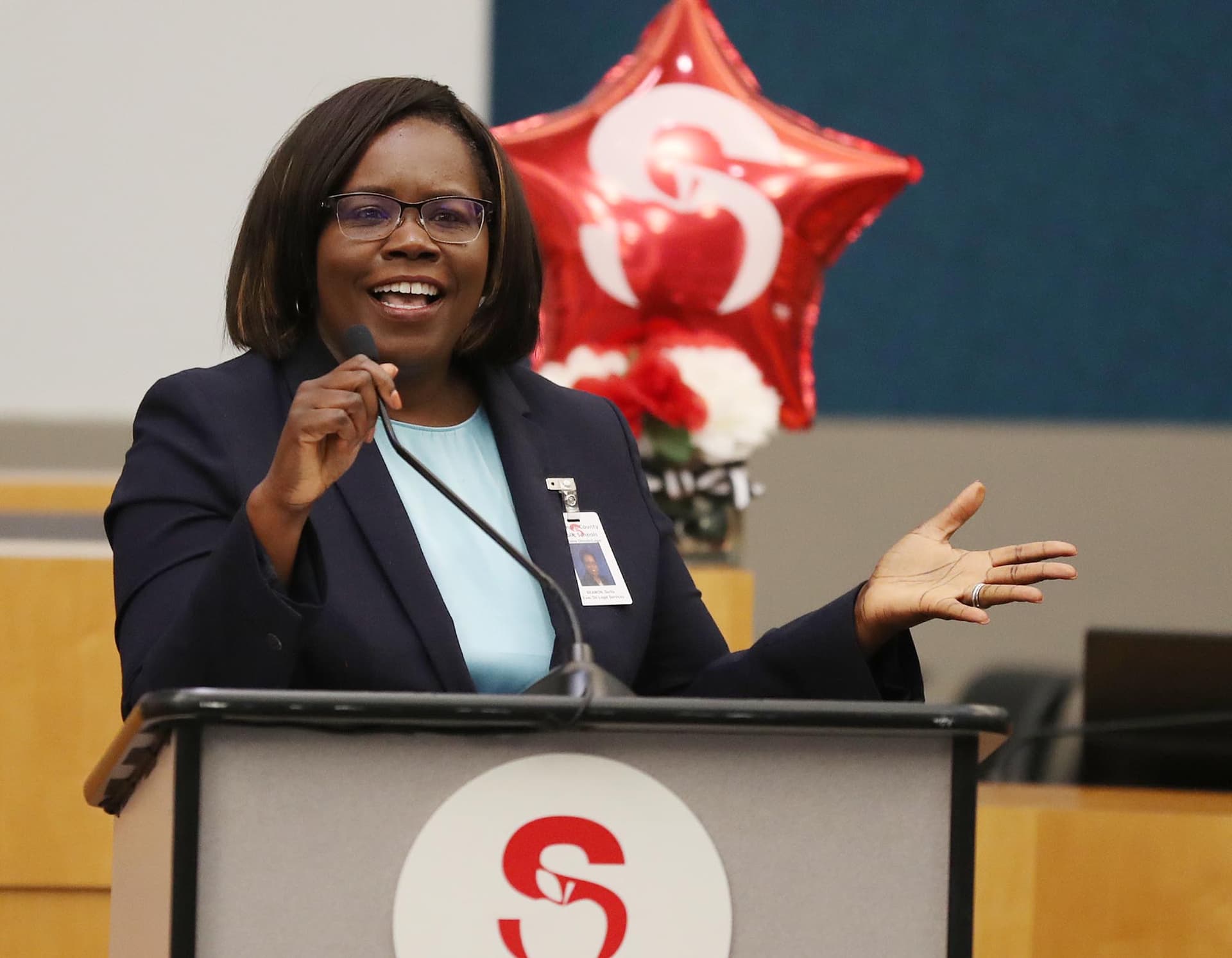
Oviedo counselor uses classroom culture lessons to build student confidence
At Hagerty, Andrea Fuhrer turns class time into a confidence-building exercise, pairing culture lessons with college-and-career guidance students can actually use.
Culture lessons with a bigger purpose
At Hagerty High School in Oviedo, Andrea Fuhrer is using a classroom that looks less like a standard lecture hall and more like a safe place to practice confidence. Students line up to sample dishes, then talk about the culture behind each one and what the food means to them, a simple exercise that Fuhrer uses to build global awareness and help students connect with one another.
That matters because Fuhrer is not just teaching content. As a teacher and college and career counselor, she blends academics, emotional support, and planning for life after high school. She has worked in education for 17 years, and her approach is built around a basic idea she states plainly: students need people around them who support them so they can thrive through the challenges they face.
For Oviedo families, the lesson is bigger than the activity itself. It shows what school-based support looks like when it is done intentionally: students are not just asked to complete assignments, they are encouraged to speak up, reflect, and see themselves as capable in a room where belonging is part of the curriculum.
A counseling role that reaches beyond one class period
Fuhrer’s work sits inside a larger counseling structure at Hagerty and across Seminole County Public Schools. The district says its comprehensive school counseling plan is meant to support programs that meet the needs of all students, and its counseling framework includes social-emotional learning, mental-health stigma reduction, positive school climate, and trauma-informed practices.
That framework helps explain why Fuhrer’s class matters. The Florida Department of Education’s counseling model describes tier-one services that can include social-emotional learning classroom lessons and workshops, which is exactly the kind of environment Fuhrer is creating. Her classroom culture lesson is not a side activity; it reflects a broader system in which counseling is designed to shape student confidence, not only solve problems after they appear.
Hagerty says that Dr. Andrea Fuhrer, the college and career counselor, is located in the College and Career Room in the back of the media center. Students can stop by after school for help, and they can also find her during both lunches in the cafeteria. That access is significant because it makes support visible and routine, not limited to a formal appointment that students may never schedule.
Why confidence connects to graduation readiness
The stakes are practical. Students who feel comfortable asking questions, joining conversations, and seeking help are more likely to make use of the counseling resources that can shape their next step after graduation. At Hagerty, that includes dual enrollment opportunities with Seminole State College and the University of Central Florida for qualified students.
Hagerty says dual enrollment can help students earn college credit while also moving toward a high school diploma, and it can lead to an A.A. degree, an A.S. degree, or a career certificate. That is a powerful pipeline for families watching college costs and career readiness at the same time.
Seminole State College says its career pathways partnership with Seminole County Public Schools can allow students to earn up to 12 college credits and save up to $1,000. Seminole County Public Schools also says some articulated career programs may qualify students for the Florida Bright Futures Gold Seal Vocational Scholars Award, which adds another measurable incentive for students who are willing to stay engaged in a path that starts in high school.

For parents, that means confidence is not a soft extra. A student who feels supported in Fuhrer’s room may be more likely to ask about dual enrollment, career certificates, or credit-bearing pathways before senior year narrows the options.
What families should know before the next school year
The most important takeaway from Fuhrer’s approach is that support is not abstract. It is visible in the hallway, during lunch, and after school. It is also built into a system that recognizes students may need help with more than grades, including the social and emotional pressures that can affect whether they stay on track.
Families in Seminole County should keep three parts of that support structure in view:
- Hagerty’s College and Career Room is in the back of the media center, where students can find Fuhrer during both lunches and after school.
- Seminole County Public Schools says its counseling plan includes social-emotional learning, mental-health stigma reduction, positive school climate, and trauma-informed practices.
- Students who qualify may use dual enrollment at Seminole State College or the University of Central Florida to earn college credit, an A.A., an A.S., or a career certificate.
The broader safety net matters too. The Florida Department of Health in Seminole County highlights 988 Florida Lifeline and 211 as support resources for residents, an important reminder that school counseling is one layer of help within a larger community network.
A local example of what student support can produce
The Hagerty profile stands out because it puts a concrete face on a question many families are asking: what does student support actually look like when it works? In Fuhrer’s classroom, it looks like students talking across cultures. In the college-and-career office, it looks like a counselor who is reachable during lunch and after school. In the district’s counseling framework, it looks like a system built around belonging, resilience, and readiness.
That combination is what gives the story weight for Seminole County. It suggests that confidence, graduation readiness, and post-high-school planning are connected, and that the students most likely to succeed are often the ones who feel seen long before they fill out a college application or choose a career path.
This article was produced by Prism’s automated news system from verified source data, official records, and press releases, then run through automated quality and moderation checks before publishing. The system is built and supervised by the people who set the standards it runs under. Read our full AI policy.
Did this article answer your question?