Seminole County's 100 Sentinel Chickens Serve as Early Warning System for Mosquito-Borne Diseases
Seminole County stations 100 chickens countywide each spring to monitor for 7 mosquito-borne viruses. A Seminole horse confirmed with EEE in 2025 shows the stakes.
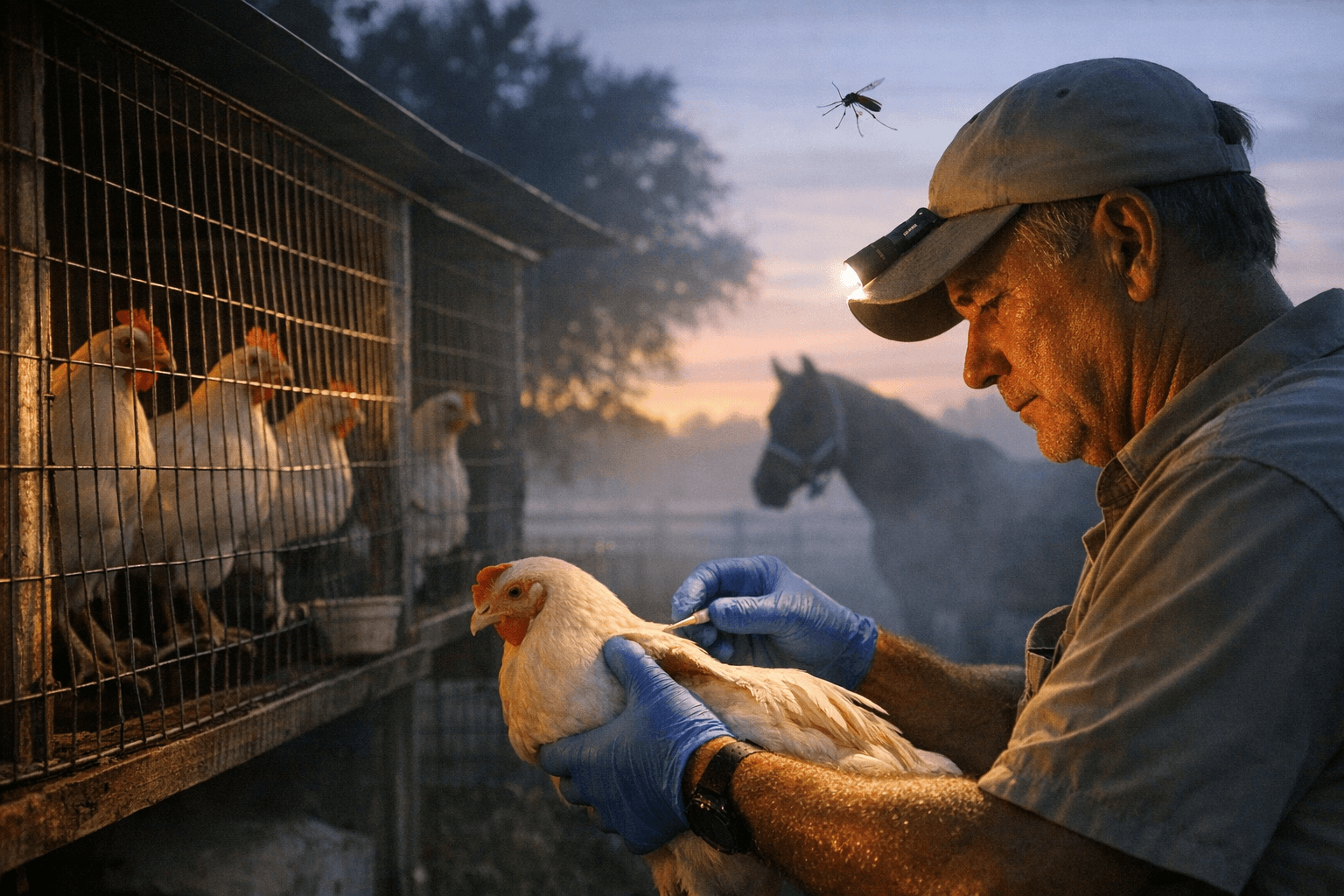
One hundred chickens, their blood drawn weekly and shipped to a state laboratory in Tampa, form Seminole County's first line of defense against seven mosquito-borne viruses: West Nile, Eastern Equine Encephalitis, St. Louis Encephalitis, Highlands J Virus, Zika, Chikungunya, and Dengue.
Theressa Jones, manager of Seminole County's Mosquito Control Program, oversees the deployment each spring, placing tagged birds into coops at strategic locations across the county. Her team draws a small blood sample from the vein beneath each bird's wing and ships it to Tampa, where state laboratory technicians use ELISA testing to detect arbovirus antibodies. Results come back by Friday.
"We test them for antibodies every week," Jones said. "If they have an antibody to a certain mosquito-borne illness then we know we need to go to that area and suppress the adult mosquito population."
The chickens are ideal sentinels for a simple biological reason: mosquitoes that carry these viruses preferentially feed on birds, while the chickens themselves cannot get sick from arboviruses and cannot transmit them to humans. Thomas Unnasch, a University of South Florida biologist who specializes in vector-borne diseases, has described the approach as "a really good way of monitoring," noting the birds "are sampling literally hundreds or thousands of mosquitoes every day."
Seminole County formalized its mosquito control contract in 2001, when West Nile Virus first arrived in Florida, and expanded the program significantly in 2005 and 2006. It operates under a Memorandum of Agreement with all seven of the county's cities, consolidating surveillance across municipal boundaries through the Watershed Management Division of the Environmental Services Department.
The threats the program tracks are not abstract. In June 2024, sentinel chickens in neighboring Orange County tested positive for Eastern Equine Encephalitis. Six months later, a horse in Seminole County itself was confirmed with an EEEV infection. Scientific data spanning 2005 to 2016 shows EEE is active in Florida year-round, not only during the summer months most people associate with mosquito season.
Statewide in 2024, the surveillance network identified 29 positive sentinel chickens across 13 counties for St. Louis Encephalitis Virus antibodies alone. That year, abnormally warm winter weather pushed mosquito activity into January, prompting Jones's office to field calls from residents months before the typical spring season.
"Usually, this time of year we're a little slow," Jones said. "We've been busy since January."
That early pressure moved the 2024 sentinel chicken deployment up to early April. When the system does flag activity, the response can be significant: after Hurricane Ian in 2022, elevated signals in the county's sentinel flock triggered aerial spraying across approximately 48,000 acres of eastern Seminole County, covering communities including Geneva, Chuluota, Black Hammock, and the shores of Lake Jesup and Lake Harney.
When the surveillance season ends, the 100 chickens are offered to community members, trading their posts in rural coops for private backyards across the county.
This article was produced by Prism’s automated news system from verified source data, official records, and press releases, then run through automated quality and moderation checks before publishing. The system is built and supervised by the people who set the standards it runs under. Read our full AI policy.
Did this article answer your question?