Seminole State celebrates 25 years of Oviedo campus growth
Oviedo’s Seminole State campus has become a workforce and transfer engine, with nearly 7,000-student capacity and a direct path to UCF.
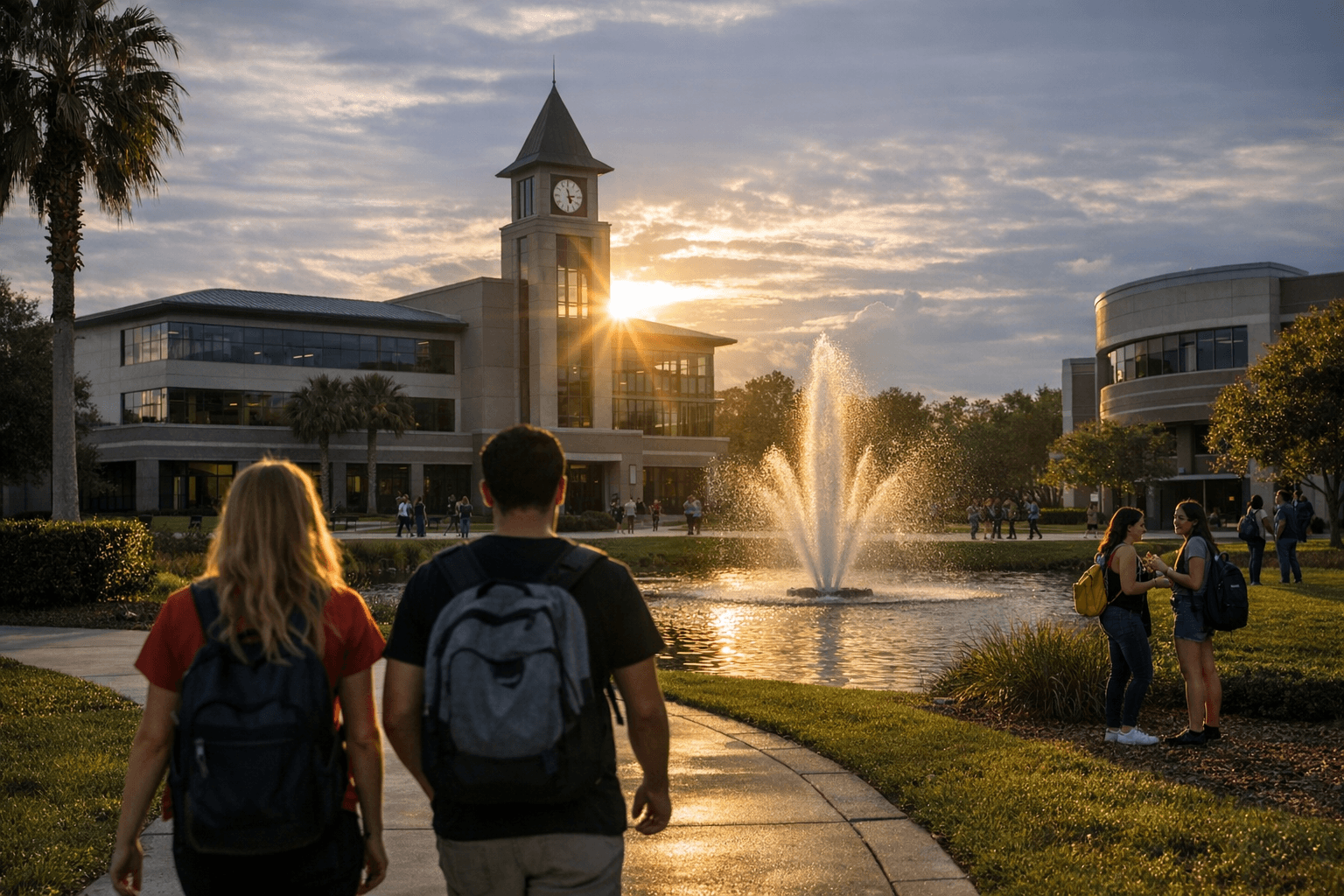
Seminole State College of Florida’s Oviedo campus is not just a landmark on the east side of the county. On 180 secluded acres in Eastern Seminole County, with 120 acres preserved as woodlands and wetlands, it has become a working part of Seminole County’s education and labor pipeline, built to move students into degrees, certifications and better-paying jobs.
A campus built for access, not ceremony
Opened in 2001, the Robert and Jane Lee Campus at Oviedo was designed with a blend of natural setting and academic utility that still defines it today. Seminole State says its learning facilities total about 147,000 square feet and can accommodate nearly 7,000 students, giving the campus the scale to serve a growing corridor without losing the small-class experience it promotes.
That matters because the campus is not limited to one lane of study. Its programs span arts, technology, English, foreign language, adult education, science, math and career certification. In practical terms, that means the site can serve a first-time college student, an adult returning for new credentials, or a student building a transfer plan with a clear next step.
What the campus delivers to the local economy
The 25-year milestone is most useful when measured against Seminole County’s actual needs. A college campus affects much more than enrollment totals. It shapes workforce development, student spending, nearby business activity and whether a city is giving residents a nearby route to higher education and training.
Seminole State’s Oviedo campus also includes an innovative economic development suite, a detail that points to the campus’s role in helping align education with employer demand. For a county that has seen continued growth and changing job needs, that kind of facility matters as much as a classroom building. It gives the college a place to connect academic programs with the skills businesses want now, not just the degrees that looked valuable 20 years ago.
The campus’s location also makes it a practical option for students and employers across Seminole County. A local campus reduces the barrier of long commutes, which can make the difference between enrolling and not enrolling, or between taking one more class and stopping short of a credential.
The transfer bridge to UCF
One of the campus’s clearest value propositions is its link to the University of Central Florida. Seminole State says the Oviedo campus is only a few miles from UCF and is a strong fit for students in the DirectConnect to UCF program, which guarantees admission to UCF for Seminole State students and alumni with qualifying associate degrees.
That transfer path is a major part of the campus’s return on investment. It gives students a nearby, lower-cost route into higher education without forcing them to leave the county for their first two years. It also keeps local talent moving through a pipeline that can begin in Oviedo and end with a four-year degree in Central Florida, which is exactly the sort of civic infrastructure that matters in a fast-growing region.
For families deciding between immediate work and more school, DirectConnect adds flexibility. It lets students start close to home, build credentials, and keep the option of continuing at UCF without starting over.
The Lee family name and what it represents
The campus was renamed the Robert and Jane Lee Campus at Oviedo in March 2018 to honor the late Robert and Jane Lee for their financial support and commitment to the college. That renaming was more than a plaque change. The Lee family’s generosity also established a scholarship that covers full tuition for two years for students from the Oviedo area.
That scholarship is one of the most direct ways the campus connects philanthropy to access. It turns a local gift into a local pathway, reducing the price of college for students who may otherwise be forced to delay or drop out. In a county where higher education, workforce readiness and family budgets are closely linked, the scholarship is as important as any building on the site.
The naming also reinforces the campus’s place in Oviedo’s identity. A college campus with local roots sends a signal that the city is investing in its future, not just managing growth around it.
By the numbers that matter
- Opened in 2001
- Renamed in March 2018
- Sits on about 180 to 185 acres
- Includes roughly 120 acres of preserved natural woodlands and wetlands
- Has about 147,000 square feet of learning facilities
- Can accommodate nearly 7,000 students
- Seminole County’s population was 470,856 in the 2020 Census
- Census Bureau estimates put the county at 494,605 in 2024 and 491,884 in 2025
Those population figures help explain why the campus continues to matter. Even with a slight dip in the 2025 estimate, the county remains well above its 2020 Census count, which keeps pressure on schools, training systems and transfer options. A campus that can absorb that demand while preserving space, class size and program variety is a county asset, not a ceremonial one.
What 25 years says about Seminole County
The stronger argument for celebrating the Oviedo campus is not nostalgia. It is performance. A campus that opened in 2001 and still sits at the intersection of education, workforce development and access to UCF has done the kind of quiet public work counties often depend on but rarely measure closely enough.
In eastern Seminole County, that work shows up in more than one place: in the student who starts with a certification course, in the graduate who transfers through DirectConnect, in the adult learner returning for a credential, and in the local economy that benefits when those students stay close to home. After 25 years, the Oviedo campus is still proving that a college can be both a natural landmark and a practical engine for the county’s future.
This article was produced by Prism’s automated news system from verified source data, official records, and press releases, then run through automated quality and moderation checks before publishing. The system is built and supervised by the people who set the standards it runs under. Read our full AI policy.
Did this article answer your question?