Duluth family marks one year since David Storbakken disappeared
A year after David Storbakken vanished in Roseville, his family still has no public answer, and state posters say he may be in crisis.
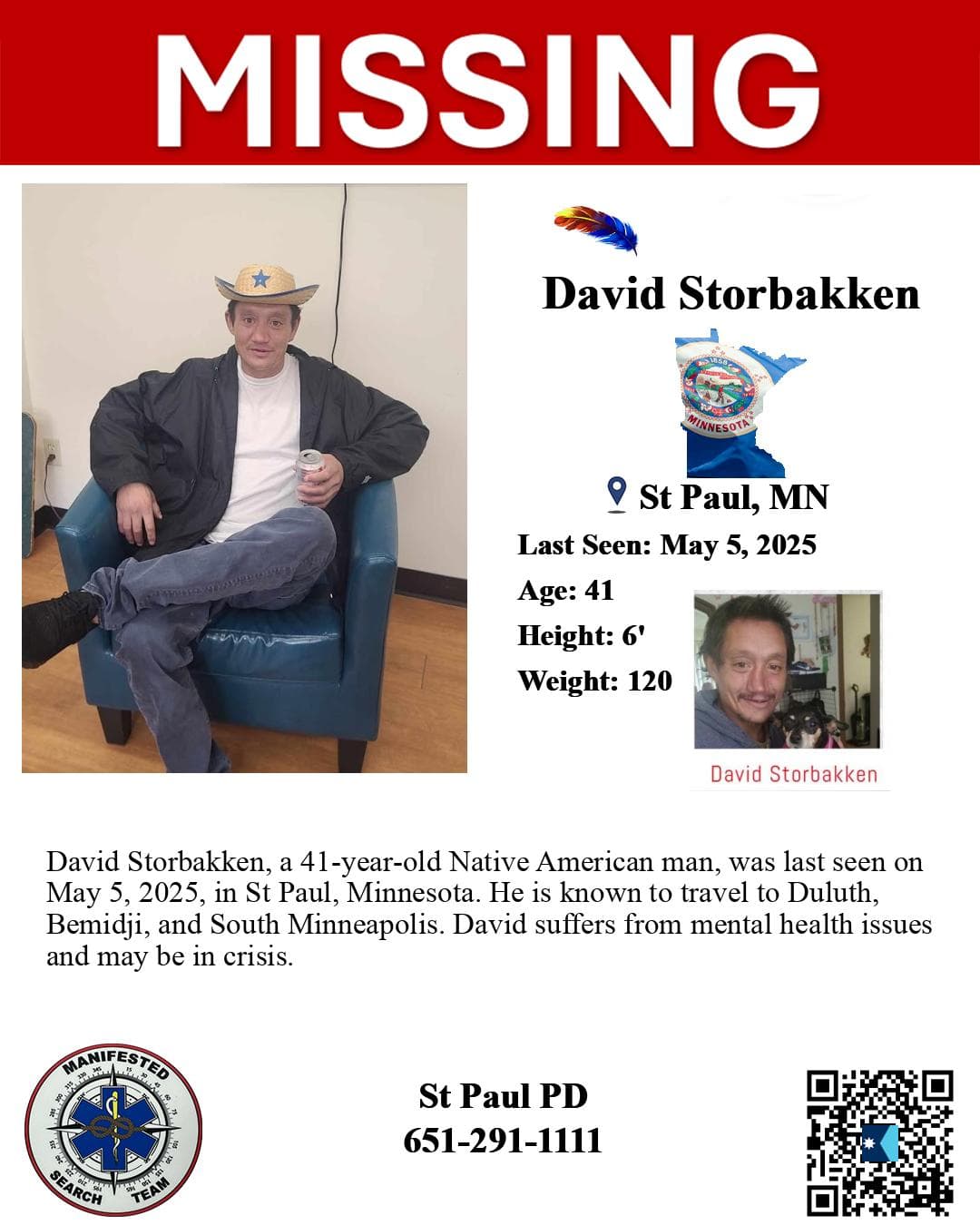
A year after David Storbakken vanished from a Roseville gas station, his Duluth family still has no public resolution, only a growing fear about what happened to the 41-year-old Native American man last seen near Rice Street and Highway 36.
State records say Storbakken was last seen around 3 a.m. on May 11, 2025, near the Speedway at 2295 Rice St. in Roseville. He was wearing a gray sweatshirt and white pants, and the Minnesota Department of Public Safety says he is known to travel between Duluth, Bemidji, St. Paul and Minneapolis. The same bulletin says his family is deeply concerned because it is unlike him not to contact his sister or others.

The pain of the case sits in what has not happened. No body has been found. No definitive explanation has been made public. For Melissa Storbakken, that uncertainty is the hardest part. She said, “I believe in my heart that something bad happened to David.”
State missing-person posters describe Storbakken as 6 feet tall, 120 pounds, with brown eyes, brown hair, a faded eagle tattoo on his hand and several missing fingers. One poster lists him as last seen in Duluth, while the Department of Public Safety bulletin places his disappearance in Roseville. State materials also say he may be in crisis, a detail that underscores why the case remains urgent even as time passes.
Storbakken’s disappearance also falls within Minnesota’s Missing and Murdered Indigenous Relatives crisis, which state officials say the Missing and Murdered Indigenous Relatives Office was created to confront. The office is housed in the Department of Public Safety’s Office of Justice Programs, and state materials describe it as the first of its kind in the nation, created in 2021 to reduce and end violence against Indigenous people.
When a case goes cold, Minnesota’s system depends on basic steps that can determine whether a name stays visible or disappears into the background. The state’s Missing and Unidentified Persons Clearinghouse says a missing person must first be reported to local law enforcement and entered into NCIC. The Department of Public Safety’s unsolved-cases database holds unresolved homicide cases, long-term missing-person cases and unidentified remains cases dating back to 1951, a reminder that some searches in Minnesota stretch far beyond a single year.
This article was produced by Prism’s automated news system from verified source data, official records, and press releases, then run through automated quality and moderation checks before publishing. The system is built and supervised by the people who set the standards it runs under. Read our full AI policy.
Did this article answer your question?