Duluth gathers in red to honor missing, murdered Indigenous relatives
Families stood at Duluth City Hall in red, pressing for answers in cases that still haunt the Twin Ports and for faster police communication on missing relatives.

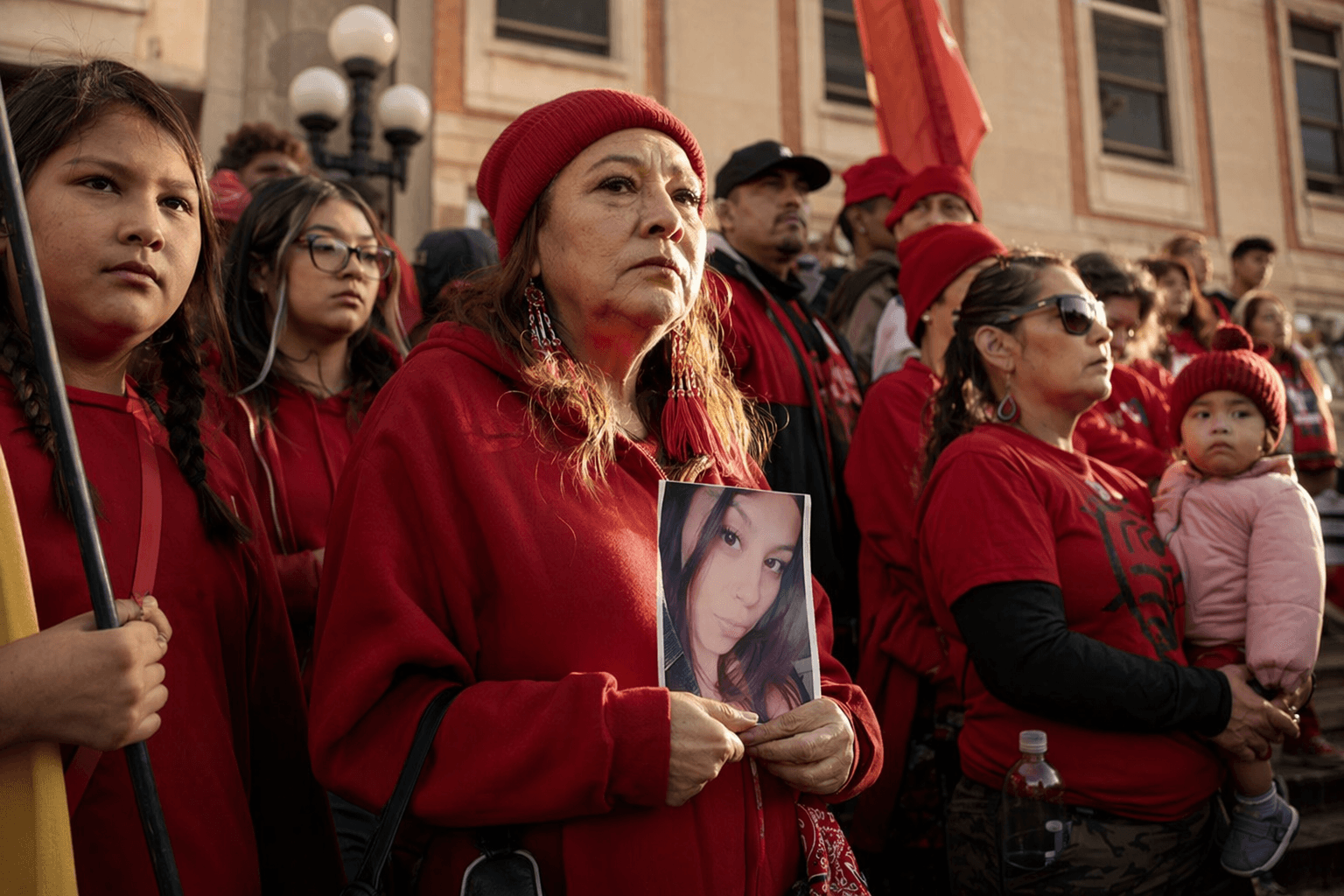
Red shirts, ribbon skirts and hand-painted signs filled the steps of Duluth City Hall as families from the Twin Ports and beyond gathered to honor missing and murdered Indigenous relatives and to demand more urgency from the systems meant to protect them.
The May 5 event marked the 6th annual Twin Ports Day of Awareness for MMIWR and ran from 10 a.m. to 2 p.m. in downtown Duluth. Families stood on the staircase to share the names of loved ones who remain missing or were killed, including Peter Martin, who disappeared in March 2024, and relatives of Amanda Boshey and Chantel Moose. Later that night, Enger Tower was set to glow red, turning one of Duluth’s most visible landmarks into a reminder of a crisis that families say cannot stay in the background.
State data shows why the concern remains so immediate. The Minnesota Department of Public Safety said 732 Indigenous people went missing in Minnesota in 2025, with women accounting for about 64.3% of those cases. On an average day last year, 63 Indigenous Minnesotans were listed as missing. Native American and Alaska Native people made up nearly 9% of missing persons cases in the state, even though they represent less than 3% of Minnesota’s population.
That imbalance has pushed pressure onto law enforcement, prosecutors and tribal advocates to improve how cases are tracked and shared. Minnesota’s Missing and Murdered Indigenous Women Task Force was created by the Legislature and signed into law by Gov. Tim Walz in 2019. Wilder Research says the task force includes representatives from 11 tribal nations, community and advocacy groups, legislators, law enforcement and the legal field, and it produced 20 mandates aimed at root causes, data collection, institutional practices, violence reduction and support for survivors and families.
The state also says its Missing and Murdered Indigenous Relatives Office helps connect law enforcement with families and provides training, outreach and family support. For relatives in Duluth, that kind of coordination is part of what still feels unfinished, especially when cases stretch across the Twin Ports and information can stall between agencies.
The city has taken one concrete step. In 2022, Duluth partnered with the Native Lives Matter Coalition and Mending the Sacred Hoop to create the Gaagige-Mikwendaagoziwag reward fund, an Ojibwe phrase meaning “They Will Be Remembered Forever,” to offer rewards for information in open missing and murdered Indigenous women and relatives cases in Duluth. For families gathered at City Hall, the message was simpler: keep talking, keep looking, and keep making the missing visible until answers come.
This article was produced by Prism’s automated news system from verified source data, official records, and press releases, then run through automated quality and moderation checks before publishing. The system is built and supervised by the people who set the standards it runs under. Read our full AI policy.
Did this article answer your question?