Monarch Fire, St. Luke’s Hospital to Offer ECPR Starting March 10, 2025
Monarch Fire and St. Luke’s Hospital in St. Louis County began offering ECPR on March 10, 2025, giving eligible cardiac arrest patients access to ECMO-based resuscitation close to home.
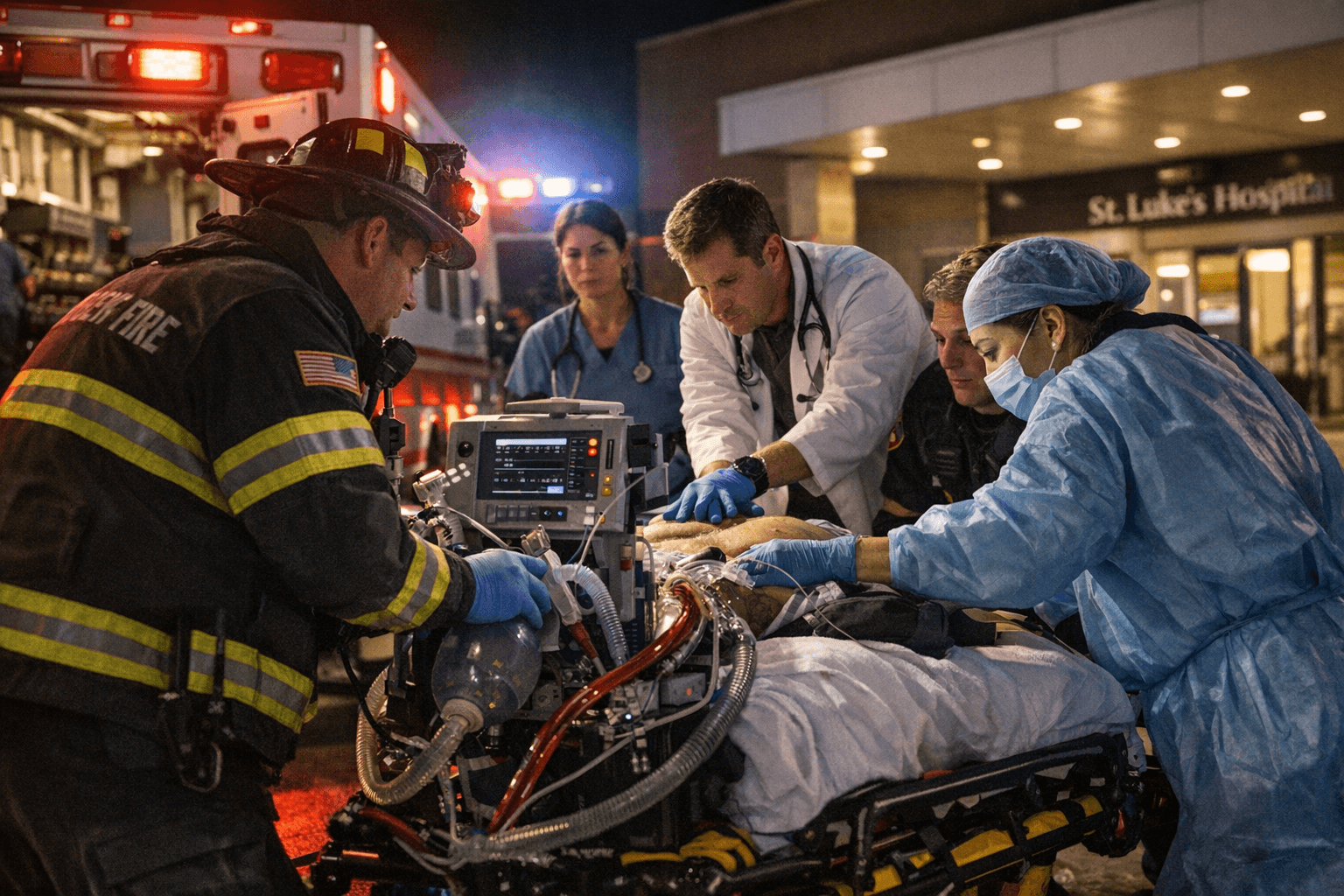
Monarch Fire Protection District and St. Luke’s Hospital launched an Extracorporeal Cardiopulmonary Resuscitation program on March 10, 2025, enabling eligible cardiac arrest patients in St. Louis County to receive ECMO-based resuscitation when traditional CPR fails. The program is framed as a coordinated, time-sensitive intervention intended to reduce delays between field resuscitation and advanced hospital care.
“Beginning today, patients who meet the criteria will have access to Extracorporeal Cardiopulmonary Resuscitation (ECPR), a pioneering initiative designed to provide the highest level of life saving intervention as quickly as possible,” the Monarch Fire Protection District wrote in its March 10 news release. The release defines ECPR as “an advanced resuscitation technique that utilizes extracorporeal membrane oxygenation (ECMO). This temporary heart and lung support is administered to patients who are unable to be revived after cardiac arrest with traditional CPR.”
Operationally, Monarch Firefighters and Paramedics will be able to alert St. Luke’s clinical team in advance of a patient’s arrival, streamlining recognition and treatment so St. Luke’s cardiothoracic surgeons can respond rapidly to the emergency department and initiate ECMO when indicated. The district framed the effort as a significant advancement in pre-hospital emergency services; the news release notes the collaboration followed more than six months of planning and coordination.
For community members with questions, Monarch listed Deputy Chief of EMS Nick Smith at 314-581-2207 and St. Luke’s Media Relations Manager Kelly Webb-Little at 314-614-9580 as contacts. The release included organizational branding and an electronic PDF format.
The St. Louis County initiative is part of a broader trend: separate hospitals named St. Luke’s are among institutions nationwide expanding extracorporeal support. In Duluth, Aspirus St. Luke’s recently launched a fully operational extracorporeal membrane oxygenation program to stabilize critically ill patients before transfer to higher-level centers. Dr. Matthew Spanier, critical care and emergency medicine physician and ECMO medical director at Aspirus St. Luke’s, said, “During time-sensitive emergencies such as severe influenza, cardiac arrest, drowning and severe hypothermia, minutes matter.” He added, “When I came here in 2020, ECMO was a clinical interest of mine,” and called the technology “life-saving for our patients and means giving them a better chance than they had in the past of returning home to their loved ones.” Aspirus invested roughly $200,000 in a German-made Getinge Cardiohelp console and has used it to stabilize patients for air transfer to Twin Cities centers.
Public health implications are sizable but require careful tracking. ECPR can improve survival for selected patients, yet outcomes depend on rapid activation, clear criteria, trained teams, and equitable access across neighborhoods and demographic groups. Key details remain to be clarified publicly for St. Louis County: the specific clinical eligibility criteria, the equipment and costs at the hospital, annual capacity, and how equity in access will be monitored. Until programs publish activation protocols and outcome data, community advocates and health policymakers should press for transparency to ensure the technology benefits patients broadly rather than concentrating advantage for those nearest advanced centers.
For now, St. Louis County residents have a new option in the chain of survival for refractory cardiac arrest. Expect leaders at Monarch Fire and St. Luke’s to report early activation numbers and outcomes in the coming months as the program moves from launch into routine practice.
Know something we missed? Have a correction or additional information?
Submit a Tip