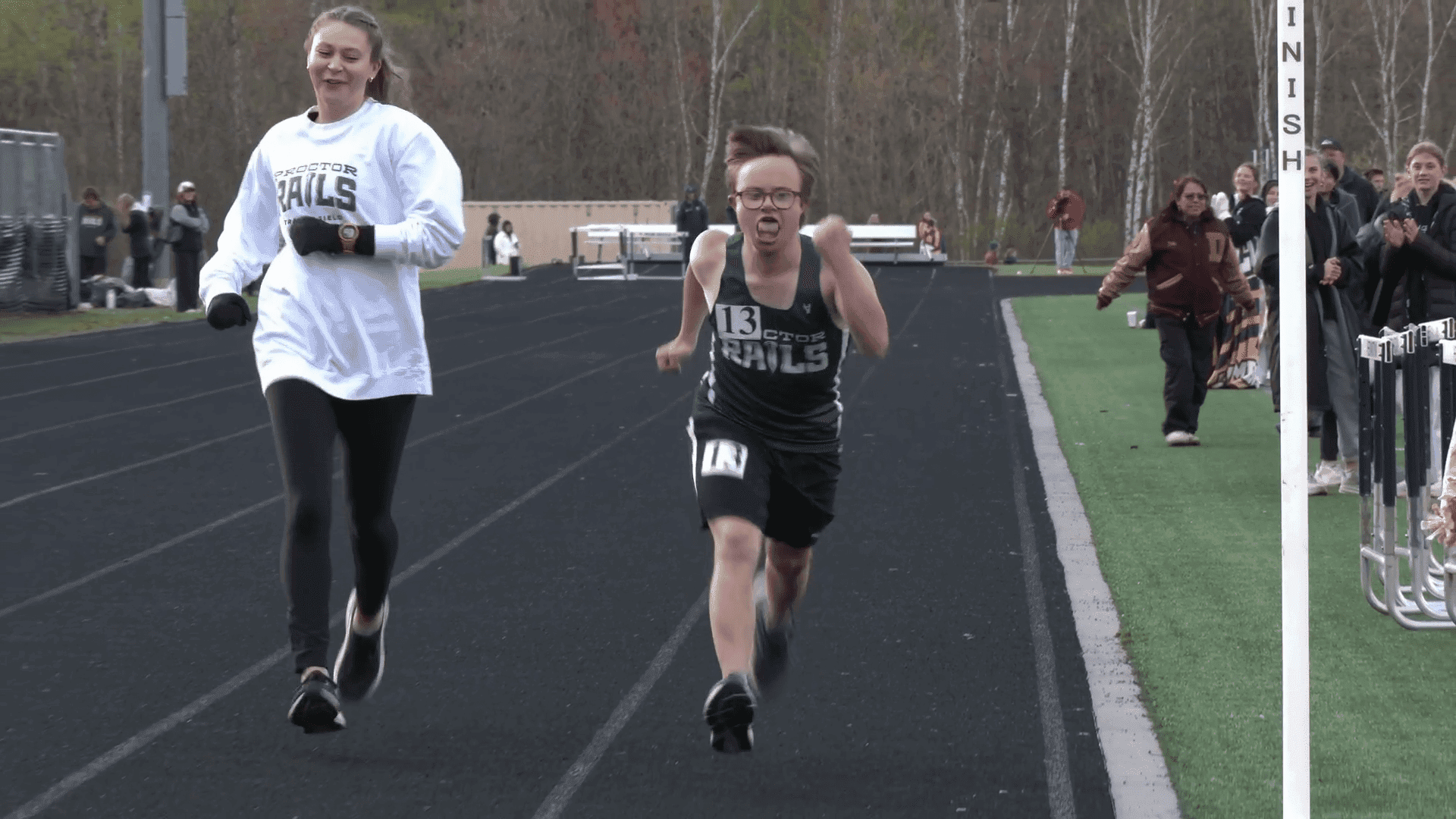
Proctor runner and guide celebrate one more race together
Noah Harnell’s final 800-meter race reunited him with Annika Voss, showing how Proctor’s strongest victories come from trust, support and shared purpose.
One more lap, one more lesson
Noah Harnell’s final 800-meter race brought back the guide runner who helped shape his high school career. Annika Voss returned for one last run beside him, turning a single race into a statement about trust, consistency and what inclusive sports can build over time.
The reunion mattered because it was about more than one finish line. It reflected a partnership that had been built through repetition, adjustment and belief, the kind of work that lets an athlete and guide move as one. In Proctor, where school athletics are woven into daily life, that bond carried weight far beyond the track.
How the partnership worked
Harnell had set a clear goal: run every race without walking. With Voss guiding him, he appears to have kept that promise every time. That is what makes the story resonate in St. Louis County, where so many sports stories are measured in scores and standings, but this one is measured in patience, steadiness and the confidence to keep going.
The original pairing was built on a practical understanding of each other’s rhythms. In a 2021 WDIO feature, Harnell crossed the finish line in a 2400-meter race on November 2, 2021, running the whole way for the first time. Voss said then that he wanted to run every race and not walk, and she had been escorting him in races for the previous two years.
That earlier milestone matters because it shows how the final race was not an isolated emotional moment. It was the latest chapter in a long process of training, communication and mutual adaptation. A guide runner cannot simply appear on race day and make inclusion happen. The partnership depends on practice, trust and the kind of shared discipline that turns ordinary workouts into dependable competition.
Why Annika Voss’s return changed the night
Voss had left Proctor for Columbus, Ohio, where she was working on her second master’s degree at Ohio State University. While she was away, her younger sister Amelia filled in as Harnell’s guide, keeping the race plan intact and the support system steady. That handoff says as much about the family and school network around Harnell as it does about the runner himself.
Then Voss texted Nathan Johnson, Proctor’s head track and field coach, and asked if she could come back for Harnell’s last race. Johnson said yes immediately. That quick answer captured how deeply the school values this kind of continuity, especially when the athlete’s final race carries both competitive and emotional significance.
The race also underscores a broader lesson about inclusive high school sports: access takes structure. It takes people willing to adjust schedules, fill in when needed, and return when it matters most. It takes a coach who understands that one more race may require a different arrangement, but still deserves the full support of the program.
The coaching culture behind the moment
Johnson’s reaction was rooted in a larger coaching philosophy that runs through Proctor athletics. He said the phrase “hard work works” traces back to former Proctor cross-country coach Dick Saarela, a reminder that the school’s culture has long treated effort as a defining value. In this story, that phrase is not a slogan on a wall. It is the logic that made the final race possible.
Johnson himself has coached track, basketball and football for 24 years, and that kind of breadth matters in a smaller school system. Coaches often become the ones who hold together the details, from practice schedules to athlete support to last-minute changes when a guide runner is away at graduate school. At Proctor, that institutional knowledge helps turn a good idea into an operational reality.
There is also a family thread in the program. Lowell Harnell, Noah’s father, is the head boys and girls cross country coach, a 1985 Proctor graduate who has coached the Rails since 1996. His long tenure adds another layer of continuity to a story built on long memory, local relationships and a school community that knows its athletes well.
What Voss brought to Proctor before the final race
Voss’s role at Proctor did not begin with this reunion. The district’s athletics page lists her as assistant boys coach and guide runner, and it notes that she was a former Proctor High School runner who qualified multiple times for state in cross country and track and field. She also competed collegiately at the University of Mary and the College of St. Scholastica.
That background matters because it shows she was not only a helper on the rail. She was an accomplished runner whose own competitive experience made her especially suited to guide another athlete through races that demanded precision. In inclusive sports, expertise like that can be the difference between symbolic participation and genuine athletic opportunity.
The 2021 feature already made clear how natural that role felt to her. She was not describing an abstract service project. She was describing a teammate relationship, one shaped by the same expectations that govern every serious sports program: show up, prepare, and do the work together. That is part of why the final reunion lands with such force. It closes a loop that began years earlier and never depended on publicity to matter.
Why this story belongs to Proctor
Proctor’s broader athletics culture has shown a recurring commitment to belonging. The district has also celebrated a Unified Basketball team advancing to state, another example of how participation is being widened rather than narrowed. Together, these stories suggest a school community that sees sports as more than a scoreboard. It treats them as a place where confidence, access and connection can be built on purpose.
For St. Louis County readers, that is the deeper significance of Harnell and Voss running one more race together. The finish line was important, but the support system behind it was the real story. A coach said yes, a sister stepped in, a former runner returned, and a young athlete got one last chance to race the way he had trained to race from the start.
That is what inclusive high school sports make possible long after the final split is recorded. They create habits of trust, communities that learn how to adapt, and memories that outlast the season. In Proctor, one final 800-meter race became a local lesson in what steady partnership can make real.
This article was produced by Prism’s automated news system from verified source data, official records, and press releases, then run through automated quality and moderation checks before publishing. The system is built and supervised by the people who set the standards it runs under. Read our full AI policy.
Did this article answer your question?