Brookhaven physicist wins Breakthrough Prize in global muon study
William Morse’s Breakthrough Prize honor reached from Santa Monica back to Upton, where Brookhaven’s muon work is tied to jobs, prestige and a family milestone.
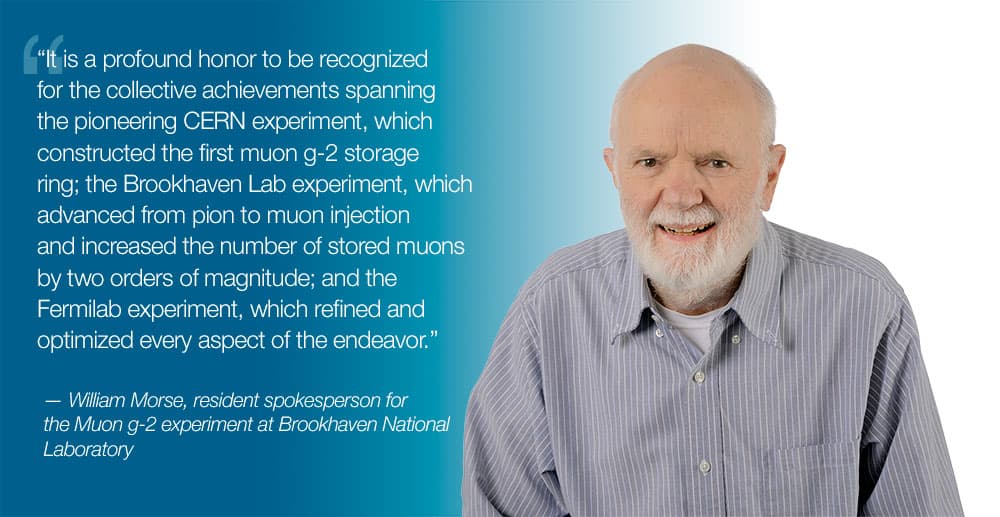
William Morse stood at the center of a global physics project with Suffolk roots when the Muon g-2 collaboration received the 2026 Breakthrough Prize in Fundamental Physics at Barker Hangar in Santa Monica.
Morse, a physicist in Brookhaven National Laboratory’s Electronic Detector Group, was among the living co-authors recognized for work that helped drive one of the most precise measurements ever made of the muon’s anomalous magnetic moment. The $3 million prize is being divided among roughly 400 scientists across the Brookhaven, CERN and Fermilab collaborations, giving each researcher only a small personal share but a place in a result that could point to new particles or other physics beyond the Standard Model.

For Suffolk County, the honor lands closer to home than a typical scientific trophy. Brookhaven in Upton remains one of the East End’s biggest names in research and a major source of national prestige, and Morse’s role shows how a local scientist can sit inside an experiment whose reach stretches from Geneva to Chicago. The prize also reinforces the lab’s standing as a place where federal investment produces jobs, technical expertise and a long-term scientific identity for Long Island.
The recognition carried a family connection as well. Morse attended the ceremony with relatives, and his son, David Morse, was also part of a team that won the same prize in 2025 through the Large Hadron Collider collaborations. That put father and son in a rare position: each tied to a Breakthrough Prize that reflects the scale and longevity of modern particle physics.
Brookhaven’s own history makes the award even more rooted in Suffolk. The lab says its Muon g-2 experiment was built from 1989 to 1996 and collected data from 1997 to 2001, using the Alternating Gradient Synchrotron to generate the muons. Brookhaven said the first analysis, announced in 2001, showed poor agreement between experiment and theory, setting off years of sharper measurements and renewed interest in whether the Standard Model leaves something out.
The collaboration’s story spans more than six decades, beginning with CERN-era work in the 1950s and 1961, moving through Brookhaven, and ending its modern run with a final Fermilab publication in 2025. Brookhaven and the Breakthrough Prize Foundation said the 2026 award honors the living co-authors of those publications and the multi-decade campaign that pushed experimental precision further than before.
Morse and Robert Carey were previously recognized together with the W.K.H. Panofsky Prize in 2022, and Brookhaven said Morse played a crucial role in designing and building the storage ring and in understanding the data. The new prize turns that long arc of work into another public marker of what Brookhaven has contributed from Suffolk County to one of physics’ biggest open questions.
This article was produced by Prism’s automated news system from verified source data, official records, and press releases, then run through automated quality and moderation checks before publishing. The system is built and supervised by the people who set the standards it runs under. Read our full AI policy.
Did this article answer your question?