Reporter questions accuracy of sex labels in Suffolk County crime coverage
Different outlets labeled Beatrix Lacroix differently in a Suffolk County arrest case, raising questions about how police and reporters verify sex in crime stories.
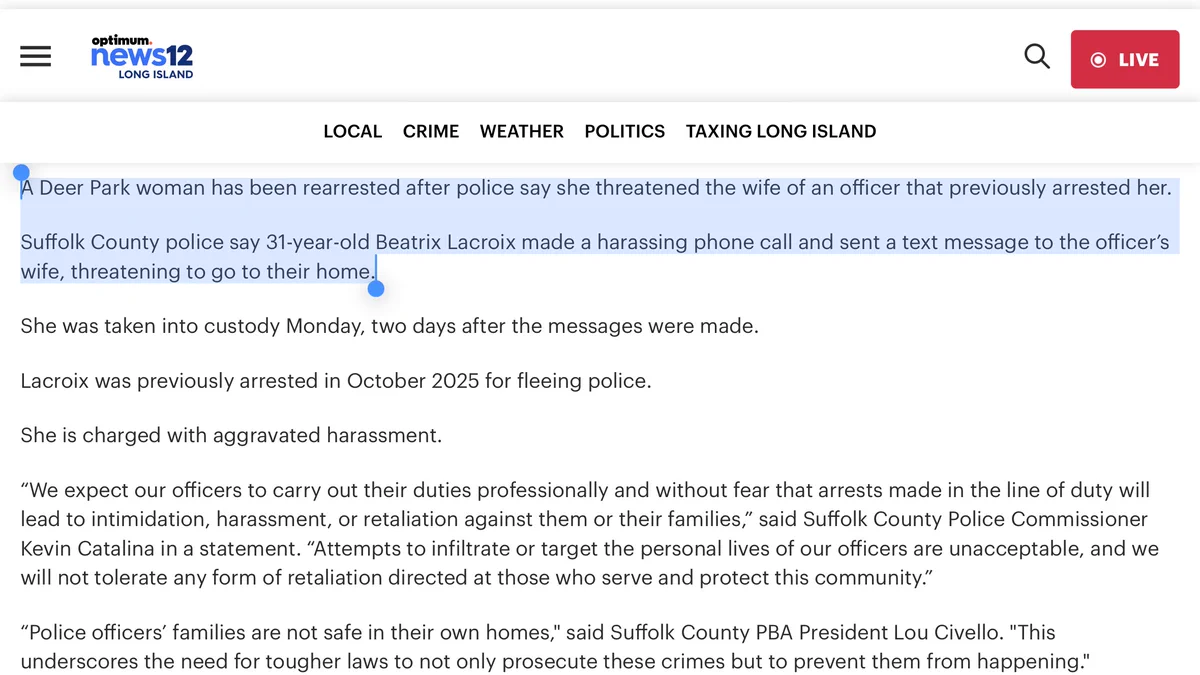
Suffolk County police identified Beatrix Lacroix, 31, as the person accused of making a harassing phone call and sending a text message to an officer’s wife, but local coverage and a later headline described her in different terms.
News 12 Long Island said on May 21, 2026, that Suffolk County police were investigating Lacroix as a woman after police said she threatened to go to the officer’s home. The Suffolk County Police Department’s own release called the case “Woman Arrested for Harassing Officer's Family Member Following ...” and said Lacroix made the harassing call on May 16 to the family member of an officer who had arrested her for fleeing police in October 2025.

That same episode was described differently two days later. The New York Post ran a May 23, 2026, story headlined “Trans woman charged with threatening cop's wife on Long Island, police say,” using a label that did not appear in the police department’s release and was not the wording used by News 12.
The variation matters because even small inconsistencies in identifying an arrestee can shape how readers understand a crime, the people involved, and the reliability of the record. In Suffolk County, where police narratives often anchor fast-moving local crime coverage, a mismatch between a department release and published descriptions can quickly become part of the public account of a case.
The Suffolk County Police Department says its crime statistics data is based on New York State Division of Criminal Justice Services Uniform Crime Reporting guidelines. That standard governs how crime data are compiled, but the recent Lacroix case shows how separate layers of reporting, from police releases to TV coverage and tabloid headlines, can leave residents with different impressions of the same arrest.
The question now is whether the Lacroix case was a one-off labeling mistake or part of a broader data-quality problem in Suffolk County crime coverage. The answer will hinge on how police verify sex and gender details before releasing arrest information, and how quickly corrections move through the system when a published account gets it wrong.
This article was produced by Prism’s automated news system from verified source data, official records, and press releases, then run through automated quality and moderation checks before publishing. The system is built and supervised by the people who set the standards it runs under. Read our full AI policy.
Did this article answer your question?