Riverhead Roundtable Examines Whether SEQRA Hinders Affordable Housing Development
A Riverhead roundtable debated changes to New York’s SEQRA and whether streamlining environmental review would speed affordable housing or erode protections, with local stakes for Suffolk projects.
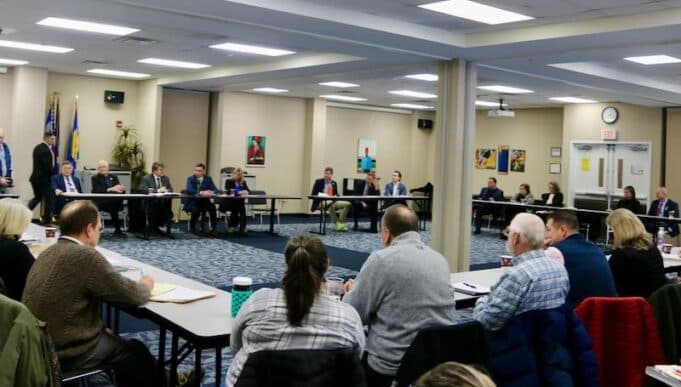
Advocates, local officials and civic groups met in Riverhead to weigh competing visions for reforming New York’s State Environmental Quality Review Act, known as SEQRA. The meeting, convened by State Sen. Anthony Palumbo at Suffolk County Community College on Feb. 2, focused on whether proposed changes would remove red tape for affordable housing or create broad environmental exemptions that could affect Long Island neighborhoods.
Supporters of the governor’s “Let Them Build Agenda” pressed for faster approvals to tackle the statewide housing shortage. Carlina Rivera, president and CEO of the New York State Association for Affordable Housing, said, “The Governor’s proposed ‘Let Them Build Agenda,’ including changes to the State Environmental Quality Review Act (SEQRA) aimed at streamlining approvals for certain housing and infrastructure projects, is both welcome and necessary. NYSAFAH has consistently advocated for reforms that strike the right balance between accelerating the construction of much needed housing and maintaining strong environmental protections. These changes will help remove unnecessary delays, reduce costs, and allow responsible projects to move forward more efficiently, which is critical to addressing New York’s housing shortage at the scale the crisis demands.” Heather Mulligan, president and CEO of the New York State Business Council, added: “New York’s housing shortage is an ongoing economic concern in all regions of New York State. Modernizing environmental review rules, without hindering protections, can cut years of red tape, lower construction costs, and accelerate the delivery of housing that families and workers can afford. Expediting essential investment projects, will support job creation, community growth, and help make New York more competitive.”
Environmental advocates pushed back, warning that vague statutory language could swallow safeguards. “No amount of ‘streamlining’ SEQRA can meaningfully bring those housing costs down. The legislature must engage more on these root causes of unaffordable housing if we are to find lasting solutions. Merely blaming the environmental review process will only ensure that new unaffordable housing comes now with greater environmental impacts,” a Sierra Club statement at the meeting said. The group flagged that a “vague definition of ‘previously disturbed’ could exempt environmental reviews for housing developments in almost any part of the state, in almost any land use context.”
Technical analysts and planners noted practical consequences for subsidized projects. “The very same proposal, with the same environmental impact, receives different treatment based solely on whether public subsidies are involved,” a Media4/Manhattan Institute analysis observed, underscoring that CEQR - New York City’s implementation of SEQRA - is triggered by government role or funding. That differential makes government-subsidized affordable housing more likely to require review than identical market-rate projects, increasing costs and litigation risk.

Speakers used concrete cautionary examples. RUPCO’s Woodstock Commons was cited as delayed roughly a decade and reduced from zoning for 250 units to roughly 20% of that after review and litigation. In Sag Harbor a planned 100% affordable project was blocked on procedural grounds; Village Mayor James Larocca said of the plaintiffs, “It’s not representative of any broad base in this community. These are all people living in million-dollar or more homes. They don’t represent the grassroots segment of our community.”
For Suffolk County residents the debate matters because local affordable projects often depend on public subsidies and discretionary approvals that trigger SEQRA reviews. Lawmakers are now being urged to reconcile the governor’s broad streamlining push with narrower legislative alternatives such as S.3492A, which targets urban, transit-accessible sites and explicitly excludes flood hazards, contaminated soils, critical environmental areas, historic districts and locations without adequate water and sewer capacity. The next steps will be legislative: committee reviews, the release of exact statutory language and, locally, whether Riverhead and other East End projects proceed without the delays critics say have stalled housing elsewhere.
This article was produced by Prism’s automated news system from verified source data, official records, and press releases, then run through automated quality and moderation checks before publishing. The system is built and supervised by the people who set the standards it runs under. Read our full AI policy.
Did this article answer your question?