Suffolk County, Stony Brook Launch Free Boat Inspections to Fight Invasive Species
A $65,750 state grant is sending free watercraft inspectors to up to nine Great South Bay boat launches this season to stop invasive species from spreading in the estuary.
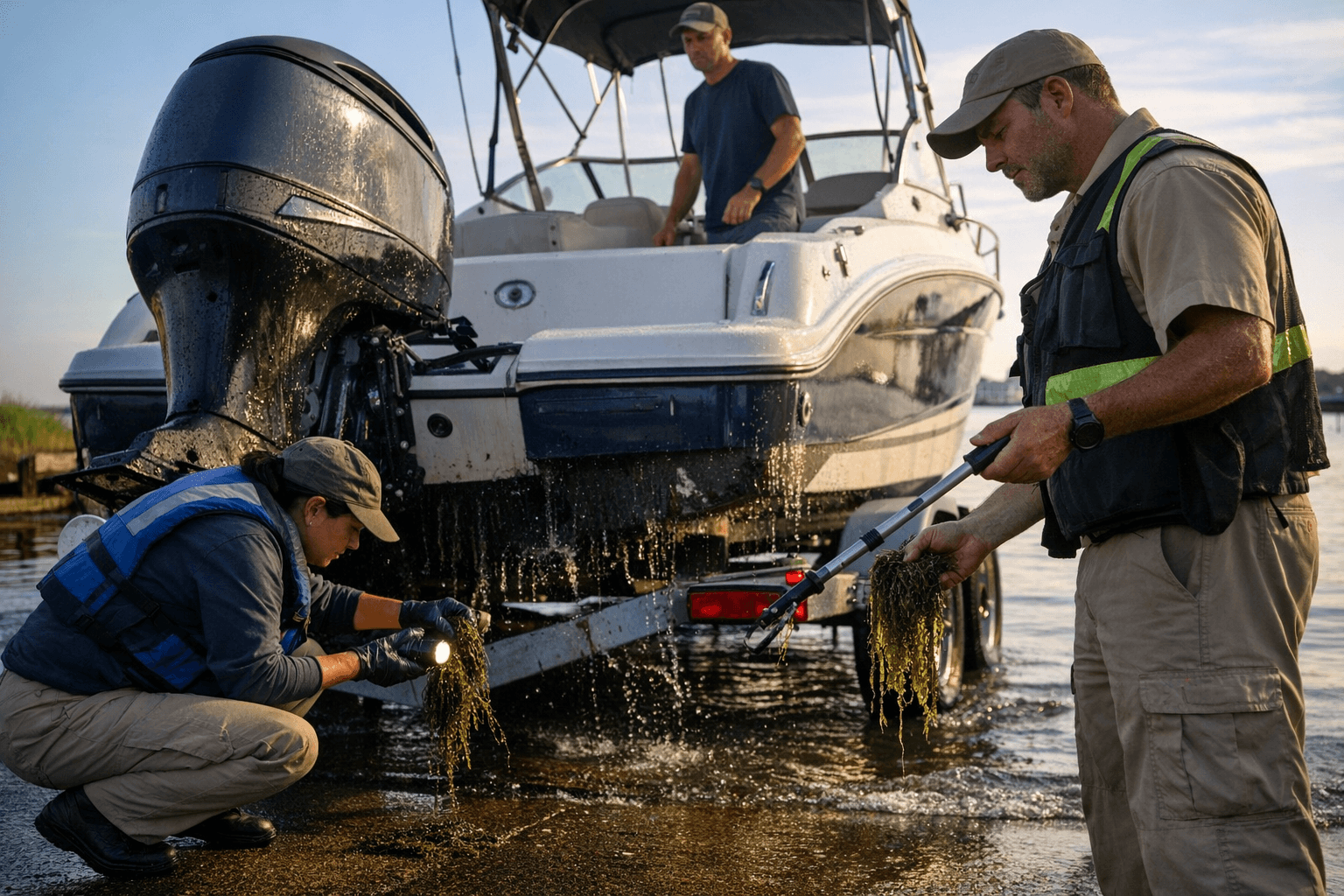
Three years after an invasive red seaweed from Japan first appeared in Great South Bay, it has spread to the point where marine researchers describe it as practically everywhere across the estuary. Now, the first free watercraft inspection stations on the bay have been deployed, with trained stewards positioned at public boat launches to prevent more non-native species from making the same crossing on a trailer hull.
Save the Great South Bay secured $65,750 to staff an AIS outreach, education, and voluntary watercraft inspection program at up to nine high-priority, publicly owned boat launches on the bay. The funding is part of a $5.1 million package announced March 30 by New York State Department of Environmental Conservation Commissioner Amanda Lefton, covering 51 invasive species projects statewide.
Commissioner Lefton said the investment reflects the scale of the challenge: "Managing invasive species and mitigating their negative impacts to our lands and waters is essential to the environment, public health, and quality of life," adding that "investing in science-based management and strong local partnerships is strengthening New York's efforts to combat invasive species, protect biodiversity, build more resilient ecosystems, and protect our forests, waters."
Under the inspection program, stewards check boats for plant fragments, mud, and biological material capable of transporting aquatic invasive species between water bodies, with decontamination equipment on hand for any vessel that arrives carrying hitchhikers. The inspections are voluntary, meaning boaters are not required to stop, though organizers say participation is the critical variable in whether the program succeeds.
The Research Foundation for the State University of New York at Stony Brook received a separate $176,954 grant to integrate automated lake-survey tools that increase detection efficiency and spatial coverage, and to advance control and long-term suppression of AIS through a mathematically informed management framework improving the mechanical and hand harvesting of aquatic invasive plants.
The bay's ecology gives urgency to both efforts. Great South Bay is home to productive hard clam beds and eelgrass meadows. The South Shore Estuary Reserve, the larger estuarine system stretching from Southampton to Nassau County, is home to 1.5 million people and anchors Long Island's tourism, seafood, and recreation industries.
An invasive seaweed from Japan first detected in Great South Bay three years ago has spread to the point of being described as "everywhere" by a marine researcher, with Dr. Christopher Gobler of Stony Brook's School of Marine and Atmospheric Sciences identifying the species.
What the grant announcement left unspecified: how many boats the inspection stations aim to screen this season, and by what benchmark officials will determine whether the program has meaningfully reduced new invasive introductions into the bay. Those metrics will matter as the state weighs further investment. Governor Hochul's 2026-27 executive budget proposed a record $425 million for the Environmental Protection Fund, the account that finances grants like these.
This article was produced by Prism’s automated news system from verified source data, official records, and press releases, then run through automated quality and moderation checks before publishing. The system is built and supervised by the people who set the standards it runs under. Read our full AI policy.
Did this article answer your question?