Rand Plaintiffs Seek Recusal of Four NH Supreme Court Justices in Education Funding Case
Plaintiffs in the Rand school funding case asked four of five NH Supreme Court justices to step aside, citing their prior roles defending the state in related litigation.

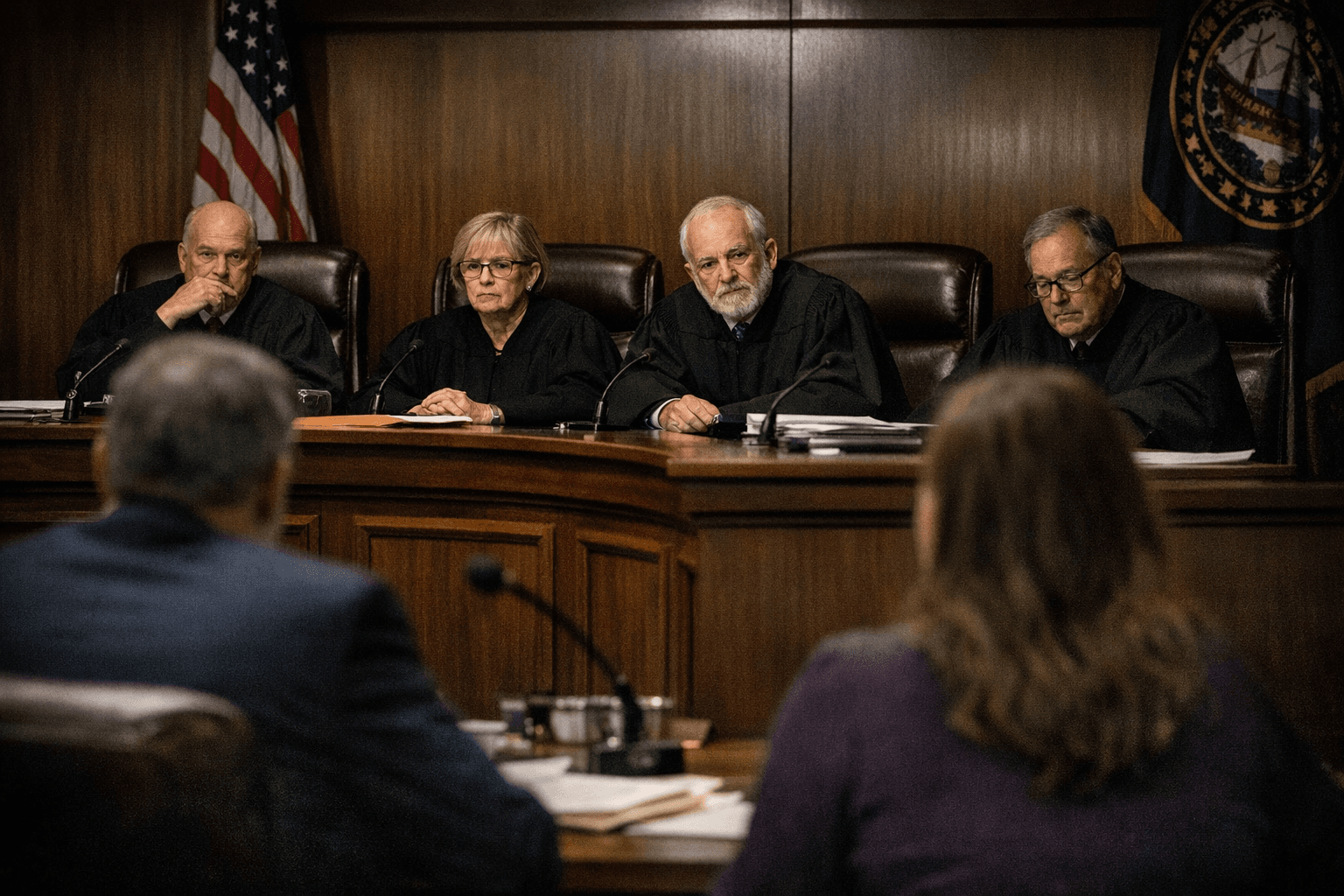
Attorneys representing the plaintiffs in the Rand education-funding lawsuit filed motions March 16 asking four of the five New Hampshire Supreme Court justices to recuse themselves from the state's appeal, arguing their prior legal careers create an irreparable appearance of partiality in one of the most consequential school-funding cases in the state's history.
The recusal requests target Chief Justice Gordon MacDonald, Associate Justice Bryan Gould, Senior Associate Justice Patrick Donovan, and Associate Justice Daniel Will. Only Associate Justice Melissa B. Countway was not asked to step aside.
The case, Steven Rand, et al. v. The State of New Hampshire, docketed as Case No. 2024-0138, reaches the Supreme Court after Rockingham County Superior Court Judge David Ruoff determined the state has failed to meet its constitutional obligation to fund adequate education and special education services. Ruoff found the state instead shifts that burden onto local property taxpayers, a practice the plaintiffs argue is unconstitutional because tax rates vary widely across municipalities while the state constitution requires proportional and reasonable state taxes.
Plaintiffs' attorneys John Tobin, Andru Volinsky, and Natalie Laflamme argued in their motions that MacDonald and Will are disqualified because of their service in a closely related 2021 case known as ConVal. MacDonald served as attorney general from 2017 to 2021 and, according to the attorneys, "directly or indirectly" had a hand in fashioning the state's defense in that litigation. Will, serving as solicitor general, went further: he argued before the court in ConVal, which required the state to defend the constitutionality of the current education funding structure.
Donovan's conflict, the attorneys contend, runs deeper still. A motion filed in the case argues that Donovan "must recuse himself from all proceedings in the Rand case to avoid the appearance of partiality that results from his having litigated the opposing side of most of the issues raised by the Rand plaintiffs for a period of over ten years, first as an assistant attorney general and then as an attorney in private practice." That prior work included defending the state in Claremont II in 1997, a case that raised the same core question now before the court: whether relying solely on local property taxes to fund education is unconstitutional.
The attorneys grounded their motions in New Hampshire Supreme Court Rules 21-A and 38, Canon 2, Rule 2.11, which require disqualification "whenever the judge's impartiality might reasonably be questioned, regardless of whether any of the specific provisions of paragraphs (A)(1) through (6) apply."
Beyond individual disqualification, the plaintiffs asked the court to convene a panel of lower-court judges to decide the recusal questions rather than allowing the justices to rule on their own fitness to sit. "Ineffective recusal practices and procedures effectively allow for self-policing by members of the New Hampshire Supreme Court and self-policing will diminish the Court's public standing," the attorneys wrote. They further argued that the current procedure violates both the state and federal constitutions by denying parties due process and an impartial tribunal.
The stakes extend well beyond the recusal motions themselves. The Department of Justice has indicated it plans to ask the justices to overturn a pair of landmark 1990s Claremont rulings that established the state's constitutional duty to fund public education, along with three decades of decisions built on those precedents. The plaintiffs also seek MacDonald's recusal from a separate pending appeal brought by the Coalition Communities, a group representing 26 property-rich municipalities that the plaintiffs allege retain statewide education property tax revenue exceeding their actual costs of adequate education, producing disproportionate tax burdens elsewhere in the state.
A ruling affirming or reversing Judge Ruoff's decision could fundamentally reshape how New Hampshire funds its public schools.
This article was produced by Prism’s automated news system from verified source data, official records, and press releases, then run through automated quality and moderation checks before publishing. The system is built and supervised by the people who set the standards it runs under. Read our full AI policy.
Did this article answer your question?