Saint-Gaudens Park in Cornish preserves art, history, and gardens
Saint-Gaudens brings art, gardens, and steady visitor spending to Cornish, with park visitors generating $7.3 million in nearby communities in 2024.

A Cornish landmark with real local payoff
The busiest days at Saint-Gaudens National Historical Park do more than fill a scenic hillside in Cornish. They send visitors toward Sullivan County shops, restaurants, and lodging, and in 2024 park visitors to Saint-Gaudens and Marsh-Billings-Rockefeller National Historical Park spent $7.3 million in nearby communities. That kind of spending is one reason the park matters far beyond its gates: it is a cultural site, yes, but also a working tourism asset that helps shape how outsiders experience the county.
Saint-Gaudens is one of the clearest examples of a place that local people can use, not just admire. It offers a low-cost day trip that combines gardens, walking paths, historic buildings, and art history in one stop. For families, schools, and anyone looking for an outing that feels quieter than a crowded recreation area, the park gives Cornish a rare blend of public access and national significance.
Why the site matters now
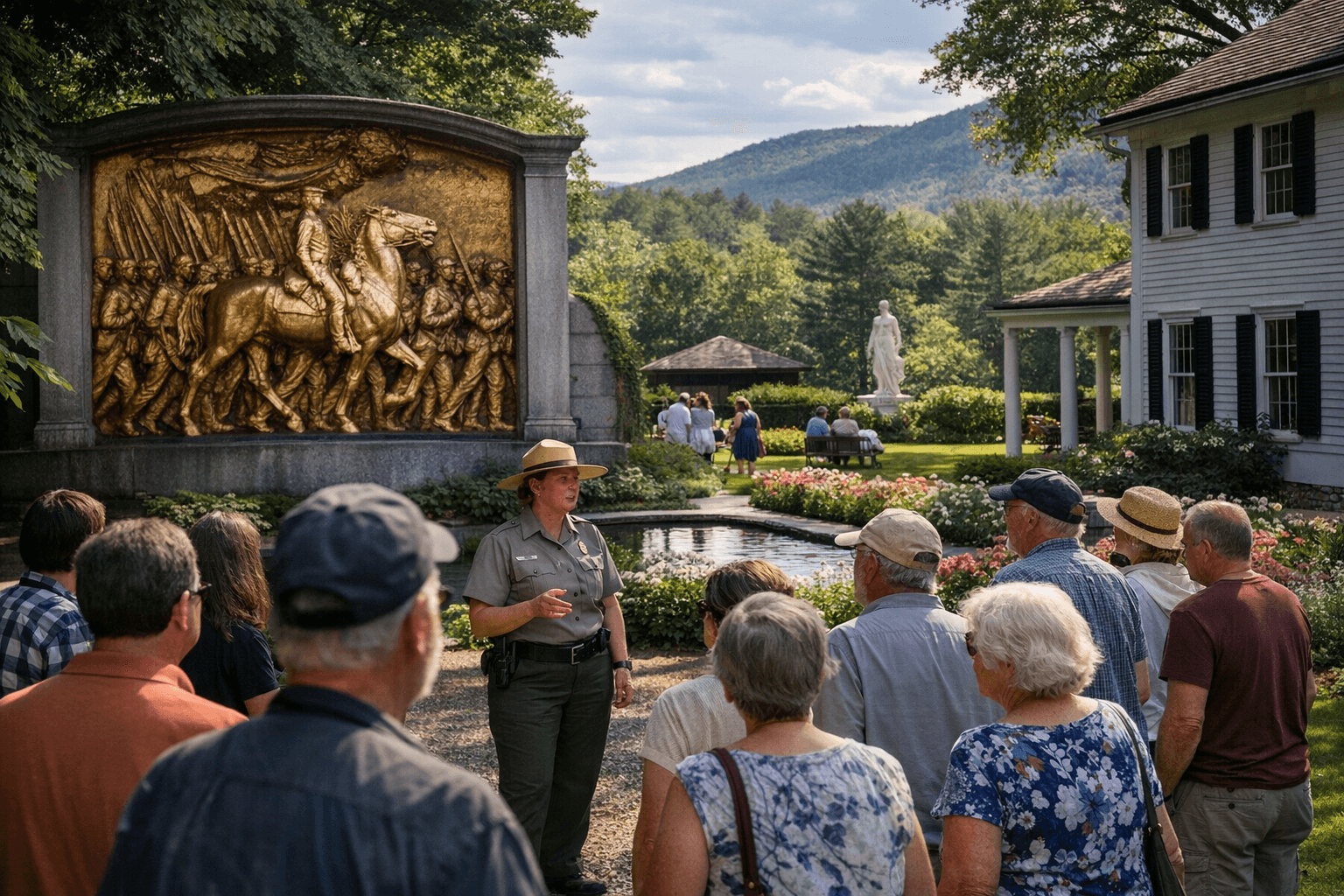
The National Park Service describes Augustus Saint-Gaudens as America’s foremost sculptor of the Gilded Age, and the park preserves the home, studios, and gardens tied to his life and work. Saint-Gaudens, born March 1, 1848, and who died August 3, 1907, created more than 150 works of art, from cameos to major public monuments. Among the best known are the Standing Lincoln, the Shaw Memorial, and the 1907 Twenty-Dollar Gold Piece design, which the National Park Service says is considered America’s most beautiful coin.
That national reputation gives Sullivan County something most rural places do not have: a landmark that draws visitors for art, but keeps them here long enough to notice the region itself. The park’s setting, in a small Upper Valley town, turns a major American sculptor’s legacy into an on-the-ground experience rather than a museum display tucked away in a city.
What you can actually do there
For a day trip, the park works because it is both structured and flexible. Its trails and grounds are open year-round during daylight hours, so even outside the main season you can walk the property and take in the landscape. The visitor center and core buildings are generally open Thursday through Monday from Memorial Day weekend through October 31, and Aspet, the historic home, opens on select hours as staffing allows.
That makes Saint-Gaudens especially useful for local residents who want a repeatable outing close to home. A visit can be as simple as a peaceful walk through the gardens, or as full as a ranger-led program, an art activity, and a deeper look at how sculpture, landscape design, and American public memory fit together. The park says it offers a peaceful walk through the gardens, an art activity with a ranger, and a tour through American history.
A practical guide to planning a visit
If you want the easiest experience, plan around the open season when the visitor center and main buildings are available Thursday through Monday. The grounds are still open outside that window, but the fuller experience comes when the interpretive spaces and historic interiors are accessible. Because Aspet is open only when staffing allows, it pays to treat the house as a bonus rather than the only reason to go.
- a short family outing that does not require a long drive
- a school or homeschool lesson on American history and public art
- a quiet afternoon when you want a walk with a cultural destination at the end
- a shoulder-season visit when gardens, paths, and buildings are less crowded than peak summer weekends
The park is also a strong choice for:
How Saint-Gaudens became a Cornish story
Saint-Gaudens first came to Cornish in the summer of 1885 after his friend and attorney Charles Beaman encouraged him to work there on his Abraham Lincoln monument. Beaman told him the region had “many Lincoln-shaped men” for models, a line that captures both the humor of the moment and the practical way the place entered American art history. The Standing Lincoln became the first monument Saint-Gaudens completed in Cornish, and that work linked a small New Hampshire town to one of the most important public sculptures in the country.
The park also preserves the story of the Cornish Colony, a flourishing late-19th- and early-20th-century arts community that grew around Saint-Gaudens. The colony included painters, sculptors, writers, playwrights, poets, actors, essayists, landscape designers, and patrons. The National Park Service identifies Augustus and Augusta Saint-Gaudens as central figures, alongside Louis St. Gaudens, Annetta Johnson Saint-Gaudens, Stephen Parrish, Maxfield Parrish, Kenyon Cox, Percy MacKaye, and Charles Platt.
That matters locally because it frames Cornish not just as a scenic town, but as a place that once attracted a serious creative network. The park’s own materials say it continues that tradition, and for Sullivan County that means one of the region’s strongest heritage stories is still visible on the ground.
Why preservation is part of the value
The site’s longevity is not accidental. The estate was declared a National Historic Landmark in 1962, and Congress authorized Saint-Gaudens National Historical Park in 1964. The Saint-Gaudens Memorial, established by Augusta Saint-Gaudens in 1919, opened the home to the public as a museum in 1927 after her death in 1926. In 1964, the memorial donated the property and many furnishings to the National Park Service, which has preserved, protected, and interpreted the site since then.
That history explains why the park feels so intact today. It is not simply a preserved house with a few objects on display. The park’s museum collection contains more than 60,000 items related to Saint-Gaudens and the Cornish Colony, which gives curators and interpreters a deep bench of material to draw from. Preservation here is not abstract either: it supports the structures, the landscape, the art, and the visitor experience that keep the site relevant for today’s audience.
The National Park Service also says it keeps 80% of the fees collected at the park to support visitor services and deferred maintenance projects, a reminder that the site’s upkeep depends on steady management as much as on its history. For local people, that means the park’s condition is part of its economic and cultural value.
A living venue, not a static museum
Saint-Gaudens still functions as an active cultural place. Its annual summer concert series has been held on the grounds since 1946, and the tradition connects directly to Saint-Gaudens himself, who hosted concerts in his studio for family and friends. Some performances use the Little Studio’s historic piano, once owned by Cornish Colony painter Maxfield Parrish, adding another layer of local texture to an already distinctive venue.
The park also continues to host ranger-led tours, exhibitions, and special programming such as Sculptural Visions, which connect Saint-Gaudens’s legacy to broader conversations about sculpture and public memory. That blend of art, landscape, and programming is what keeps the park from becoming a static relic. It remains a place where Sullivan County can point to a nationally significant story and also show how that story still brings people, energy, and spending into Cornish today.
For a county looking for durable visitor assets, Saint-Gaudens is unusually strong. It is beautiful, but beauty is not the whole case. It is open, educational, economically useful, and tied to a story that reaches from Cornish to Chicago, Boston, and Washington, DC. That makes it one of Sullivan County’s most practical cultural landmarks, and one of the clearest ways the county turns heritage into everyday value.
This article was produced by Prism’s automated news system from verified source data, official records, and press releases, then run through automated quality and moderation checks before publishing. The system is built and supervised by the people who set the standards it runs under. Read our full AI policy.
Did this article answer your question?