Resident Urges Police to Protect Banksy Artworks on Park City's Main Street
A Park City resident called police to protect Banksy works on Main Street, where pieces that could fetch millions at auction sit without a formal security plan.
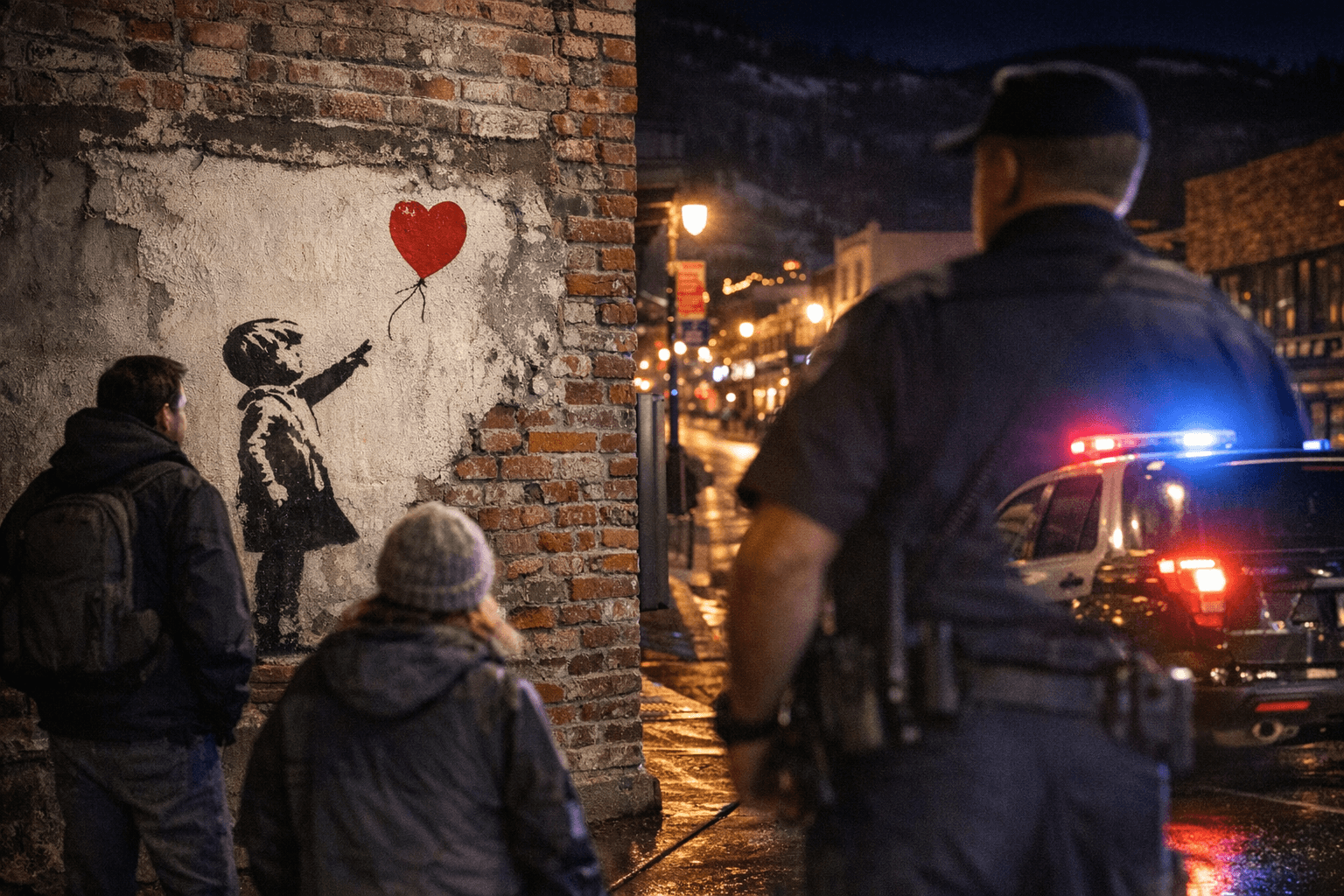
A Banksy original sold for nearly $5 million at auction in 2024. The ones on Park City's Main Street have no formal security plan.
That gap prompted a resident to contact the Park City Police Department, urging officers to take proactive steps to protect the handful of works the anonymous British artist created here during the 2010 Sundance Film Festival. The outreach, which carried no allegation of an imminent criminal threat, framed preservation of the pieces as a matter of civic interest: tourism, public safety, and downtown heritage.
The works include a rat in the covered breezeway on the north side of the Egyptian Theatre connecting Main Street to Swede Alley, a praying boy at 537 Main, a Camera Man and Flower painting, and an angel boy. All four date to Banksy's visit for the premiere of his documentary "Exit Through the Gift Shop" and have drawn visitors to the corridor ever since.
Their market value creates a concrete criminal incentive. Banksy originals fetched as much as $4.7 million at auction last year, and a stolen Banksy sign in another city was valued at $500,000 on the open market before police recovered it. Extracting a work from a wall is a method that has been attempted on Banksy pieces in other cities, and Park City's pieces carry their own history of attack. A previous incident cracked the glass protecting the Camera Man and Flower work; during the same episode, the Praying Boy was nearly obliterated. The Praying Boy has since been fitted with plexiglass, but protections across the remaining pieces vary.
The ownership question complicates what police can actually do. Street art applied to a private building typically belongs to the property owner under U.S. law, not to the artist and not to the city. Officers cannot unilaterally place surveillance equipment on private property or install physical barriers without owner consent. Their available tools are patrol presence, community awareness, and responding to reported tampering.
"The Banksy has done a lot for Park City," said Claire Wiley of the Arts Council of Park City and Summit County, noting that the city and county together host more than 100 public art pieces and that Banksy's profile routinely introduces visitors to the broader collection. Randy Barton, director of the Egyptian Theatre and the first caretaker of the Dirty Rat, has described the works as part of what makes Park City a "small town that has world-class art."
That cultural draw has made the pieces inseparable from Main Street's identity as a visitor destination. Recent reporting identifying Banksy as Robin Gunningham, a Bristol-born man whose attorney disputed parts of the claim, brought a fresh wave of attention to the Park City pieces and implicitly told a wider audience exactly where the art lives. More visibility drives foot traffic and reinforces the works' legitimacy; it also lowers the threshold for anyone who knows what they are worth.
The most practical near-term actions are likely to involve the Police Department engaging directly with adjacent property owners about surveillance options and coordinating with community members who walk the corridor daily. Residents who observe scraping, drilling, or any unusual activity near the Main Street pieces should call the Park City Police Department's non-emergency line immediately, before damage becomes irreversible.
This article was produced by Prism’s automated news system from verified source data, official records, and press releases, then run through automated quality and moderation checks before publishing. The system is built and supervised by the people who set the standards it runs under. Read our full AI policy.
Did this article answer your question?