Self-Help Homes Expands Sweat Equity Program to Address Wasatch County Housing Shortage
A federal loan-limit cut threatens to shrink Self-Help Homes' Utah output from 150 homes a year to as few as 20, even as 44 new units take shape in Heber City.

Phelps built his Heber City home in 2013 with his own hands, qualifying for the program on roughly $25,000 a year. Today he supervises construction crews for the same nonprofit that housed him, watching the income floor that once let him in nearly triple under the pressure of inflation, rising land prices, and a housing market that has made homeownership in Heber City effectively inaccessible without, as he puts it, "very wealthy" parents.
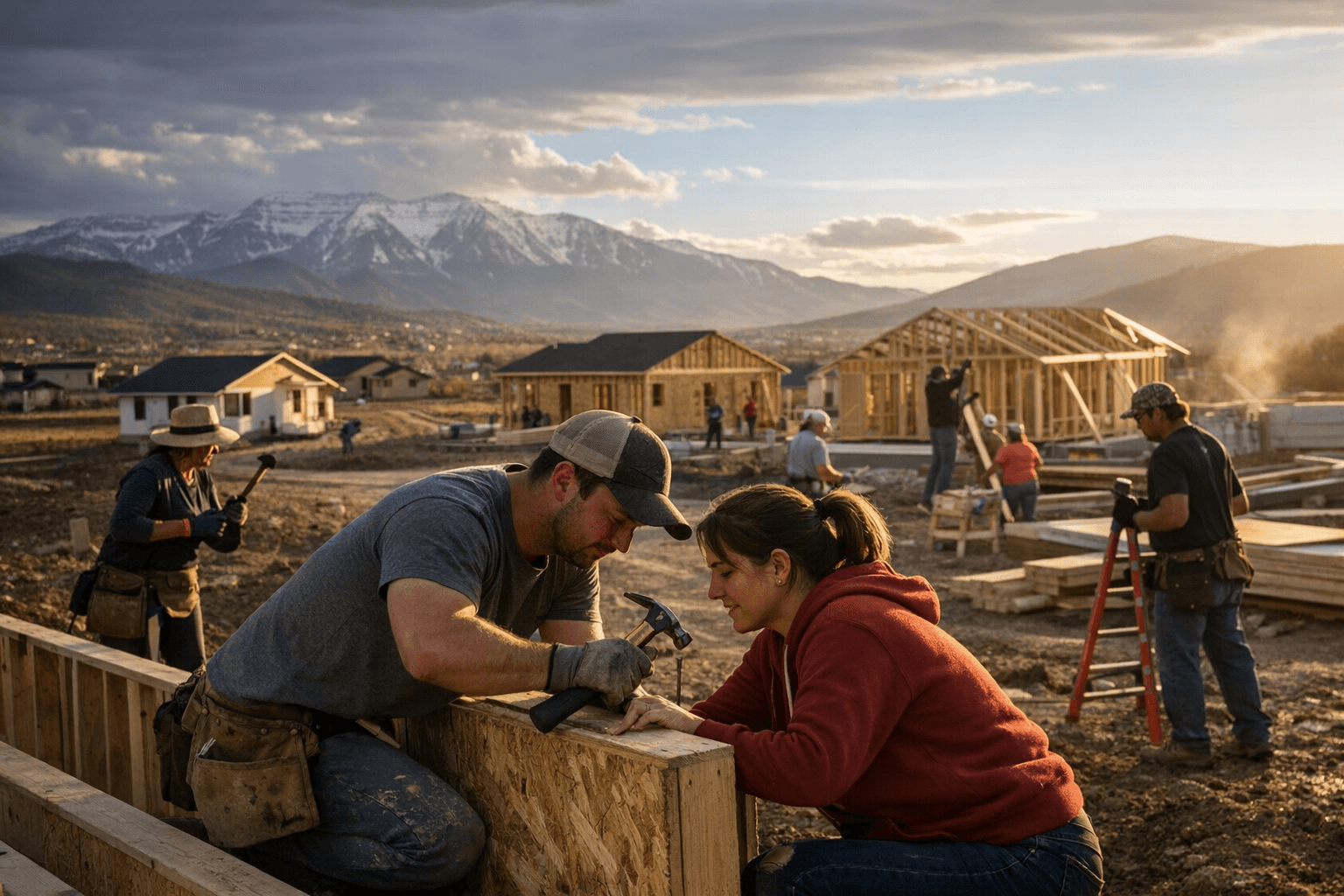
That nonprofit, Self-Help Homes, is now pushing its largest Wasatch County expansion yet: 44 homes planned for approximately 17 acres adjacent to the Wasatch County Events Complex, a development the organization calls Wasatch Vista. Another 12 homes are set to begin construction in the coming months, adding to the 143 the group has built in Heber City since launching its Mutual Self-Help Housing program there in June 2010.
The model is deliberately labor-intensive. Qualifying families build their own homes alongside fellow participants, contributing at least 65 to 70 percent of the labor and logging a minimum of 35 hours per week on-site. No construction experience is required, and no one moves in until every home in the group is finished. The typical unit runs 1,500 square feet with three bedrooms and two bathrooms. Financing comes through USDA Section 502 rural housing loans, which subsidize interest rates as low as 1 percent, available to households earning no more than 80 percent of area median income. Self-Help Homes estimates families save an average of $70,000 compared to market-rate construction, primarily because there is no general contractor fee.
Recent Heber City participants include Paulina, who works at an appliance repair company, and her husband Jessie, who is legally blind, as well as Quaid and Kaitlin Larson. Executive Director Brad Bishop, who has led the organization for more than 22 years, describes participants as representing "a lot of the workforce in every city," including teachers, school workers, public employees, managers, and self-employed individuals who cannot compete in the open market but earn too much for conventional low-income assistance.
That workforce angle carries particular weight along the Wasatch Back, where Summit County employers have long struggled with employee retention driven by regional housing costs. Self-Help Homes was originally created as a nonprofit arm of the Housing Authority of Utah County specifically to address affordable housing in rural Summit, Utah, and Wasatch Counties.
The program now faces a significant federal obstacle. On February 10, USDA Rural Development reduced the Section 502 loan cap from 80 percent to 60 percent of the FHA mortgage limit for a given area, a change made through a handbook update rather than an act of Congress. In Wasatch County, the new ceiling of $698,200 still clears the typical Self-Help Home price of $420,000 to $430,000, leaving Heber City's pipeline intact for now. In Utah County, however, the new limit falls to $360,800, and in Washington County to $364,300, thresholds that effectively shut the program out of those markets.
Bishop warns that if the limits are not reversed, Self-Help Homes' statewide annual output could collapse from roughly 150 homes to between 20 and 40. He is urging supporters to contact Utah's congressional delegation. Because the change came through administrative policy rather than legislation, Congress has the authority to pressure a reversal without passing new law.
Statewide, Self-Help Homes has built more than 650 homes since 2000. The question now is whether the 44 homes taking shape near the Wasatch County Events Complex represent a new chapter for the region, or one of the program's last large-scale efforts before federal funding constraints force a dramatic contraction.
This article was produced by Prism’s automated news system from verified source data, official records, and press releases, then run through automated quality and moderation checks before publishing. The system is built and supervised by the people who set the standards it runs under. Read our full AI policy.
Did this article answer your question?