Summit County Jail uses work programs to feed, rehabilitate inmates
Jess is up before dawn in the Summit County Jail kitchen, where inmate labor now feeds seniors and tests whether work inside custody changes behavior or just lowers costs.
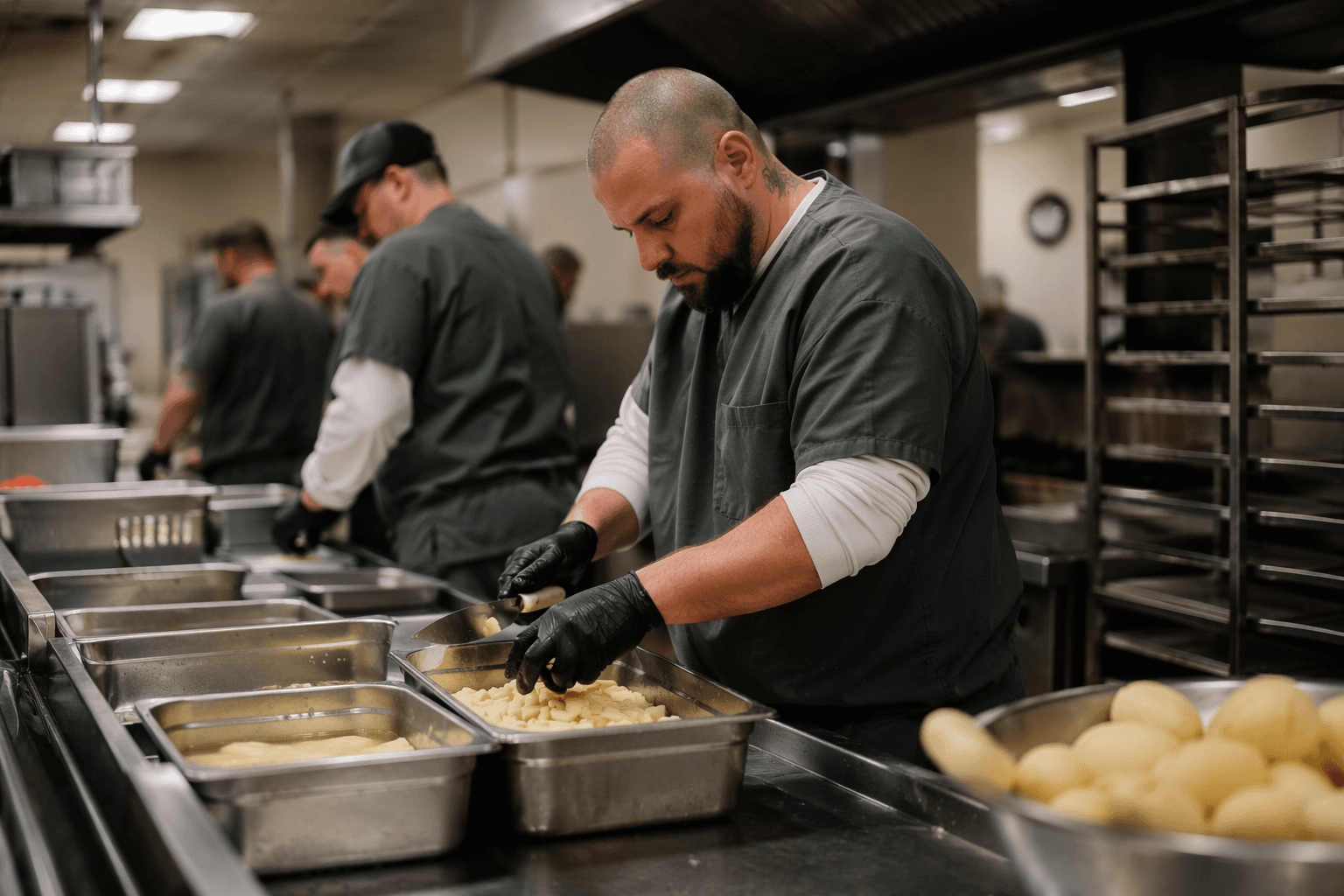
Jess starts his shift at 4:30 a.m., moving between trays, dishes and the day’s menu in a kitchen that does more than feed the jail. The same space now helps send Meals on Wheels meals out to older residents across the Wasatch Back, putting Summit County’s inmate work program at the center of a bigger question: is this a real accountability tool for convicted inmates, or a practical way to run the jail more cheaply?
What the jail work actually looks like
Inside the Summit County Jail, the work is ordinary on purpose. Jess and three other inmates help prep trays, unload dishes and keep the kitchen moving under Sherry Mecham, who is listed in public payroll records as the kitchen manager and has worked for the Summit County Sheriff’s Office since 2014. The job is not limited to meal service. Incarcerated people can also tend the garden on the north side of the jail, wash county vehicles and help with other county projects.
That garden has its own identity. It specializes in pumpkins, which says as much about the scale of the program as any policy memo does. A 2022 Park Record article said inmates had sole responsibility for maintaining the garden grounds, and it also noted that the program had already shaped what kitchen staff wanted inmates to grow, showing this was not a one-off experiment but a routine part of jail operations.
Who is doing the work
The jail mostly houses people awaiting trial, but it also holds about 45 people convicted of crimes. Those convicted inmates are in county custody through contracts with the Utah Department of Corrections, which gives them access to programming and work assignments instead of sending them immediately to state prison. In practical terms, that means Summit County is operating as part of a larger state correctional system, not apart from it.
The scale is not small. The Utah Department of Corrections says about 25 percent of Utah state inmates are housed in county jail facilities through its Inmate Placement Program. Statewide, Utah has roughly 6,000 to 6,500 state inmates in correctional facilities, so county jail contracts are a meaningful part of how the state manages incarceration, overcrowding and placement decisions. That makes the Summit County Jail kitchen and garden more than local conveniences; they are small pieces of a statewide custody strategy.
Why state officials use county jails
The department says county jail contracts help prevent overcrowding and maintain safe staff-to-inmate ratios. It also points to another reason that matters in a place like Summit County: keeping some incarcerated people closer to family and community ties while they serve time. For inmates who are still eligible for programming and work, that can mean more than convenience. It can shape whether they come out with habits that are useful outside jail walls.
That is where the public-value test gets sharper. The work program may lower idle time and give jail staff a more manageable operation, but the real question is whether it improves reentry, reduces disciplinary problems or produces a measurable cost benefit for taxpayers. The county’s case rests on the idea that structure and responsibility are themselves part of accountability, not a substitute for it.
Meals on Wheels turns jail labor into public service
The kitchen’s newest outside role began in early September 2025, when Summit County Jail started sending meals to Meals on Wheels recipients in the Wasatch Back. KPCW reported that the first meals were scheduled to go out Sept. 4, with the Mountainland Association of Governments paying for both the meals and deliveries. The voluntary donation requested for each meal is $4.
That arrangement gives the kitchen a visible community function. It ties inmate labor to older residents who rely on delivered meals, and it gives the county a way to point to work that is not just internal maintenance. But it also raises the hard-nosed question readers will ask: if the jail can produce meals for seniors and handle its own kitchen labor at the same time, how much of the system is about rehabilitation, and how much is simply about stretching public dollars farther?
A long-running county model, not a new idea
Summit County has used jail programming as a correctional tool for years. A 2017 Park Record story said classes at the jail covered parenting, anger management, gardening, religion and other topics, and that some of those programs were available only to state inmates serving longer sentences. That earlier mix of classes and work shows the county has long treated incarceration as a place where routine, discipline and skills training can overlap.
The garden story from 2022 also helps explain why the work program took root. Inmates already had responsibility for the grounds, and kitchen staff were taking cues from that system when they suggested what to grow. The pumpkin patch and the meal trays look unglamorous, but they are part of a deliberate structure that asks incarcerated people to contribute to the jail’s daily life instead of simply waiting out their sentences.
What the county is really betting on
Sherry Mecham’s kitchen operation is a good example of the county’s broader wager. If inmates can be trusted to cook, clean, garden and support county services, the jail gains labor, but it also gains a daily framework for behavior. That framework is what county and state officials point to when they talk about accountability, family ties and safer staffing.
The sharper debate is whether those benefits are enough to justify the program on public terms. In Summit County, the answer is not hidden in slogans about rehabilitation. It is in the numbers, the staffing patterns, the inmate assignments and the meals leaving the jail kitchen for people who are not incarcerated at all.
This article was produced by Prism’s automated news system from verified source data, official records, and press releases, then run through automated quality and moderation checks before publishing. The system is built and supervised by the people who set the standards it runs under. Read our full AI policy.
Did this article answer your question?