Guymon calendars centralize city meetings, school events and community gatherings
Guymon’s calendars do more than list events: they put council meetings, school dates and civic gatherings in one place residents can actually use.
Guymon’s public calendar is becoming a civic access point
Guymon’s most useful public-service pages are not flashy. They are practical tools that put city meetings, school dates and community gatherings in one place, so residents do not have to chase down notices across social media pages, flyers and separate agency websites.

That matters in Texas County, where people plan around long drives, work shifts and family obligations. A single calendar does not solve every information gap, but it does give the town a shared starting point for knowing when decisions are being made and when the community is gathering.
What the city calendar reliably shows
The City of Guymon’s events calendar pulls together a steady stream of civic and community items for 2026, including Pioneer Days, the Rotary BBQ, the carnival, PRCA rodeo performances, the parade, the tractor pull and Cowboy Church. The listings make it easier to see how public life in town is stacked across government, school and celebration, instead of scattered across separate notices.
The city council schedule is especially clear. Council meetings are set for 6:00 p.m. on the second Tuesday of each month at City Council Chambers, 424 N Main Street, and the posted 2026 schedule runs from January 13 through December 8. That kind of fixed pattern gives residents a dependable date to work around, whether they are following a zoning issue, a city service question or a broader policy discussion.
The public also has a direct path into that process. The council page says residents are invited to participate and provides a Citizen Comment Form for agenda and non-agenda items before meetings. In practice, that turns the calendar from a passive listing into an access tool: it tells you when officials meet, where they meet and how to get on the record.
Why the chamber page matters too
The Guymon Chamber of Commerce’s news-and-events page works as a broader community bulletin board. The chamber describes itself as an independent, not-for-profit organization that advocates for businesses in and around Guymon, and its calendar shows that role in real time. Alongside chamber activities and networking events, it lists public meetings and local seasonal events that shape the town’s routine.
Residents can find Texas County Commissioner meetings, hospital board meetings, school board meetings, airport board meetings and city council meetings there, along with Board of Adjustment and Planning & Zoning meetings, Fair Board meetings, Parks Board meetings, Convention & Tourism Board meetings and Chamber Board meetings. It also includes community items such as Pioneer Days, the 5-State Run, Mayhem Monster Trucks and No Man’s Land Historical Society meetings.
That mix is useful because it shows where power, planning and public life overlap. If the city calendar tells you when to show up downtown, the chamber page helps you track the rest of the local machinery, from county decisions to civic events that draw the county together.
A few quick things stand out for anyone trying to keep up:
- city council and board meetings are visible without digging through scattered notices
- community events are listed beside government sessions, which helps show what is affecting the week ahead
- the chamber also invites users to sign up for e-Blast updates, which can help keep the calendar from going stale between visits
School calendars are part of the same system
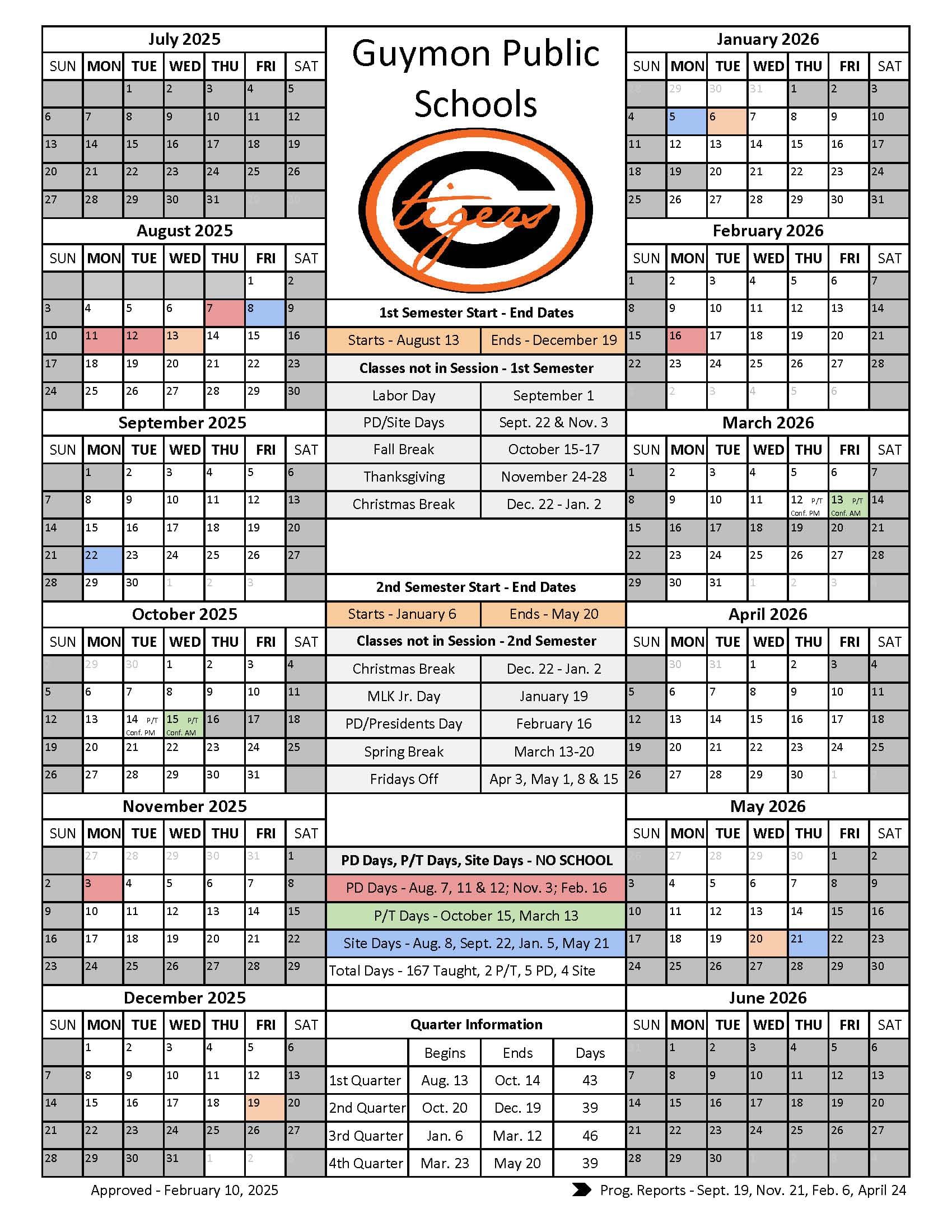
Guymon Public Schools keeps its own district calendars for the 2025-26 and 2026-27 school years, which is another reminder that no single page catches everything. Families tracking class schedules, breaks and school activities still need the district’s own calendar, even if the city and chamber pages cover much of the public schedule around it.
That separation is a strength and a limitation at the same time. It gives each institution control over its own schedule, but it also means residents have to know where to look, especially when school life, city government and business events all compete for attention in the same town.
Why centralization matters in Guymon
Guymon’s population makes the calendar issue more than a convenience. The U.S. Census Bureau estimates the city’s population at 12,241 in July 2025, down from 12,965 in the 2020 census. It also reports that 61.3% of residents identify as Hispanic or Latino, and 49.2% of residents age 5 and older speak a language other than English at home.
That demographic mix gives a centralized calendar added value. When nearly half of residents age 5 and older speak a language other than English at home, a single, predictable place to check dates can be more accessible than depending on informal word-of-mouth or scattered online posts. In a city where public information has to reach families, business owners and commuters alike, consistency matters.
The calendar pages also reflect how Guymon’s public life is organized around more than one institution. The city page is strongest on official meetings and city-sponsored events. The chamber page widens the lens to county boards, school governance and business life. The schools page then picks up the academic schedule. Together, they form a practical map of civic life in Texas County, but residents still have to move between them to get the full picture.
The bottom line for staying involved
For anyone who wants to follow what is happening in Guymon, these calendars do the work of a public bulletin board that never quite used to exist in one place. They show when the council meets, when the boards gather, when the schools are in session and when the town’s signature events fill Pioneer Arena, Sunset Lane and other familiar places around town.
That is why the calendars matter: they make local government, school life and community tradition visible enough to follow. In a county where missing one meeting can mean missing the discussion altogether, that kind of access is not just convenient. It is how residents stay connected to the decisions and gatherings that shape everyday life.
This article was produced by Prism’s automated news system from verified source data, official records, and press releases, then run through automated quality and moderation checks before publishing. The system is built and supervised by the people who set the standards it runs under. Read our full AI policy.
Know something we missed? Have a correction or additional information?
Submit a Tip