Hooker’s real frontier roots run deeper than its novelty name
Hooker’s name gets the laugh, but the town’s real story runs through John “Hooker” Threlkeld, a 1908 rebuild, and landmarks locals still use every day.
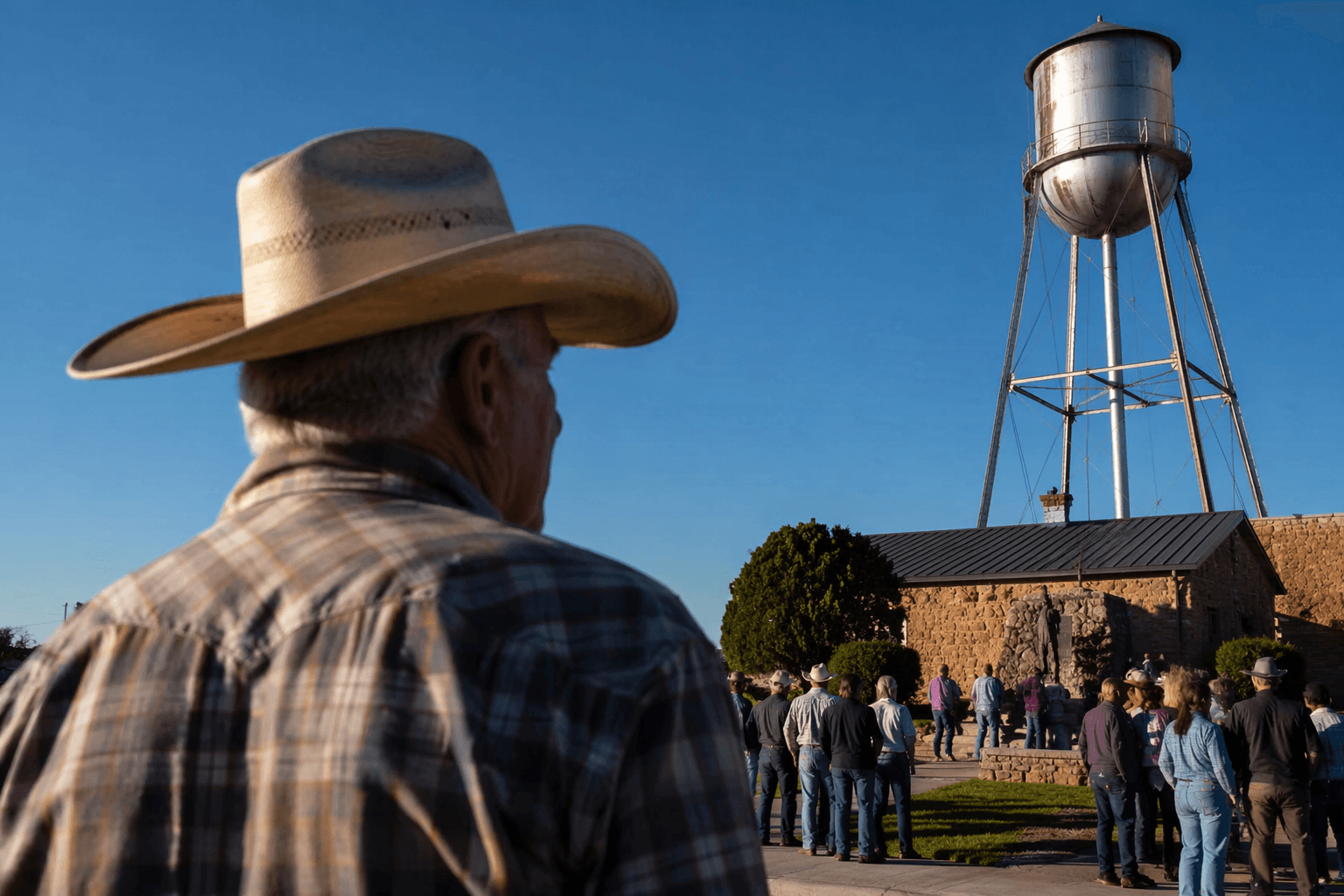
Hooker gets attention for its name, but the better story starts with a real cattleman. John “Hooker” Threlkeld rode west in the 1860s, reached No Man’s Land in 1873, and spent about 30 years in the saddle, including years as foreman for the OX Ranch. The town that grew around that frontier memory still shows its history in the roads, the rail line, the newspaper, the carnival and the golf course that anchor everyday life.
The cattleman behind the name
The Hooker Chamber of Commerce and the Oklahoma Historical Society both connect the town’s name to Threlkeld, with regional historian Henry Chrisman cited in the historical record as the source for that naming tradition. Threlkeld was born in Kentucky on November 13, 1846, and his nickname has its own frontier lore: some locals say it came from Civil War Gen. “Fighting Joe” Hooker, others trace it to an older Beaver River cattleman named Hooker, and another explanation says it referred to Threlkeld’s skill as a “hooker” of cattle, meaning a top roper.
That kind of origin story matters because it shows Hooker was never just a label on a map. It grew out of cattle culture, oral history and the working life of the Panhandle, where the name of a man became the name of a town.
From No Man’s Land to a townsite
Before Hooker became a city, the land sat in No Man’s Land, the strip that surrounding states and territories did not want. Cattlemen were among the first to use the range, and the town’s early development followed the practical logic of ranching, schooling, worship and trade. Once settlement took hold, schools, churches and businesses pushed the place from open range toward a permanent town.
The Chicago Townsite Company organized and sold Hooker town lots in 1904. By 1907, the Oklahoma Historical Society says Hooker had 448 residents, and by 1910 the population had reached 525. Those numbers show a small community, but also a fast-forming one, built in the middle of a county that would remain deeply tied to livestock and farm trade.
The fire that remade the business district
Hooker’s early boom was interrupted in June 1908, when fire hit hard. The blaze destroyed the Hooker Advance building and press and wiped out more than half of the business district, including 42 businesses and other buildings. The newspaper survived, but the fire became part of the town’s long memory because it marked both loss and recovery in the same breath.
The Hooker Advance had begun publishing on February 19, 1904, and by 1907 it was circulating at roughly 700 to 1,000 copies. In October 1908, only months after the fire, it began displaying the seal of Oklahoma on its banner. That detail captures Hooker’s rebuild in a single image: even after a devastating fire, the town was still printing, still organizing, still trying to define itself in a young state.
What you can still see now
Hooker’s history is not locked away in a museum case. It is visible where the highways meet, where the trains run, and where local institutions still operate in public view. The Hooker Chamber of Commerce places the town at the junction of U.S. Highways 54 and 64 and State Highway 94, with Union Pacific rail service still running through the community. Those routes matter because they explain why Hooker has long been more than a dot on the map: it is a place connected to movement, freight and the wider Panhandle.
The Hooker Historical Society says its work is to preserve documents, photographs and heirlooms, which gives the town a formal memory bank as well as a civic one. That preservation instinct extends into the institutions locals still use, from the municipal golf course to the annual carnival to youth sports.
Institutions that keep the story in daily life
Dr. and Mrs. L.G. Blackmer became major civic figures in Hooker, and Dr. Blackmer’s generosity helped create Blackmer Golf Course. The city-operated Blackmer Municipal Golf Course sits at 401 West Panhandle Street, opened in 1953, and plays as a nine-hole public course at par 36 over about 3,300 yards. It is a small-town course in the best sense, practical and local, a place where the town’s name appears on a sign but the civic story is the real draw.
The Hooker Lions Club was chartered in 1949, and its long-running carnival still remains part of the town’s identity. In 1967, Hooker added a little league park and a new library, and the baseball nickname shifted to the Hooker Horny Toads. Those milestones matter because they show how the town kept making new traditions instead of relying only on old ones.
A small town inside a cattle county
Hooker’s present-day scale still reflects the rural geography around it. The U.S. Census Bureau counted 1,802 residents in Hooker in 2020. The broader Hooker census county division in Texas County had 3,601 residents and covered 469.2 square miles, a reminder that the town sits inside a large, dispersed agricultural landscape rather than an urban corridor.
Texas County’s cattle economy remains a major part of that setting. The USDA’s 2022 Census of Agriculture recorded 196,160 cattle and calves in the county on December 31, 2022. That figure helps explain why Hooker’s origin story, from Threlkeld and the OX Ranch to the rail line and highway junctions, still fits the local economy. This is a place where the frontier past is not a costume for tourists. It is the framework around which the town’s roads, institutions and civic habits were built, and the framework residents still drive past every day.
This article was produced by Prism’s automated news system from verified source data, official records, and press releases, then run through automated quality and moderation checks before publishing. The system is built and supervised by the people who set the standards it runs under. Read our full AI policy.
Did this article answer your question?