OPSU Anchors Texas County With Workforce Training, Education, and Community Services
Remove OPSU from Goodwell and Texas County loses 885 jobs, $47 million in wages, and its only four-year university within a 120-mile radius.
The Numbers Behind the Name
Pull OPSU out of Goodwell and the math turns brutal fast. A fiscal year 2024 economic impact analysis found that Oklahoma Panhandle State University supported 885 jobs and generated more than $47 million in wages across the state, while returning $14.39 in total economic output for every single dollar Oklahoma invested in the institution. That ratio puts OPSU among the most efficient public investments in the state, a fact that carries particular weight in Texas County, where the university's payroll, student spending, and campus procurement flow directly into Guymon businesses, Goodwell landlords, and supply chains that stretch from Texhoma to Hooker. Strip that engine out and the hollowing-out starts immediately: restaurants lose lunch traffic, apartments lose tenants, and small employers lose the local hiring pipeline that keeps them from posting the same job ad year after year.
The Only Four-Year School Within 120 Miles
Geography alone makes the stakes clear. As the closest four-year institution within a 120-mile radius, OPSU is not one option among several for Panhandle families weighing college decisions. It is, for most, the practical option. The Oklahoma Panhandle sits far from major state population centers, and commuting to another university is not a realistic calculation for a working family in Guymon or a graduating senior in Texhoma. That isolation amplifies every program OPSU offers and every student it retains. Graduates who earn a degree without leaving the region are demonstrably more likely to stay and work locally, meaning each credential awarded at the Goodwell campus is also a quiet retention event for the county workforce.
Training the Workers Texas County Actually Needs
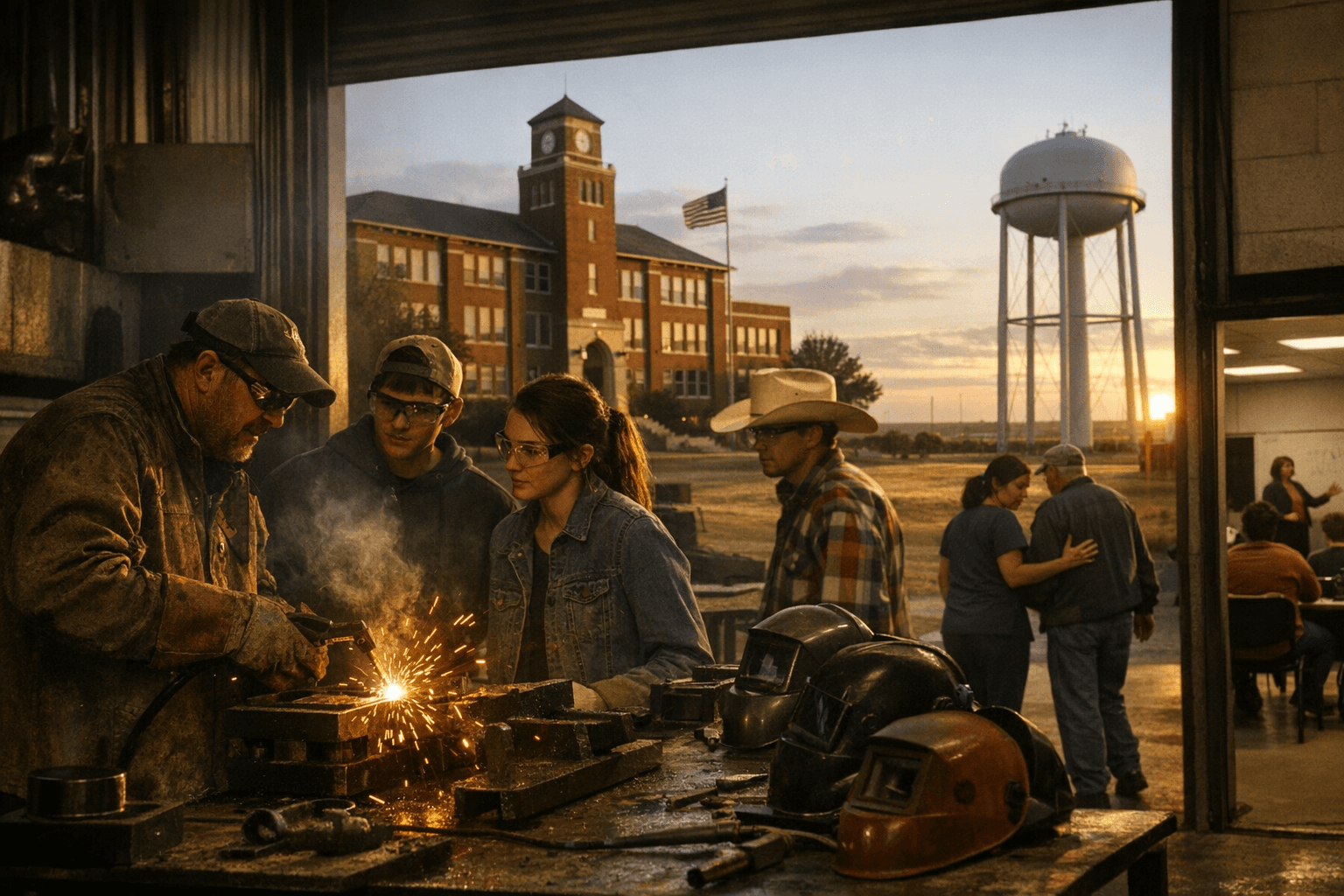
The university's three colleges deliver career-oriented bachelor's and associate programs calibrated to the region's labor market rather than to abstract national trends. Agriculture and animal science programs produce graduates qualified to work across the Panhandle's bovine, equine, swine, and row-crop industries. The education division, accredited by the Council for the Accreditation of Educator Preparation since 2017, turns out certified elementary, math, English, and physical education teachers for school districts that would otherwise recruit from distant markets and lose those hires within two years. The nursing and emergency services department pairs pre-professional tracks with emergency medical and fire protection certificates, and offers an accredited RN-to-BSN online pathway for working nurses already serving the region's healthcare system.
That combination matters because rural healthcare and rural education are the two sectors that most consistently fail to recruit and retain talent in remote areas. A nurse trained in Goodwell and connected to Guymon's healthcare community through clinical rotations does not need to be convinced the Panhandle is worth working in. She already lives there.
Panhandle Promise and the Dual-Credit Pipeline
The financial barrier to higher education is real and measurable: the average unmet funding gap for OPSU students runs approximately $16,800 over four years. The Panhandle Promise Scholarship is designed to close that gap for students pursuing teacher education pathways, directly addressing the pipeline problem for local school districts. Beyond scholarships, OPSU's dual-credit offerings let high school students in Texas County begin accumulating college credits before graduation, compressing both the time and cost required to earn a degree. For families in Hooker or Texhoma who are weighing whether four years of tuition is feasible, the ability to arrive at Goodwell with a semester's worth of credits already banked changes the entire enrollment conversation.
Extension Outreach and the Ag Economy
OPSU's agricultural outreach functions as a practical resource for the producers who drive Texas County's economy. Through extension-style partnerships with local farmers and ranchers, the university translates research and current best practices into operating decisions for agri-businesses working in a semiarid environment where a late-season weather shift or a commodity price swing can erase a year's margin in weeks. That applied knowledge transfer, moving from campus research to ranch decisions, is the kind of service that does not show up neatly in an enrollment count but represents real economic value to the county's agricultural sector.
Aggies Game Days and the Visitor Economy
When the Aggies host a visiting squad from a neighboring state, Guymon's hotels fill, its restaurants move more covers, and retailers see foot traffic that a typical Tuesday in the Panhandle does not generate. OPSU's athletics program competes in conferences that draw teams and their traveling fans from across the region, converting the campus calendar into a recurring economic event for local businesses. The community value runs deeper than receipts. For youth athletes in Texas County, OPSU games and summer camps provide accessible, close-to-home exposure to college athletics and campus life, a proving ground that does not require a six-hour drive or an overnight hotel stay.
Civic Infrastructure and the Long View
OPSU's events calendar, commencement ceremonies, guest lectures, community workshops, and cultural programming, functions as civic infrastructure in a county that lacks the population density to support large independent arts or conference venues. The campus serves as a meeting place for the policy discussions, workforce conversations, and community events that shape Texas County's direction. Vice President of Advancement Dr. Ryan Blanton framed it directly: "OPSU's presence is invaluable for our region's economic development. It's not just about education; it's about sustaining the vitality of our businesses, industries, and families."
For employers seeking to build a local hiring pipeline, the practical lever is straightforward: internship agreements and adjunct teaching partnerships with the university convert classroom training into applied, site-specific experience that makes new graduates job-ready from day one. For nonprofits and civic organizations, OPSU's campus events office offers co-sponsorship opportunities that can extend the reach and budget of community programs well beyond what either partner could accomplish alone.
What Comes Next Depends on What Is Sustained
OPSU's capacity to anchor Texas County long-term rests on three variables: retaining students who might otherwise leave the state for larger campuses, securing program funding for high-need disciplines like nursing and teacher education, and deepening partnerships with local employers who benefit most directly from what the university produces. A $14-to-$1 return on public investment is a compelling argument for continued state support, but it is an argument that local leaders, business owners, and civic organizations in Guymon and across the Panhandle are best positioned to make loudly and often. The university's sustained presence is not a given; it is the product of deliberate choices by the community and the state, and those choices will define what Texas County's workforce, healthcare system, and schools look like a generation from now.
This article was produced by Prism’s automated news system from verified source data, official records, and press releases, then run through automated quality and moderation checks before publishing. The system is built and supervised by the people who set the standards it runs under. Read our full AI policy.
Did this article answer your question?