Optima Refuge preserves Texas County wildlife and High Plains habitat
Optima Refuge gives Texas County a rare public window into High Plains prairie, with 4,333 acres of habitat, birding, photography, and year-round hunting access.
A hidden-in-plain-sight High Plains asset
Optima National Wildlife Refuge is one of Texas County’s most distinctive public places, a stretch of protected prairie and bottomland that gives residents a close look at the Oklahoma Panhandle’s wild side. The 4,333-acre refuge, established in 1975 under the Fish and Wildlife Coordination Act, sits on the Coldwater Creek arm of the Army Corps of Engineers’ Optima Reservoir Project and is managed for resident wildlife and migratory birds.
That makes it more than a scenic stop. In a county shaped by agriculture, energy, and long transportation corridors, Optima is one of the few nearby places where the landscape is set aside first for habitat, not development. For families in Hardesty and across Texas County, it is a rare public land asset that connects everyday life to a living stretch of the High Plains.
What the refuge protects
The refuge’s uplands are classic shortgrass country, with buffalo grass, blue grama, sandsage, and yucca anchoring the open ground. Those plant communities support a mix of grassland and edge habitat that matters in a semi-arid region where wildlife often depends on every available patch of cover, feed, and water. The refuge’s grasslands and wooded bottomland provide room for both resident species and travelers passing through on seasonal migration.
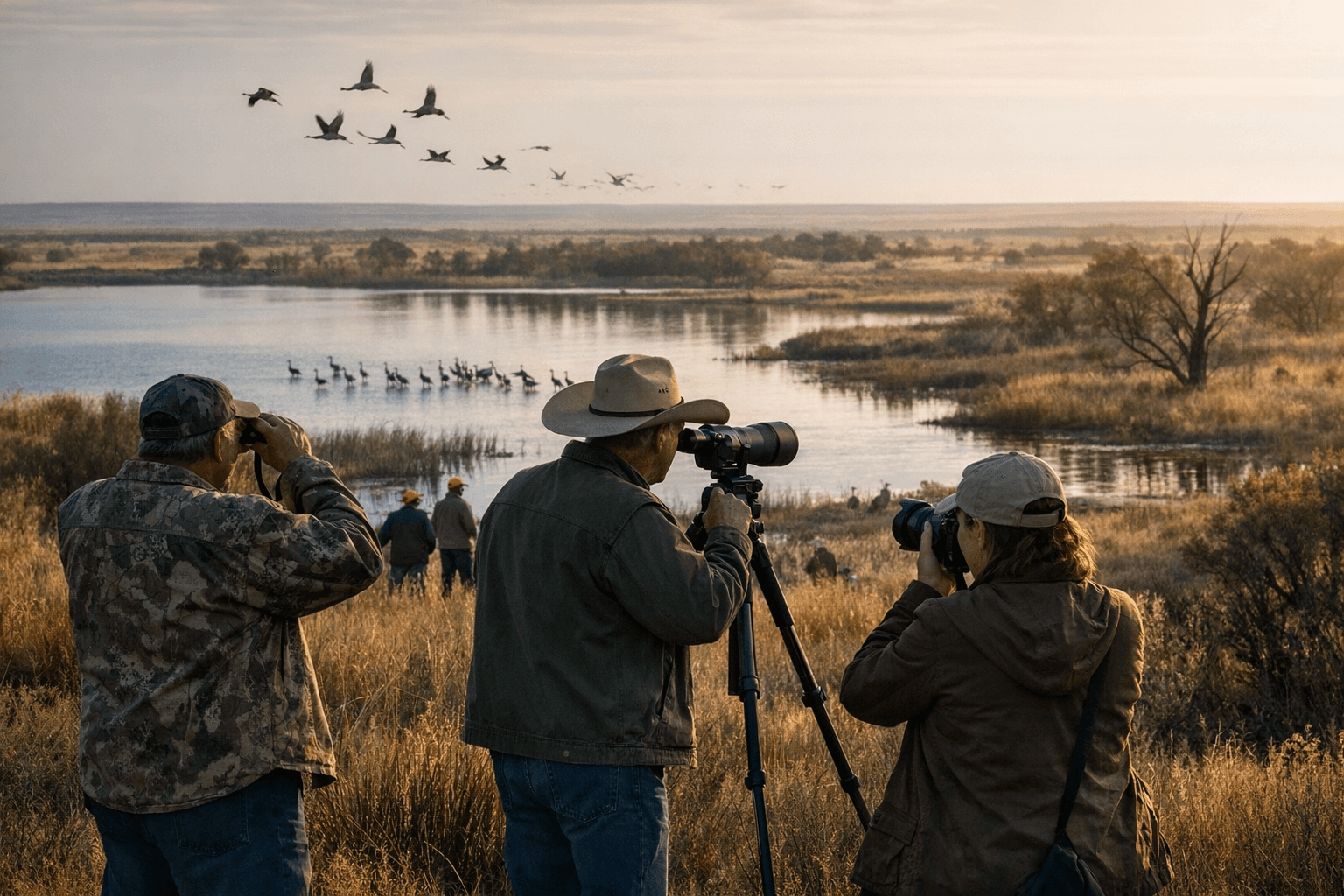
Wildlife use here is broad and visible. The U.S. Fish and Wildlife Service identifies white-tailed deer, coyotes, Rio Grande turkeys, quail, songbirds, and raptors as part of the refuge’s wildlife community, and says raptors are common year-round. It is also described as a migratory stopover and summer home for many songbirds and raptors, which gives the site a seasonal rhythm that changes with the calendar and the weather.
For birders, that matters because Optima is not just a place to check species off a list. It is a place to watch a working prairie ecosystem in motion, where nesting, migration, hunting, and shelter all overlap in a relatively compact public landscape. For photographers, the same mix of open horizon, bottomland, and wildlife movement creates one of the most accessible settings in the region for capturing the High Plains as it really is.
What you can actually do there
Optima works because it is practical. The refuge offers wildlife observation, photography, and public hunting, so a visit can be as simple as an early-morning drive to the edge of the area, a pair of binoculars, and time to walk. Access is walk-in only, with no driving access into the refuge itself, so planning a visit means being ready to cover ground on foot and move quietly through the habitat.
That walk-in character is part of the experience. It keeps the refuge quieter than many roadside outdoor destinations and helps preserve the sense that this is a protected landscape rather than a pass-through attraction. Visitors who want to see more than a quick roadside view can use that slower pace to look for birds in the grassland edges, scan for deer movement near cover, or wait for raptors riding the thermals.
Hunters also use the area, and the refuge’s hunting information highlights bobwhite quail and scaled quail, along with the healthy mixed-grass prairie that supports often abundant quail populations. The surrounding public hunting area is open year-round, which gives the site unusual flexibility for people who depend on local public land for recreation close to home.
- Birders can watch for songbirds and raptors during migration and summer.
- Photographers can use the open prairie and wooded bottomland for landscape and wildlife shots.
- Hunters can find bobwhite quail and scaled quail in a prairie system known for strong habitat.
- Families can use the refuge as a low-cost way to spend time outdoors without leaving the county.
Why the refuge matters for community life
Optima’s value is bigger than recreation. Public land like this gives Texas County residents access to healthy outdoor space without the cost of travel, private-land permission, or long-distance planning. In a rural area where many people already spend hours on the road for work, school, or errands, a local refuge becomes part of the county’s everyday well-being, not just its weekend leisure.
There is also a public health dimension to that access. Places that support walking, wildlife observation, and quiet time outdoors can help reduce stress and increase physical activity, especially for families who may not have many free nearby options. Just as important, the refuge gives school groups and local families a concrete place to learn about prairie ecology, water resources, migratory birds, and the reality of conservation in a dry landscape.
That lesson is especially relevant in northwest Oklahoma, where land use is always a balancing act. Agriculture, energy, and infrastructure all shape the region, and habitat can disappear in small increments that are easy to overlook until wildlife has fewer places to rest or feed. Optima shows what it looks like when a public agency holds space for wildlife first, then allows people to enjoy it responsibly.
A larger public landscape than it first appears
Optima also sits within a broader outdoor complex that many people may not realize is this large. TravelOK describes about 3,400 acres of public hunting land managed by the Oklahoma Department of Wildlife Conservation next to about 4,300 acres of federal wildlife refuge land. Together, those adjacent lands create a much larger block of public outdoor space than a casual visitor might expect from a map pin near the reservoir.
That size is part of the story, but so is the identity of the place. This is not a polished attraction built around amenities. It is a working refuge, a stretch of protected High Plains habitat where the landscape itself is the draw. For Texas County residents, that makes Optima one of the clearest examples of a local resource that is easy to miss until you step onto it, look across the prairie, and realize how rare it is to have this much public wildlife country so close to home.
In a county where so much land is already spoken for, Optima remains one of the few places where the High Plains can be seen, heard, and protected at the same time.
This article was produced by Prism’s automated news system from verified source data, official records, and press releases, then run through automated quality and moderation checks before publishing. The system is built and supervised by the people who set the standards it runs under. Read our full AI policy.
Did this article answer your question?