Texas County Courthouse, Built in 1927, Anchors Guymon as Historic Landmark
Guymon's 1927 courthouse processes deeds, marriages, and court cases weekly while standing as one of Oklahoma's most storied historic landmarks.
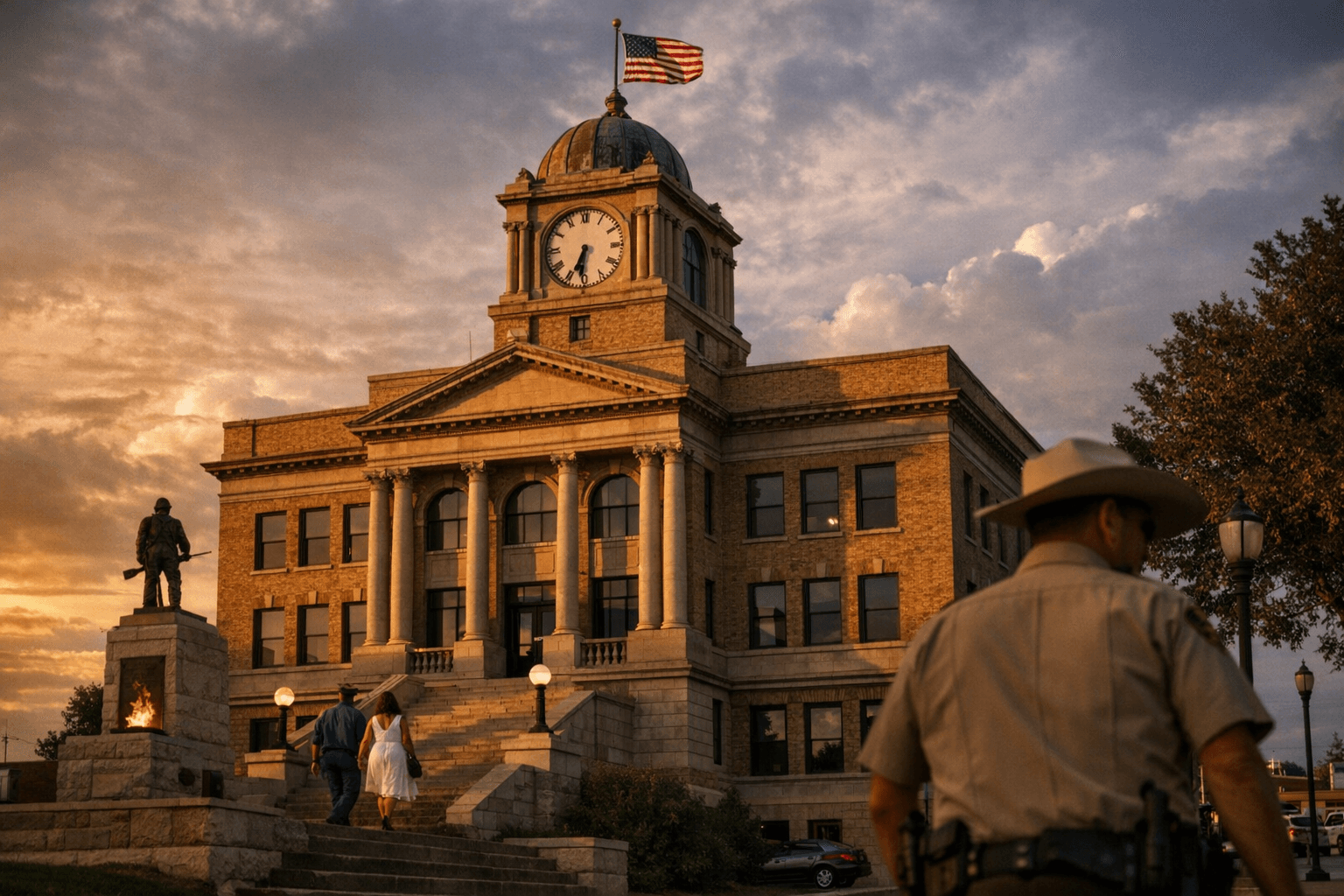
Every week, Texas County residents walk through the front doors of the same building their great-grandparents did. Someone is filing a deed after closing on a wheat farm north of Hooker. Someone else is picking up a certified copy of a birth certificate, or checking in for a district court appearance, or attending a Board of County Commissioners session. The red-brick, four-story structure at the center of downtown Guymon has been absorbing that daily foot traffic since 1927, and nothing about its fundamental purpose has changed.
That continuity is what separates the Texas County Courthouse from a museum piece. It is a working government building, housing county offices and courtrooms where the legal and civic machinery of a 2,048-square-mile county runs Monday through Friday. With a 2020 census population of 21,384, Texas County is the second-largest county in Oklahoma by land area, and nearly every significant legal transaction tied to that land passes through this building.
The Clerk's Office: Where Most Residents Start
For the majority of people who visit the courthouse, the first stop is the County Clerk's office. Wendy Johnson, a Guymon native who has served as County Clerk since April 2015, oversees an office that functions as the county's official registrar of deeds and custodian of records. Her staff, including First Deputy for Land Records Alisha Perez, processes the property filings, mineral rights documents, plat records, and vital records requests that keep the Panhandle's agricultural and energy economy moving. The office is reachable at (580) 338-3233 and keeps standard business hours of 8:00 a.m. to 5:00 p.m. The County Clerk's office also posts agendas, records board proceedings, and supports the county elections process. For anyone needing certified copies of public records, the clerk's office at P.O. Box 197, Guymon, OK 73942 remains the primary point of access.
The Court Clerk, located at Suite 301 of 319 N. Main Street, handles dockets and filings for district court. Residents with civil disputes, property matters, or scheduled hearings navigate to that office, which processes the cases that keep the county's judicial calendar full.
Built to Signal Progress, Standing Through the Dust
The courthouse did not appear in downtown Guymon by accident or default. It was a statement. Designed by architect Maurice Jaynes and constructed by the Kriepke Construction Company, one of Oklahoma's prominent builders of the era, the building opened in 1927 at a cost of $200,000. That figure, equivalent to several million dollars today, reflected real institutional confidence in the Oklahoma Panhandle's future at a time when the region was still asserting its identity. Local newspapers praised the building in its first decade, and it came to represent the success and growth of the Panhandle as a whole.
The timing carries its own weight. The courthouse opened just two years before the stock market crash of 1929, and within a decade the same Panhandle soil it was built to govern became the epicenter of the Dust Bowl. Guymon was battered by the ecological and economic collapse of the 1930s, yet the courthouse stood. Its four stories of red brick did not waver as topsoil blew east and families left. By the 1940 census, Guymon's population had actually grown to 2,290, buoyed in part by opportunities from the nearby Hugoton-Panhandle gas field. The building that was meant to symbolize growth ended up witnessing survival, and that distinction made it something more durable than civic optimism.
Jaynes designed the structure in classical revival styles, the architectural language most commonly used for courthouse and civic buildings in that period. His work extended across multiple Oklahoma counties: he also designed the courthouses in Dewey County and Harper County, and similar Panhandle courthouse construction projects in Beaver County and Cimarron County were completed around the same period. The Texas County building's fourth floor served for years as a jail; once a new county jail facility was built, that space transitioned to operations and storage, the only major repurposing the structure has undergone in nearly a century.
A National Register Listing That Still Pays Dividends
On August 24, 1984, the courthouse was added to the National Register of Historic Places under reference number 84003439, formalizing what local residents already understood: this building matters. The NRHP designation does more than affix a historical marker. It shapes how the building can be maintained, opens doors to preservation grant funding, and provides a framework for the broader conversation about protecting downtown Guymon's architectural identity. For a county seat in the rural Panhandle, that kind of institutional recognition carries tangible weight when budgets are tight and preservation competes with operational costs.
Texas County itself was formed at Oklahoma statehood in 1907, carved from Beaver County, which had formerly been part of the Public Land Strip. Guymon became the seat of county government from the start, and the courthouse built two decades later was the physical consolidation of that civic identity. The building is the oldest institution many Texas County residents interact with on a recurring basis, older than their schools, their banks, and most of the commercial blocks around it.
Planning a Visit or a Records Request
The courthouse is located in downtown Guymon, Oklahoma's Panhandle seat of government. For residents needing to file documents, obtain certified copies of records, attend public meetings, or appear in district court, standard county business hours apply, though court schedules and specific records request procedures should be confirmed directly with the relevant office before visiting. The County Clerk's office at (580) 338-3233 is the fastest entry point for records and land document questions.
For those approaching the building as a historic site, the structure rewards a closer look. The four-story red-brick facade reflects the civic ambition of the 1920s, and knowing that the top floor once held a county jail adds a layer of history that no restoration project has scrubbed away. The Encyclopedia of Oklahoma History's Texas County entry provides deeper context on the county's settlement patterns and formation for visitors interested in the broader regional story.
Nearly a century after architect Maurice Jaynes drew the plans and Kriepke Construction broke ground, the Texas County Courthouse still does exactly what it was built to do. The names on the court dockets change. The technology in the clerk's office has moved from ledger books to digital records. But the building at the center of Guymon remains the place where Texas County, in the most concrete sense, governs itself.
This article was produced by Prism’s automated news system from verified source data, official records, and press releases, then run through automated quality and moderation checks before publishing. The system is built and supervised by the people who set the standards it runs under. Read our full AI policy.
Did this article answer your question?