Texas County Courthouse stands as symbol of county's growth and history
Built to serve a sprawling High Plains county, the 1927 Guymon courthouse still anchors Texas County government and marks the shift from frontier uncertainty to civic order.

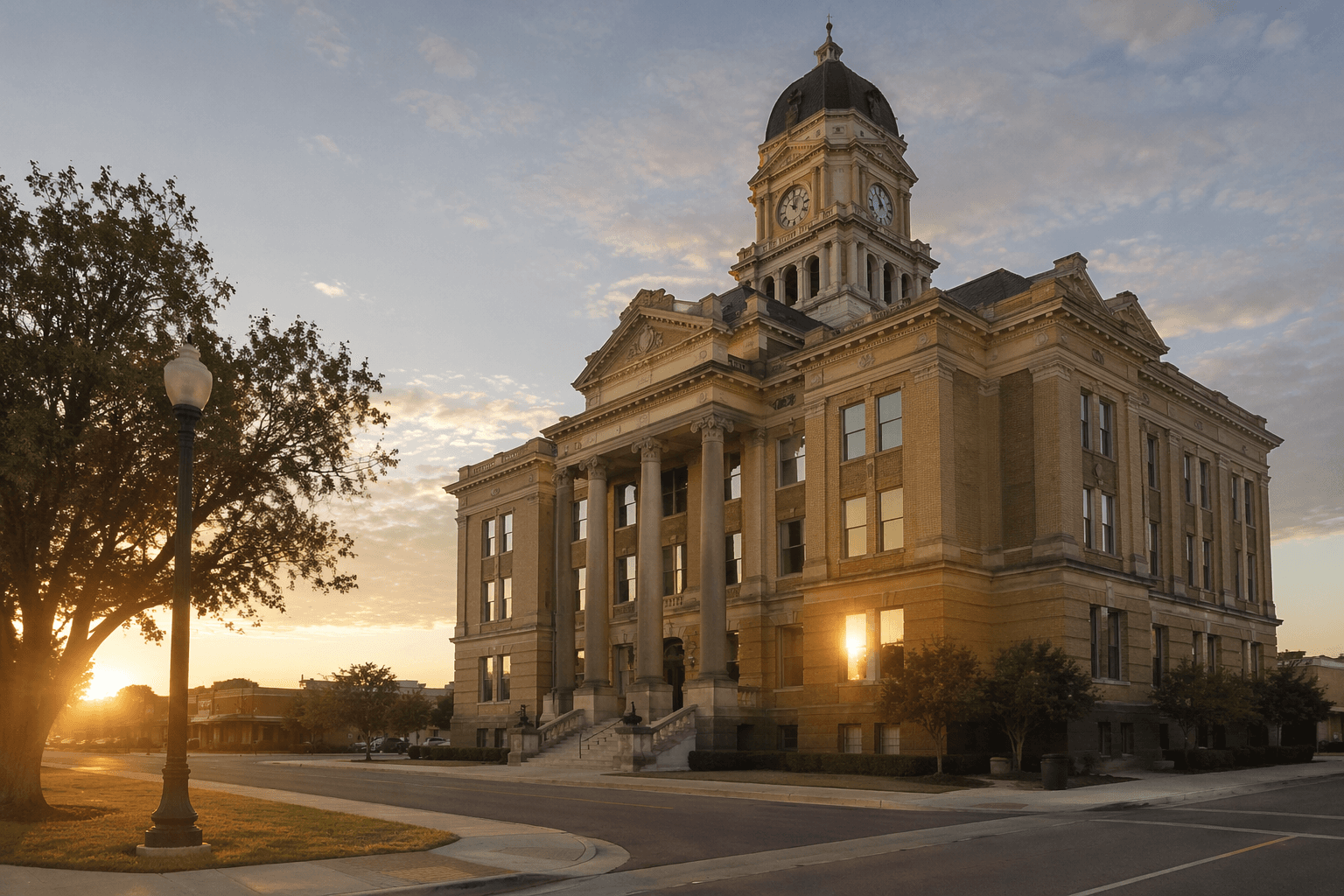
Texas County residents still come to 319 North Main Street in Guymon for the work that keeps county government moving. The four-story red-brick courthouse opened in 1927, and it remains the place where records are kept, courtroom business is handled, and the county’s decisions take shape in public view.
A county seat built to endure
Texas County did not arrive at this point by accident. It was created at Oklahoma statehood in 1907 from the central one-third of old Beaver County, and Guymon has served as the county seat since that same year. The county’s name reaches back to the Texas Cession of 1850, when this land sat within a broad frontier zone that was not attached to any state or territory until much later.
That unsettled history mattered. From 1850 to 1890, the land that would become Texas County was never surveyed or divided into townships the way eastern Oklahoma counties were. The courthouse that stands in Guymon today came later, after the county had moved from a loosely defined borderland into an organized civic community with a permanent seat of government.
What stands at 319 North Main
The courthouse itself is built for visibility as much as function. Maurice Jaynes designed the building, Kriepke Construction Company built it, and the project cost $200,000. Construction began in 1926 and the courthouse opened in 1927, a four-story structure of red brick that still dominates its block in downtown Guymon.
Inside, the building has always done practical work. The National Park Service nomination for the courthouse identifies county offices, a courtroom, and jail space as part of its historic function. The fourth floor once served as a jail, then shifted to storage after a new jail was built, a reminder that the building has been adjusted to meet changing county needs without losing its central role.
Why Guymon became the county’s civic center
The courthouse rose in a town that had already become the obvious commercial hub of the county. Guymon had 839 residents in 1907, 1,342 in 1910, 1,507 in 1920, and 2,181 in 1930. By 1911, the town already supported three banks, two newspapers, four doctors, three hotels, a cooperative flour mill, a grain company, and retail businesses.
That kind of growth explains why the courthouse landed where it did. Texas County is the second-largest county in Oklahoma, covering about 2,049 square miles, and its economy has long depended on cattle raising and farming. In a county that large, the courthouse is not only a symbol of government, it is the place where a dispersed rural population meets a single center for authority, paperwork, and public business.
A building that signaled permanence
The courthouse was never just a functional box for offices and court sessions. The National Register nomination describes it as the “center of political activity in Texas County since 1927,” and notes that it has remained in excellent condition. Local newspapers in the late 1920s and early 1930s treated the steel, cement, and brick as signs of permanence, growth, progress, and prosperity.
That framing still fits the building’s presence in Guymon. The courthouse became a way for Texas County to show that its government was settled, durable, and meant to last. In a region where the landscape had long been defined by uncertainty, the courthouse gave the county a fixed address and a visible civic anchor.
How the broader county history fits the building
Texas County’s land use helps explain why the courthouse matters so much to local life. The county’s arable sections became farmland, while the remainder largely serves as rangeland for grazing. That pattern reflects a county economy shaped by agriculture, distance, and the practical need for a central place to handle public records and legal affairs.
The courthouse also sits within the larger story of the Oklahoma Panhandle. The Oklahoma Historical Society’s Guymon history entry says the courthouse helped symbolize the success and growth of the Panhandle, and the National Park Service nomination adds that the present courthouse became a focus of civic pride. Those ideas are visible in the way the building still functions today: not as a preserved shell, but as an active seat of county government.
Preservation and public life
The courthouse was added to the National Register of Historic Places on August 24, 1984, placing it within Oklahoma’s broader courthouse preservation framework administered through the Oklahoma Historical Society’s State Historic Preservation Office. That designation recognizes the building as important not only for its architecture, but for the public life it has carried for nearly a century.
The structure’s survival through the Dust Bowl years deepens that story. Guymon’s historical record notes severe wind damage in the 1930s, including Black Sunday on April 14, 1935, yet the town still had 2,290 people by the 1940 census. Through that era and beyond, the courthouse stayed in place, continuing to house county business while the surrounding region absorbed change.
Texas County’s courthouse remains what it was built to be: a working landmark. It is where county offices operate, where a courtroom still serves the public, and where the county’s history is not only remembered but used every day in the business of government.
This article was produced by Prism’s automated news system from verified source data, official records, and press releases, then run through automated quality and moderation checks before publishing. The system is built and supervised by the people who set the standards it runs under. Read our full AI policy.
Did this article answer your question?