Max Square Serves as Civic Heart of Downtown La Grande
At Adams and Fourth, a compact plaza with a lighted stage anchors La Grande's downtown life, from Saturday farmers markets to a tale of a bootlegger, a fountain, and a temperance crusade.
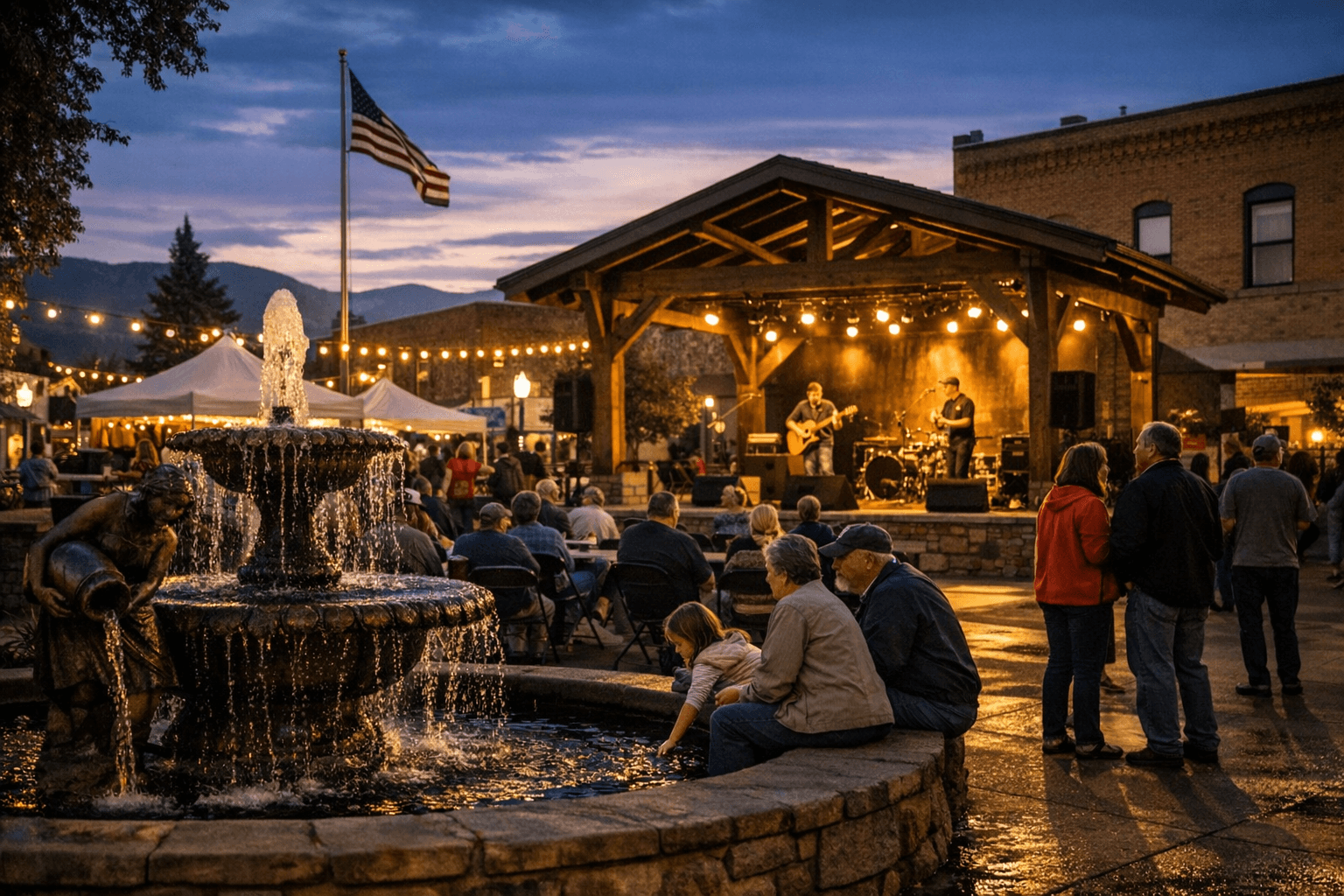
At the corner of Adams Avenue and Fourth Street, a single city block does the work that most towns spread across an entire district. Max Square, the compact civic plaza listed by the City of La Grande at 201-3 Fourth Street, sits on the edge of the historic downtown district and functions as the community's de facto town square: a gathering point for Saturday markets, summer concerts, and neighborhood celebrations, framed by City Hall and the Cook Memorial Library directly across the street.
A space built for community
The park's physical footprint is modest but purposeful. A small, lighted stage anchors the square, paired with fixed concrete seating and perimeter lighting that keeps the space usable after dark. A transit stop is integrated into the park itself, making it one of the few public squares in Eastern Oregon where a resident can step off a bus and walk directly into a community event. La Grande Economic Development describes Max Square as "a natural gathering place for locals throughout the year," and the City of La Grande confirms that the facility is available to rent for private or community events. Prospective renters can manage reservations and notification subscriptions through the City's online account system; booking details and availability are listed on the city's facility page. One practical note for anyone planning an event: the City explicitly states there are no restroom facilities at Max Square, so organizers of larger gatherings will need to plan accordingly.
What happens here
The City's own facility page captures the range of programming that takes place at Max Square in a single sentence: the park's stage and seating provide "a venue for community celebrations, musical events, and the Farmer's Market." Photos archived on the City's site give those categories texture. The Matt Cooper Quintet has performed during Farmers Market hours, illustrating how music and the market regularly overlap at the square. A recurring "Music At Max Square" series brings performers to the lighted stage, and welcome banners strung for the historic downtown district signal the square's role as a first impression for visitors approaching from Adams Avenue. The Saturday Farmers Market draws both residents and Eastern Oregon University students to the plaza, reinforcing what planners have described as Max Square's dual identity: a neighborhood anchor and a campus-adjacent destination.
Cast Iron Mary: the story at the entrance
Standing at the park's entrance is a large bronze historical reproduction of Cast Iron Mary, and the story behind it is one of the more vivid pieces of civic history in Union County. The original Cast Iron Mary was erected on September 1, 1904, by the Women's Christian Temperance Union. Her purpose was explicitly two-fold: first, to provide good, clean drinking water for people, horses, and dogs; and second, to entice the menfolk away from the numerous taverns that lined La Grande's streets at the time.
The fountain did not survive intact. City records describe what happened next with admirable directness: "Built to last, Mary survived only twenty years. On the night of April 22, 1922, George Noble, a local bootlegger who was fleeing from police, lost control of his automobile and crashed into the fountain. Mr. Noble escaped unhurt, but totaled both his automobile and Cast Iron Mary." The math embedded in that account is worth noting: the original was erected September 1, 1904, and destroyed April 22, 1922, an interval of roughly 17 and a half years. City text rounds that figure to "twenty years," a discrepancy that local historians and newspaper archives could clarify. What stands at the entrance today is a bronze reproduction; the sources do not specify when the reproduction was installed or who commissioned it, details worth pursuing with the City or the Union County Museum.
Downtown context and the square's civic neighbors
Max Square does not stand alone. City Hall and the Cook Memorial Library face the square directly across the street, creating a civic cluster unusual in a city of La Grande's size. That proximity gives the square an institutional weight beyond its physical footprint: residents can attend a council meeting, return a library book, and pick up produce from the farmers market within a single block. A community connection shuttle bus also serves the area, extending the square's reach to residents without personal vehicles.
The surrounding streetscape has drawn consistent praise in planning assessments. Wide sidewalks, well-defined crosswalks, wide travel lanes, and accessible public parking all contribute to what one planning document describes as a district that is "compact and easy to shop, given that parking is not a problem." The same document identifies Max Square as a downtown asset alongside the historic district designation, the urban renewal district, and the view corridor running from Eastern Oregon University toward downtown along 6th Street.
What planners see and what could change
An Oregon downtown planning document treats Max Square as the focal point of a broader redevelopment vision for the surrounding blocks. The recommendations are specific. Planners suggest considering a median approach on Fourth Street adjacent to the library and the ODS building, along with bump-outs at the Max Square intersection to slow traffic and improve pedestrian comfort. The document describes the corner simply: "Max Square, good intersection for a bump out or two."
Larger proposals target the blocks immediately to the east. The planning document recommends redeveloping those buildings to create more intensive mixed-use development, with retail on the ground floor and housing or offices above, with ground-floor uses specifically oriented toward the square. Streetscape improvements along Adams and 6th, including bulb-outs, street trees, and benches, appear alongside a suggestion for modest changes to Max Square's own design timed to coincide with adjacent redevelopment.
The document also identifies the Adams and 6th corridor as a key gateway to Eastern Oregon University, noting strong architectural building elements, an existing popular business for students and residents (the Highway 30 coffee shop), and a strong view corridor between the campus and downtown. The planning vision imagines a downtown that could stretch from Oak Street to Willow, encompassing Jefferson and Washington streets, with freeway access treated as an asset rather than a barrier.
Not all of the planning document's observations are flattering. One passage offers a direct comparison: "The character, heart of every town is the downtown. La Grande is fairly poor in this area. Look at Baker City, Joseph, Walla Walla." That candid critique, paired with the document's list of genuine assets, frames Max Square not as a finished civic product but as the most promising nucleus for something more.
The square's combination of institutional neighbors, transit access, an active events calendar, and a genuinely unusual piece of local history in Cast Iron Mary gives it more raw material than most small-city plazas ever have. Whether the adjacent redevelopment recommendations move forward, and whether the square itself sees the modest design changes planners have proposed, will determine whether that potential is fully realized in the years ahead.
This article was produced by Prism’s automated news system from verified source data, official records, and press releases, then run through automated quality and moderation checks before publishing. The system is built and supervised by the people who set the standards it runs under. Read our full AI policy.
Did this article answer your question?