ODOT $242M Shortfall Forces Lawmakers to Weigh Cuts Affecting Union County Roads
ODOT told lawmakers a roughly $242 million 2025-2027 gap could eliminate 1,039 positions and force maintenance-shop closures that threaten service to communities including Union County.
ODOT officials told lawmakers in mid-February that the agency faces an approximately $242 million shortfall for the 2025-2027 biennium, and presented options that include eliminating 1,039 positions agencywide or asking the Legislature to redirect legally dedicated funds. Interim Director Lisa Sumption and Finance and Budget Division Administrator Daniel Porter made the presentation to the Joint Subcommittee on Transportation and Economic Development on Feb. 10.
The agency framed the $242 million as “the difference between legislatively approved service levels and revenue available under current law,” and said the gap reflects revenue available under current statute while most new revenue from House Bill 3991 is delayed by a voter referral. HB 3991 passed in Sept. 2025; petitioners’ signatures sent key portions to the ballot and Gov. Tina Kotek on Jan. 7 called on lawmakers to address the gap and repeal HB 3991 while pursuing longer-term funding in 2027.
Under the workforce-reduction scenario ODOT estimated 1,039 positions would be affected: 471 currently filled roles would be laid off and 568 vacant positions would be eliminated, figures presented by ODOT and reported by KATU and in GovDelivery. GovDelivery summarized the impact: “Without new resources for the current budget cycle, the agency estimates it would need to reduce its workforce by more than 1,000 positions, including eliminating about 570 vacant positions and laying off approximately 470 current employees.” KATU reported ODOT warned for more than a year that, without legislative action, it would be forced to cut jobs and reduce services.
ODOT and KATU cited stark operational consequences. KATU quoted an official identified only as Lawrence saying, “When we’re closing down multiple maintenance shops all across Oregon, we’re talking about entire communities completely disconnected,” and “You’re going to have entire communities completely disconnected from the rest of the world. That’s not hyperbole. That’s not an exaggeration.” ODOT warned cuts would reduce frontline maintenance and direct customer service, and that highways could go un-serviced if reductions proceed.
Vacancy and staffing numbers vary across reports. ODOT’s presentation used the 568-vacancy figure; GovDelivery echoed about 570 vacancies to be eliminated and roughly 470 layoffs. The Oregon Capital Chronicle reported an alternate “worst case scenario” of leaving 151 vacancies open while laying off 471 workers, and also noted there are “already 700 vacant positions within the agency.” ODOT additionally reported that more than 360 employees have left since July 2025 and that the agency has absorbed roughly $450 million in spending reductions since 2019, including more than $150 million in the current biennium.

ODOT told lawmakers that legal limits constrain internal transfers of funds. KOBI5 and ODOT materials note federal and state restrictions prevent shifting money between program accounts; as a result, one non-tax response lawmakers could pursue in the short session is legislative redirection of state funds that are program-dedicated but not yet obligated. ODOT also identified a $55 million transition need for the next cycle and said legislators may consider a $297 million funding target in the short session to support operations beyond June 30, 2027.
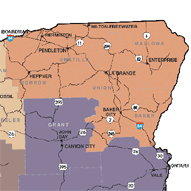
For Union County specifically, the statewide presentation did not list any maintenance shops, projects, or positions by county. The record presented to the Joint Subcommittee on Feb. 10 makes clear the choices are either workforce and service reductions or legislative action to repurpose legally dedicated, not-yet-obligated funds; local detail on whether any Union County shops or ODOT positions are slated for elimination was not provided and requires follow-up with the ODOT district manager and local maintenance supervisors. Daniel Porter framed the broader statutory context, noting that “House Bill 2017, which passed in the 2017 session, created a host of new programs and dedicated revenue sources. It was the largest and most comprehensive transportation funding package passed to date.”
Lawmakers in the current session face a choice that will shape winter service levels, maintenance-shop staffing, and whether communities across Oregon, including those in Union County, keep the same level of highway service. ODOT says it will continue implementing HB 3991 consistent with existing law until directed otherwise, while warning that absent new resources it must operate within current revenue and legal restrictions.
This article was produced by Prism’s automated news system from verified source data, official records, and press releases, then run through automated quality and moderation checks before publishing. The system is built and supervised by the people who set the standards it runs under. Read our full AI policy.
Did this article answer your question?