Packwood House tells 200 years of Lewisburg transportation history
Packwood House still shows Lewisburg's shift from ferry town to rail stop to preservation site. Its walls, Annex and museum plans turn one block into three eras.
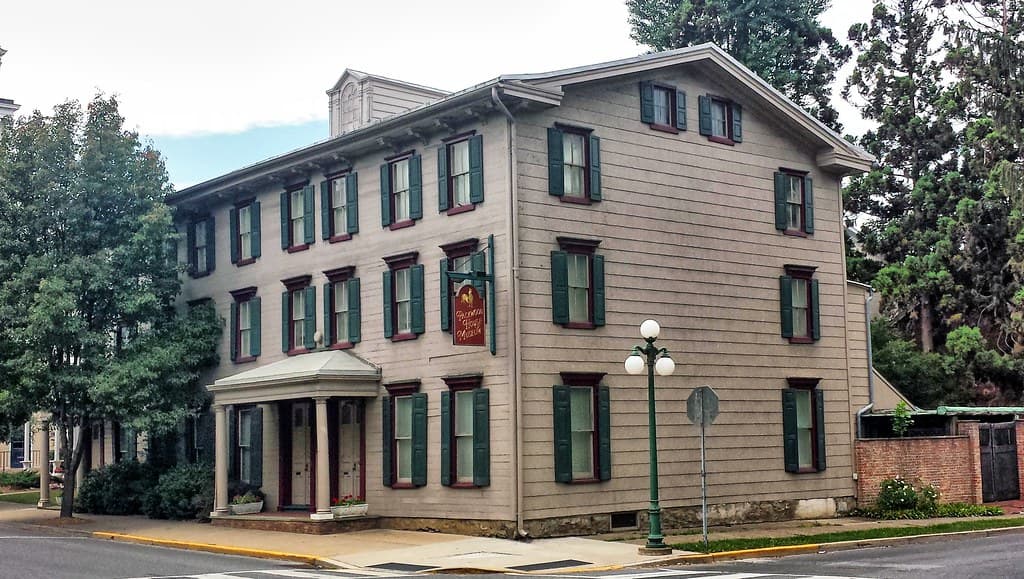
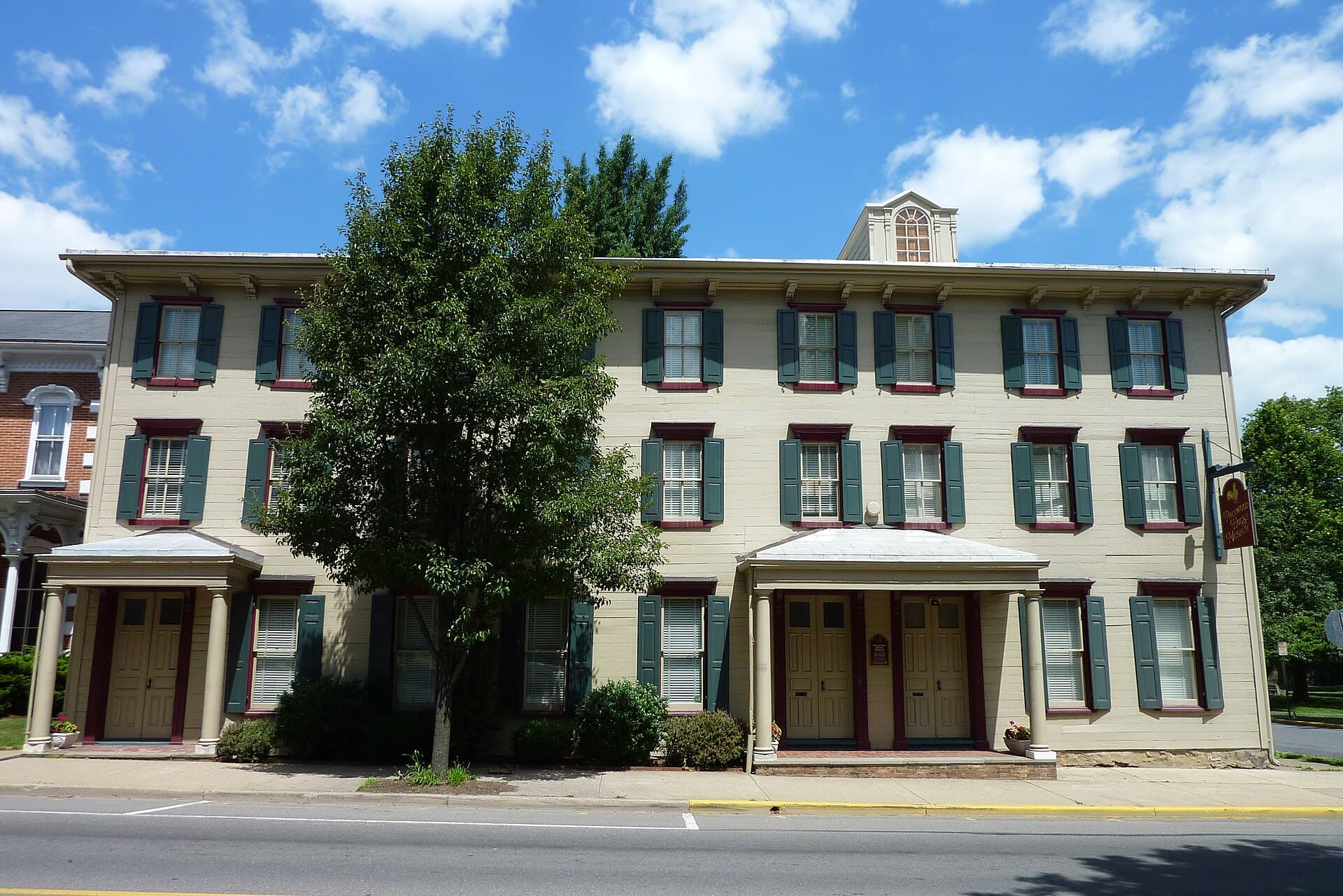
The red-brick Annex beside Packwood House now holds a riverfront gallery and collection storage, while the main building on Market Street still carries the frame of a rare three-story log house that began life as Andrew Shearer’s Tavern. Seen together, the house and Annex give Lewisburg a visible record of how Union County moved from river travel to canal and railroad commerce to preservation and public history.
A building that still shows its first job
Packwood House began in 1796, when Andrew Shearer opened a tavern on Water Street to serve ferry patrons at the riverfront. That first life matters because it explains the building’s shape and location: it was not designed as a grand residence or a museum, but as a working public house tied to transportation and trade. The Society of Architectural Historians describes it as a rare three-story log building, and the structure later became part of Lewisburg’s historic district.
The building’s early years already reflect the economy of a river town. Travelers needed food, lodging, and a place to gather before crossing or continuing upriver, and the tavern filled that role at the edge of the water. The log construction still anchors the story today because it is one of the few surviving pieces of Lewisburg that can still be read as a transportation stop rather than a decorative relic.
From riverfront tavern to Market Street hotel
By 1866, fill piled up along the riverfront and changed the building’s ground floor into a basement. That physical shift forced a new orientation toward Market Street, and the old tavern was renamed the American Hotel. The change tracks Lewisburg’s next transportation era: canal traffic and then rail travel brought a different stream of visitors, and the building adapted to meet them.
The American Hotel stayed in that role until 1886, when it was converted into apartments. Some accounts say it was later divided into three townhouses after the hotel closed in the late 1880s, which only reinforces how the structure kept changing as Lewisburg’s economy changed around it. When the Pennsylvania Railroad reduced river travel, the need for a riverfront hotel faded, and Packwood House became a physical marker of a town turning away from one set of routes and toward another.
The Fetherstons turn a local building into a collection house
In 1936, John and Edith Fetherston purchased the 27-room building and began using it to house their art collection. SAH Archipedia says they named it Packwood House after Packwood, the Fetherston ancestral Tudor estate in Warwickshire, England. That move gave the building a third life, one tied less to transportation and more to collecting, memory, and private stewardship.
Edith Fetherston is central to that chapter. She was born in Lewisburg, attended Bucknell, and became the main collector behind the museum’s holdings, gathering art, antiques, and objects from Pennsylvania and abroad. Her bequest later established the house as a privately endowed museum of Americana, and the Fetherstons lived there until her death in 1972. The museum opened to the public in 1976, giving Lewisburg a place where local roots and wider collecting tastes met under one roof.
The site’s formal recognition followed soon after. Packwood House was listed on the National Register of Historic Places in 1978, placing it among the region’s protected landmarks and confirming that the building’s value lies not only in what it contains, but in how its structure preserves layered evidence of the borough’s past. Bucknell’s digital archive project later digitized papers, ephemera, and photographs from the Fetherston collection, extending the building’s reach beyond Market Street and making its history easier to study.
What the latest ownership change means for Union County
The Packwood House closed in 2020, but the property did not disappear from civic life. In 2023, the Union County Historical Society bought the former Packwood House and its adjoining Annex in downtown Lewisburg. A representative from Sacred Heart of Jesus Catholic Church handed over the keys during the transfer, marking the start of a new chapter for a building that has repeatedly changed hands as the community around it changed.
The historical society says the renovated red-brick Annex now functions as a riverfront gallery for programs and exhibits and as a processing and storage area for collections. It has also moved forward with plans to repurpose the Packwood House itself as the Union County Museum, extending public access to the material already tied to the property. That is the point of the site today: not to freeze one era, but to let readers see several eras at once, from the Water Street tavern to the Market Street hotel to the Fetherstons’ museum house.
Packwood House remains one of Lewisburg’s clearest transportation landmarks because its walls still map the borough’s changing routes. Ferry patrons, canal travelers, rail passengers, collectors, and museum visitors have all used the same property for different purposes, and that sequence is visible in the building, the Annex, and the collections now being prepared for the next public use.
This article was produced by Prism’s automated news system from verified source data, official records, and press releases, then run through automated quality and moderation checks before publishing. The system is built and supervised by the people who set the standards it runs under. Read our full AI policy.
Did this article answer your question?