Del Rio helped launch Texas border radio across North America
A border loophole turned Del Rio into radio territory, and the city still claims the stations that carried Texas sound across North America.
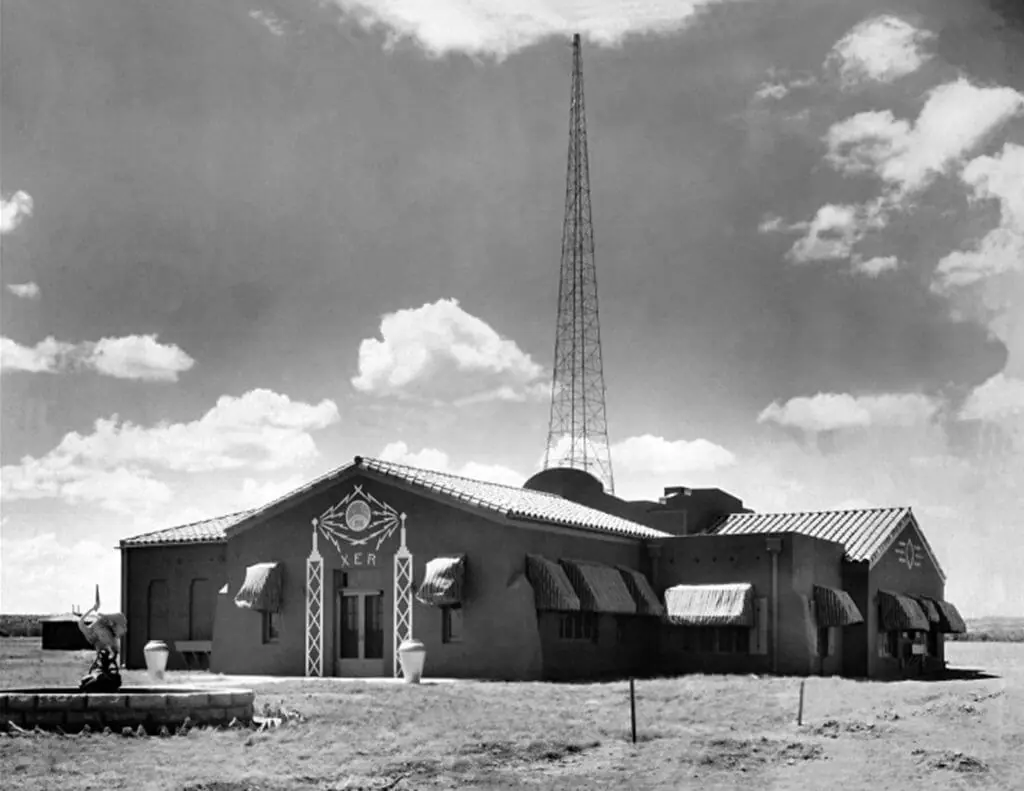
Del Rio was not just close to a radio revolution. It sat on the Texas side of the Rio Grande at the exact spot where border radio could exploit geography, law, and appetite for music at the same time. When Dr. John R. Brinkley opened XER in Villa Acuña in 1931, across from Del Rio, the signal did more than cross a river. It helped turn Val Verde County into a place that could send a sound far beyond Texas.
A border loophole that reached a continent
Border radio took shape in the early 1930s, when stations on Mexico’s northern border could operate beyond the reach of U.S. regulations. The Texas State Historical Association describes it as a half-century phenomenon, and the power levels tell the story: some border blasters ran at 500,000 watts or more, far above what U.S. stations were allowed to use. That technical rule-bending is what let a station in Villa Acuña, and later Ciudad Acuña, spill into much of North America.
A Library of Congress photograph caption places Station XER in Villa Acuña, Coahuila, Mexico, across the Rio Grande from Del Rio, Texas, around 1931. That detail matters because it shows Del Rio was not a distant observer of the border radio era. It was part of the landscape that made the era possible, the Texas edge of a system built to outrun the limits of American broadcasting.
Why Del Rio was the right place
Del Rio’s local geography and economy help explain why the border station story took root there and stayed there. The Texas Almanac places the county seat near the confluence of the Rio Grande and San Felipe Creek, and the Texas State Historical Association notes that the city’s development depended on the railroad, the military, ranching, agriculture, government-related employment, retail business, tourism, and ties with Mexico. Those are not just background facts. They describe a border town with the traffic, labor, and commercial links that could support studios, advertisers, performers, and technicians.
That cross-border mix made Del Rio a magnet for the kind of people and money border radio needed. The station could aim at listeners who were physically distant but culturally close, and the city itself could serve as the practical meeting ground between U.S. commerce and Mexican transmitters. In that sense, Del Rio was a transmitter of more than radio waves. It was a transmitter of opportunity.
The Carter Family and the music made in Del Rio’s shadow
The local legacy becomes even clearer with the Carter Family. The Val Verde County Historical Commission says A.P. Carter, Sara Carter, and Maybelle Carter performed on XERA from 1936 to 1939, a stretch that helped elevate them into country music’s “First Family” and made Maybelle the “Queen Mother of Country Music.” Library of Congress materials place the family among the earliest inductees into the Country Music Hall of Fame, underscoring how central those Del Rio-era broadcasts became to the genre’s history.
That connection is a reminder that border radio was not only about signal strength. It was also about content that traveled well. The Carter Family’s songs could be heard far outside Val Verde County, and their time on XERA helped fix Del Rio’s place in the story of American roots music. For residents today, that means the city’s cultural footprint reaches well beyond courthouse records and county lines.
XERF, Arturo González, and the business of a louder border
The postwar chapter pushed the story deeper into Del Rio’s orbit. The Texas State Historical Association says XERF’s call letters were registered in 1947 and that the station operated across from Del Rio in Ciudad Acuña, Coahuila, Mexico. It began with a 50,000-watt transmitter and later rose to 250,000 watts, a scale that carried country, rhythm-and-blues, and rock-and-roll across the United States and into Canada.
After World War II, Del Rio attorney Arturo González became a key figure in XERF’s life. By 1959, he and Ramón D. Bósquez had formed Inter-American Radio Advertising, Inc. in Del Rio to handle U.S. ad sales for the station, with the Texas corporation based on Pecan Street. At one point, the business office sat in the Roswell Hotel across the Rio Grande from Acuña, a practical sign that the station’s commercial heart still beat on both sides of the border.
The station’s reach kept growing with its reputation. Robert Weston Smith, better known as Wolfman Jack, became part of the XERF legend, and later accounts described the station as a 250,000-watt border blaster whose signal could be heard across North America and beyond. A 1983 United Press International report said a new operator sought Federal Communications Commission approval to move the studio from Ciudad Acuña to Del Rio, a move that shows how tightly the station’s future remained tied to the Texas side of the river.
What Del Rio still owns in the story
XERF’s later transfer to Instituto Mexicano de la Radio in 1986 did not erase the local claim. Del Rio still sits inside a rare American radio history that mixed border geography, legal loopholes, music business, and cultural reach. Residents can point to the city’s role in a story that helped shape country music, aired rhythms far beyond Val Verde County, and made the Rio Grande a launch point instead of a boundary.
That is why Del Rio’s border radio history endures as more than nostalgia. It is part of the city’s identity, a reminder that a place on the edge of the map once helped broadcast Texas sound across North America.
This article was produced by Prism’s automated news system from verified source data, official records, and press releases, then run through automated quality and moderation checks before publishing. The system is built and supervised by the people who set the standards it runs under. Read our full AI policy.
Did this article answer your question?