Del Rio leader touts business, council experience, infrastructure priorities
Alexandra Falcon Calderon is leaning on small-business discipline and council experience to argue Del Rio needs better streets, clearer budgets, and faster fixes.

Experience shapes her pitch
Alexandra Falcon Calderon is asking Del Rio voters to see her as more than another name on the ballot. Her case rests on a combination of small-business experience, civic involvement, and time already spent inside City Hall, all of which she says prepared her to tackle the city’s most stubborn problems.
She describes herself as a small business owner of more than 25 years, someone who has lived the realities of payroll, budgets, accountability, and hard financial decisions. That business background is central to her argument: the same discipline that keeps a company afloat, she says, should guide city government. She also points to her involvement with the Del Rio Host Lions Club, the Del Rio Downtown Association, and the Del Rio Chamber of Commerce as proof that her public life has never been confined to campaign season.
What she says she learned in office
Calderon’s message carries added weight because she has already served on the Del Rio City Council for District 3. That experience, she says, gave her firsthand exposure to how City Hall works and how decisions made in one chamber can ripple across the entire community, not just one district.
She says she worked through three city budget cycles, a claim that matters in a city where finances and infrastructure are closely linked. Those years gave her a direct view of the city’s financial challenges and opportunities, and they appear to have sharpened her focus on how budgets are built, debated, and explained to the public. Her criticism in past council discussions has centered not only on what the city plans to spend, but on whether residents and council members are seeing enough supporting detail to judge those plans clearly.
In September 2025, she criticized the lack of supporting documentation for a special council work session on the Fiscal Year 2025-2026 budget. In July 2025, she said a previous year’s budget had been balanced and told council members they were not seeing the entire budget picture. Earlier, in 2023, she asked for an additional council meeting so members could ask more questions about the proposed Fiscal Year 2023-2024 budget. Together, those moments show a candidate positioning herself as a watchdog on transparency as much as a messenger on policy.
Infrastructure is the core of her argument
If Calderon’s biography gives her credibility, infrastructure gives her campaign urgency. She says the city’s streets remain in poor condition and are felt daily by residents, making pavement, maintenance, and practical repair the kind of neighborhood-level issue voters notice every time they drive to work, school, or a store.
That message fits Del Rio’s own operational reality. The city’s Streets and Drainage Department says it maintains more than 218 centerline miles of streets, along with 16 signalized intersections, 4 flashing beacon intersections, 6 school zone flashing beacons, and more than 30 miles of drainage channel for flood control. Those numbers underscore how much of city life depends on basic maintenance that rarely draws attention when it works and becomes impossible to ignore when it fails.
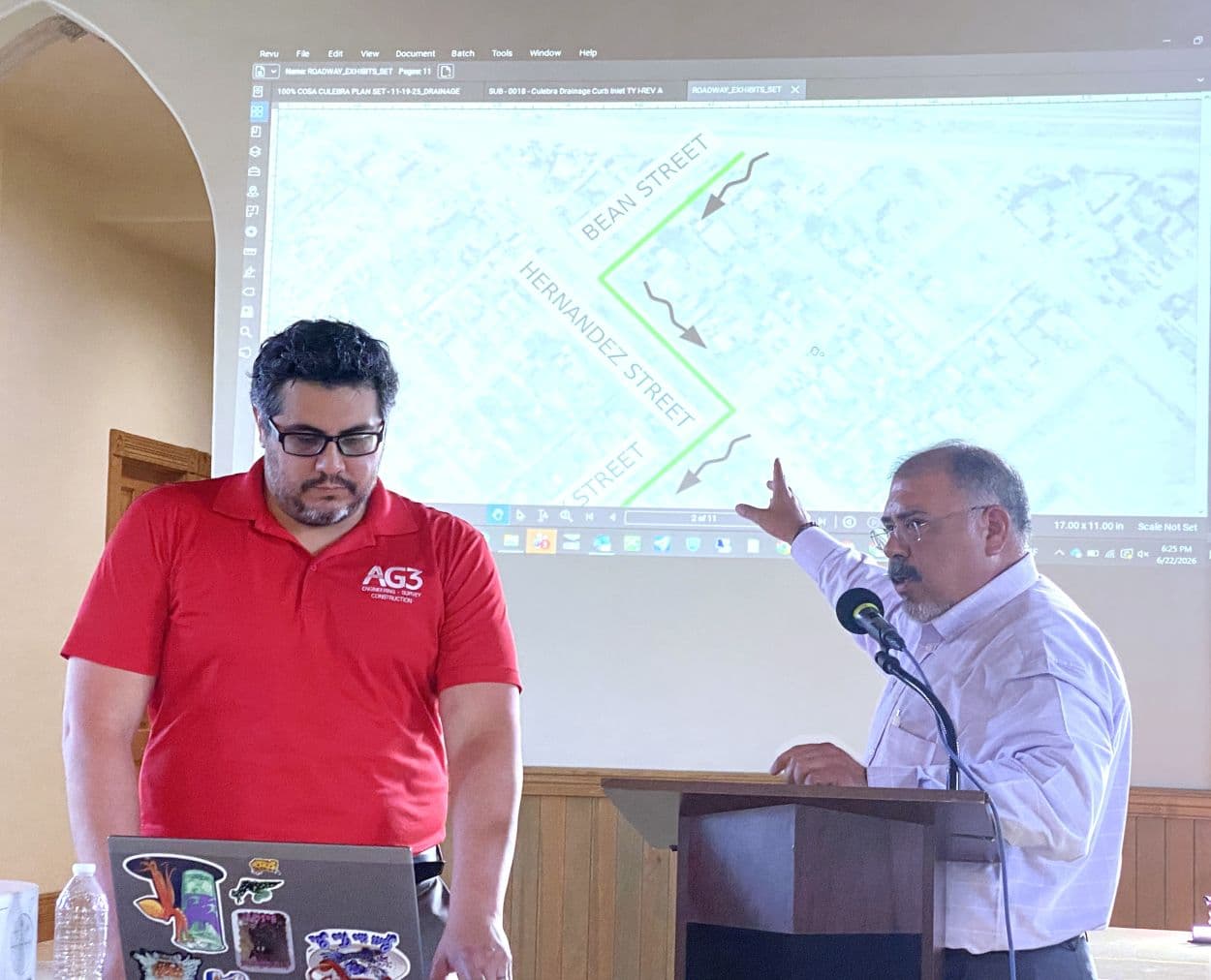
At a February 27, 2025 town hall at the Del Rio Civic Center, residents raised complaints about city facilities maintenance, drainage on the north side, and street markings. That is the kind of local feedback Calderon has tried to turn into a broader campaign message: the problems are not abstract, and they are not confined to one neighborhood. They are the everyday conditions of driving, flooding, and public safety.
Why budgets and pavement are tied together
Calderon’s emphasis on infrastructure is also a fiscal argument. The Del Rio Finance Department says its work includes organizing and preparing the operating and personnel budget, the capital improvement plan, forecasting, and monitoring expenditures. The city describes its capital improvement plan as a multi-year roadmap for major construction or reconstruction of streets, gas, water and wastewater lines, parks, and major equipment.
That matters because road repair in Del Rio is not simply a maintenance question. It is a budget question, a planning question, and a timing question. Calderon’s appeal to voters is that her business experience and prior council service make her better equipped to judge those trade-offs than a candidate offering only broad promises.
The city’s Public Works mission reinforces that connection. Del Rio says its goal is to provide “superior and fiscally responsible services” that improve quality of life and safety. Calderon’s message lands squarely inside that framework: she argues that residents want results they can see, from smoother streets to better-managed projects, and they want those results delivered without losing sight of the city’s finances.
The 2026 race gives her message higher stakes
Her campaign is unfolding in a competitive citywide race, not a narrow district contest. Del Rio ordered its May 2, 2026 general election by ordinance 2025-108 on December 16, 2025, and filing ran from January 14 through February 13, 2026 for mayor, District 1, District 2, and At-Large Place C. Ballotpedia lists Calderon as one of three candidates for At-Large Place C, alongside LeRoy Briones and Ernestina Martinez.
That broader ballot context matters because the seat she is seeking reaches beyond one neighborhood. A citywide race puts a premium on judgment, communication, and the ability to connect local frustrations to citywide priorities. Calderon’s profile suggests she wants voters to see her as someone who has already done the work of learning the system and is now better prepared to use it.
The wider field also points to a moment of municipal turnover. Six people filed for Del Rio City Council seats in the 2026 cycle, with four offices on the ballot. That means residents are not just choosing among personalities. They are choosing a direction for how the city handles roads, drainage, water, budgets, and the relationship between public explanation and public trust.
Water projects make the stakes even clearer
The city’s most pressing infrastructure debate extends beyond streets and into water. On February 4, 2026, the City of Del Rio announced it had secured a $17 million loan through the Texas Military Value Revolving Loan Fund for two projects: rehabilitation of the San Felipe East Springs Containment Wall and expansion and modernization of the Water Treatment Plant.
Governor Greg Abbott’s office said the projects are intended to add resiliency to Del Rio’s water capacity and support Laughlin Air Force Base. That gives the issue local, regional, and military significance all at once. Water infrastructure is not just about utility service; it is tied to reliability, public safety, and the city’s broader role in Val Verde County.
That is the backdrop to Calderon’s argument. She is not presenting herself as a newcomer with a single issue. She is presenting a record, a business résumé, and a return to city politics aimed at a familiar set of failures: roads that need repair, drainage that still frustrates residents, budgets that need clearer explanations, and infrastructure systems that must keep up with the city’s obligations. In a race where voters are weighing both competence and trust, her campaign rests on the claim that experience should now produce execution.
This article was produced by Prism’s automated news system from verified source data, official records, and press releases, then run through automated quality and moderation checks before publishing. The system is built and supervised by the people who set the standards it runs under. Read our full AI policy.
Did this article answer your question?