Italian stonemasons shaped Del Rio’s architecture and immigrant history
Two Italian stonemasons from Milan helped build Del Rio’s courthouse and downtown, leaving stonework that still marks the city’s daily life.
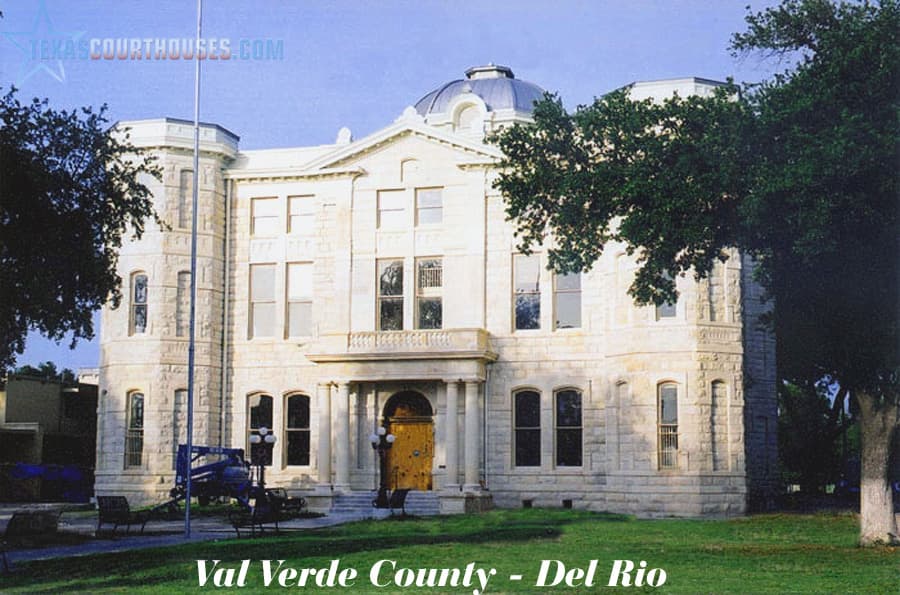
Del Rio’s downtown still carries the work of two immigrant stonemasons who arrived with railroad labor, built a courthouse, and helped turn local limestone into civic identity. Their names, G.B. Cassinelli and John Taini, surface again and again in Val Verde County history because their craft is still visible in the buildings people pass every day without noticing.
Start at the courthouse square
The clearest place to see that legacy is the Val Verde County Courthouse, an 1887 design by Larmour & Watson that Cassinelli and Taini completed in 1888. The building began as a two-story courthouse with octagonal corner towers, squat spires, and a mansard-roofed dome, then gained a third story in 1914 when Atlee B. Ayres added a floor. After hail badly damaged it in 2002, the courthouse was rehabilitated in 2004 with Texas Historic Courthouse Preservation Program funding, and its preservation remains one of the strongest examples of how Del Rio has protected its old stonework.
The details matter because the courthouse was not just a public building, it was a showcase. The Society of Architectural Historians describes the stonework as dressed-stone stringcourses and segmental-arched windows, the sort of precise masonry that still gives the square its old Texas-Borderland character. Cassinelli built the courthouse with a crew of Chinese workers who had come to the area as railroad laborers, a reminder that Del Rio’s most important landmark was shaped by multiple immigrant groups working in the same boom economy.
How two men from Milan ended up in Del Rio
Cassinelli, born in 1840, and Taini, born in 1854, emigrated from Milan to the United States in 1880 after an American contractor recruited them for a New York building project that later failed. From there, they went to work on railroads before making Del Rio their base. That path connects three forces that shaped the city at once: immigration, rail expansion, and the rise of a county seat on the border.

Val Verde County history also identifies Taini as a subcontractor on the courthouse in 1885, before the building was completed. In the years that followed, he stayed active in Del Rio as both a builder and a real-estate figure, which helps explain why his name keeps appearing in different corners of the city’s record, not just on one building. Cassinelli and Taini were not passing craftsmen; they helped establish the built environment that gave the town a lasting identity.
The Italian Colony that took root in the late 1880s
By the late 1880s, enough Italian immigrants had settled in Del Rio that the community became known as the town’s “Italian Colony.” Most of those newcomers started farms and grape orchards, while a smaller number became stonemasons and builders. The local historical record also ties the colony to families with surnames like Frankis, Garonis, Gerolas, Marinis, and Qualias, which shows how quickly this immigrant enclave became part of the town’s social fabric.
Taini later emerged as one of the colony’s leaders. Family tradition says he returned to Italy in 1889, married Erminia Gerola, and came back to Del Rio, where they raised two daughters, Annie and Lucy. The dates give that family story real shape: Annie Taini was born September 23, 1891, and Lucy Taini was born June 29, 1893. One local account also notes that Santos S. Garza later bought property on Brown Plaza from Taini and hired Lucy to work the ticket booth, a small detail that shows how the family’s reach extended into Del Rio’s business and entertainment life.
Walk downtown and you can still trace the masonry
The courthouse is only the starting point. The same craftsmen helped define the Cassinelli Gin House, Southern Pacific railroad employee housing, Sacred Heart Catholic Church, Club Café, the 1904 Methodist church building, and numerous residences around town. That list turns Del Rio’s downtown into a walking map of immigrant labor, because the buildings are still there whether people notice the names behind them or not.

The Cassinelli Gin House marker describes that structure as a strong example of the brick-and-stone commercial work typical of immigrant Italian stonemasons in Del Rio’s boom years. Around Pecan Street and Brown Plaza, that craftsmanship appears in the kind of durable, practical masonry that once signaled both ambition and permanence. Those buildings do not announce themselves as monuments, but they still shape the street-level feel of downtown, from storefront walls to church facades to modest residences that hold the same hand-worked stone.
A useful self-guided route starts at the courthouse, then moves through downtown toward Brown Plaza and the blocks where older commercial buildings still stand. From there, the story widens beyond one landmark and becomes a pattern: the same immigrant hands helped build public authority, commercial life, worship spaces, housing, and the everyday backdrop of a border town.
Why Del Rio’s setting made this story possible
Del Rio’s rise after the Civil War depended heavily on San Felipe Springs, which supplied millions of gallons of water. That abundance, together with the Southern Pacific Railroad, made the city a natural place for settlement and construction. Val Verde County was organized in 1885, and Del Rio became the county seat the same year, placing the town’s civic center at the exact moment its population and building needs were growing fastest.
The geography mattered too. Del Rio sits by the Rio Grande and San Felipe Creek, across from Ciudad Acuña, Coahuila, in a corridor where rail, water, and border commerce all met. That setting helps explain why immigrant craftsmen like Cassinelli and Taini found work here and why their stonework became part of the county’s public face. In Del Rio, architecture is not just background: it is one of the clearest records of who built the town, who settled it, and whose labor still frames the streets people use every day.
This article was produced by Prism’s automated news system from verified source data, official records, and press releases, then run through automated quality and moderation checks before publishing. The system is built and supervised by the people who set the standards it runs under. Read our full AI policy.
Did this article answer your question?