Laughlin Air Force Base shapes Del Rio as pilot-training hub
Laughlin’s runways drive Del Rio’s economy, schools and planning table, with more than 4,300 people on base and a training mission that keeps changing the city around it.
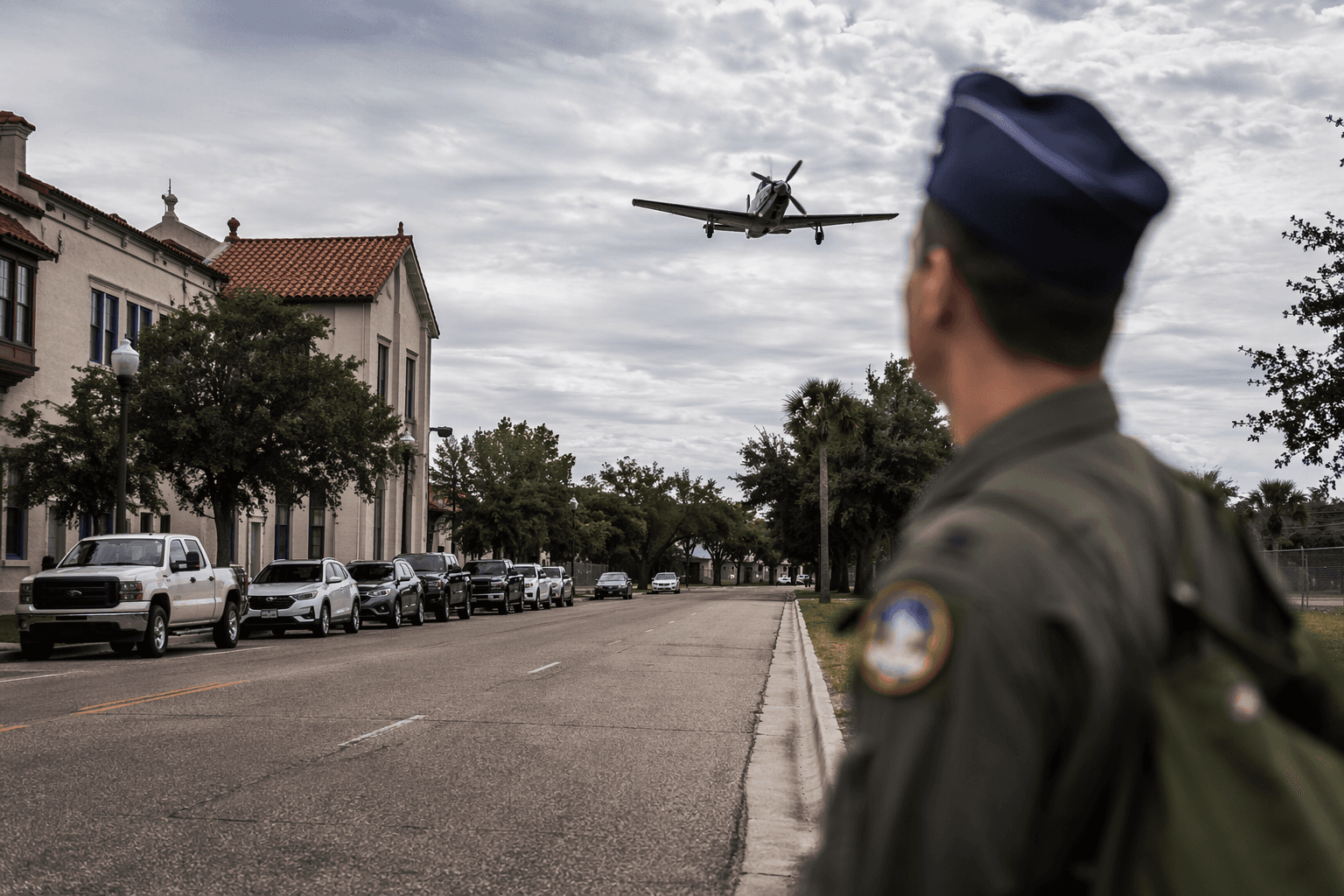
Laughlin Air Force Base is not just Del Rio’s edge-of-town landmark. It is the engine behind a daily churn of student pilots, instructors, maintainers, civilian workers and military families that gives Val Verde County a role far larger than its size on the map.
The 47th Flying Training Wing has been active at Laughlin since September 1, 1972, but its local reach is measured less by ceremony than by the volume of work it produces. Air Education and Training Command says Laughlin’s flying operation exceeds 80,000 flying hours and 51,000 sorties a year, while the base community tops 4,300 people, including more than 1,400 military personnel and 1,360 civilian employees. That scale helps explain why the base sits inside Del Rio’s economy, housing market and civic identity, not beside them.
How the pilot pipeline works
Laughlin’s mission centers on Specialized Undergraduate Pilot Training, the Air Force pipeline that turns new aviators into qualified pilots for the United States and allied nations. The 47th Operations Group runs that flying mission, and the 434th Flying Training Squadron and 85th Flying Training Squadron conduct primary training in the T-6A Texan II. The 85th FTS says its 60 instructor pilots train more than 150 students a year and fly more than 26,000 sorties, a workload that keeps the training cycle visible in Del Rio year after year.
The base’s current fleet and training structure make it more than a single-purpose installation. Laughlin also uses the T-38C Talon for advanced training, while the 96th Flying Training Squadron supplements the active units by flying T-6, T-1 and T-38 training and the Introduction to Fighter Fundamental Course. That mix creates a steady pipeline of airmen through the region, which is why the base is best understood as a recurring institution rather than a one-time economic event.
The wing’s own history shows how deep that role runs. The 47th was established as the 47 Bombardment Wing in 1947, inactivated in 1962, redesignated as the 47 Flying Training Wing on March 22, 1972, and reactivated at Laughlin on September 1, 1972, replacing the 3646th Pilot Training Wing. The wing says it has trained more than 15,000 pilots for the United States and its allies, and the historical record shows it also supported undergraduate pilot training for USAF, Air Force Reserve and friendly foreign nation air forces.
What the base means to Del Rio’s economy
Laughlin’s footprint reaches far beyond the flight line. A recent report drawing on Laughlin’s Compatible Use Study and Texas Military Preparedness Commission data put the base’s 2022 regional economic contribution at about $1.6 billion and its direct and indirect job support at 8,694. Even though those figures come through a separate report, they line up with what Del Rio sees on the ground: base payrolls, contractor spending, restaurant traffic, rentals, retail purchases and the indirect spending that follows each training class.
The base’s public events show the same pattern. The 2024 Fiesta of Flight, which combined an open house, airshow and STEAM Expo, drew roughly 16,000 spectators. It featured aircraft from across the Department of Defense and the Fuerza Aerea Mexicana’s T-6C+ aerobatic demonstration team, which made its first U.S. debut since 1944. For Del Rio, that was not just an airshow. It was a reminder that Laughlin functions as a regional draw, pulling families, students and visitors into the city and reinforcing the base’s place in local life.
That matters because the economic relationship is sensitive to staffing and training demand. If the Air Force increases throughput, Del Rio benefits from more students, more instructors and more support personnel. If priorities shift or staffing tightens, the city can feel the change in apartment demand, consumer spending and the small-business activity that follows every incoming class.

Why housing, roads and schools are part of the mission
Laughlin’s impact is not limited to payroll numbers. Val Verde County keeps public documents tied to Laughlin’s compatible-use planning, including a November 2021 compatible-use study, and the federal Office of Local Defense Community Cooperation describes those studies as collaborative work among local elected officials, planners, business leaders, chambers of commerce and base staff. That is where the base intersects with Del Rio’s practical questions about housing, traffic, infrastructure and neighborhood growth.
The reason is simple: a training base changes the local market every time the mission scales up or down. Student pilots need apartments, instructors need schools for children, civilian workers need services, and contractors need reliable roads and utilities. In Del Rio, those pressures show up in zoning conversations, commuter patterns and the kind of planning that has to account for aircraft noise, land use and mission protection at the same time.
This is also where the base becomes a civic issue, not just a military one. The compatibility work exists because Del Rio and Laughlin share the same physical space, and what happens on one side of the fence quickly affects the other. If training demand rises, the city can gain jobs and spending but also face tighter housing and greater infrastructure strain. If federal priorities move elsewhere, Del Rio stands to lose the very population churn that keeps local rentals filled and storefronts busy.
A mission that is still changing
Laughlin’s future is not frozen in the T-6 and T-38 era. The Environmental Protection Agency’s environmental impact statement database lists a final EIS for T-7A recapitalization at Laughlin, with a Notice of Intent issued January 17, 2023, and a final Federal Register date of June 21, 2024. That points to a modernization path, not a static mission, and it signals that the base’s role in pilot training is still being shaped by aircraft transitions and federal planning.
Laughlin is also feeding the broader Air Force training system. In 2024, First Assignment Instructor Pilots from Laughlin helped support Pilot Instructor Training at Joint Base San Antonio-Randolph, extending the base’s influence beyond Val Verde County and into the next layer of the training pipeline. That is the clearest sign of how the mission works now: Laughlin does not merely teach new pilots, it helps produce the instructors who will teach the next ones.
For Del Rio, that is the lasting stake. Laughlin brings payrolls, visitors, students, families and planning pressure, but it also brings status, continuity and a national mission that is woven into the city’s economy and identity. If the training pipeline holds, Del Rio keeps its place as a pilot-training hub. If it shifts, the city will feel the change in ways that go well beyond the runway.
This article was produced by Prism’s automated news system from verified source data, official records, and press releases, then run through automated quality and moderation checks before publishing. The system is built and supervised by the people who set the standards it runs under. Read our full AI policy.
Did this article answer your question?