Val Verde County announces animal movement restrictions over screwworm threat
Warm-blooded animals in Val Verde, Edwards and Sutton counties had to get TAHC approval to move, disrupting sales, shows and vet trips.
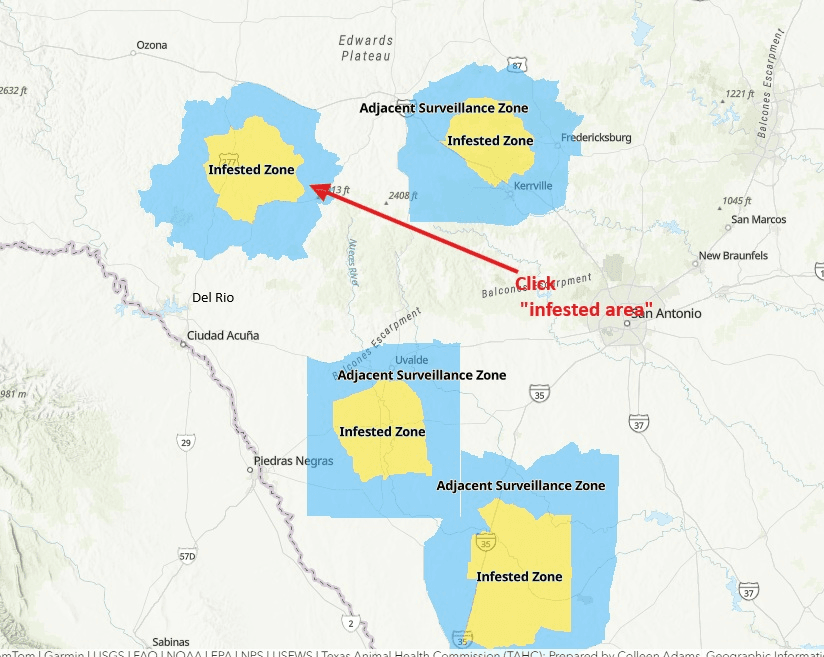
Val Verde County's alert said an executive director order barred warm-blooded animals in the infested zone from leaving without prior authorization from the Texas Animal Health Commission. Anyone moving animals out of the zone had to contact TAHC or a New World Screwworm-certified inspector, a rule that could disrupt cattle sales, horse shows, goat hauls, veterinary visits and other cross-county ranch work in Val Verde, Edwards and Sutton counties.
Ranching and rural land use are part of the area’s economy and identity, especially around Del Rio and the county’s wide ranchland. New World Screwworm is a parasitic fly whose larvae burrow into living tissue and cause NWS myiasis, and TAHC has said it poses a serious threat to livestock, exotic livestock, fowl and exotic fowl. A hold on movement could ripple quickly through sales, shows, veterinary care and the day-to-day operations that keep ranches running across county lines.
TAHC confirmed Texas’ first screwworm case on June 3 in a Zavala County calf with an umbilical lesion, and the sample was confirmed by the National Veterinary Services Laboratory in Ames, Iowa. A Texas Agriculture Alert created June 11 said the parasite was detected in a bovine in Edwards County on June 9, and a modified executive director order dated June 12 said it was detected in a goat in Edwards County on June 11 and that Infested Zone 04 had already been established on June 10.
Another Texas Agriculture Alert created July 2 said a bovine in Edwards County tested positive on June 25 and that the infested zone covering parts of Edwards, Sutton and Val Verde counties was modified. The broader response stretched across South and West Texas, with officials and USDA APHIS deploying more than 8,000 traps from Cameron County to Val Verde County since July 2025.
This article was produced by Prism’s automated news system from verified source data, official records, and press releases, then run through automated quality and moderation checks before publishing. The system is built and supervised by the people who set the standards it runs under. Read our full AI policy.
Did this article answer your question?