Your Guide to Boating, Fishing, and Permits at Lake Amistad
Amistad sits at just 31.4% capacity heading into spring, shutting down several low-lying ramps. Here's what every Del Rio boater must check before launching.
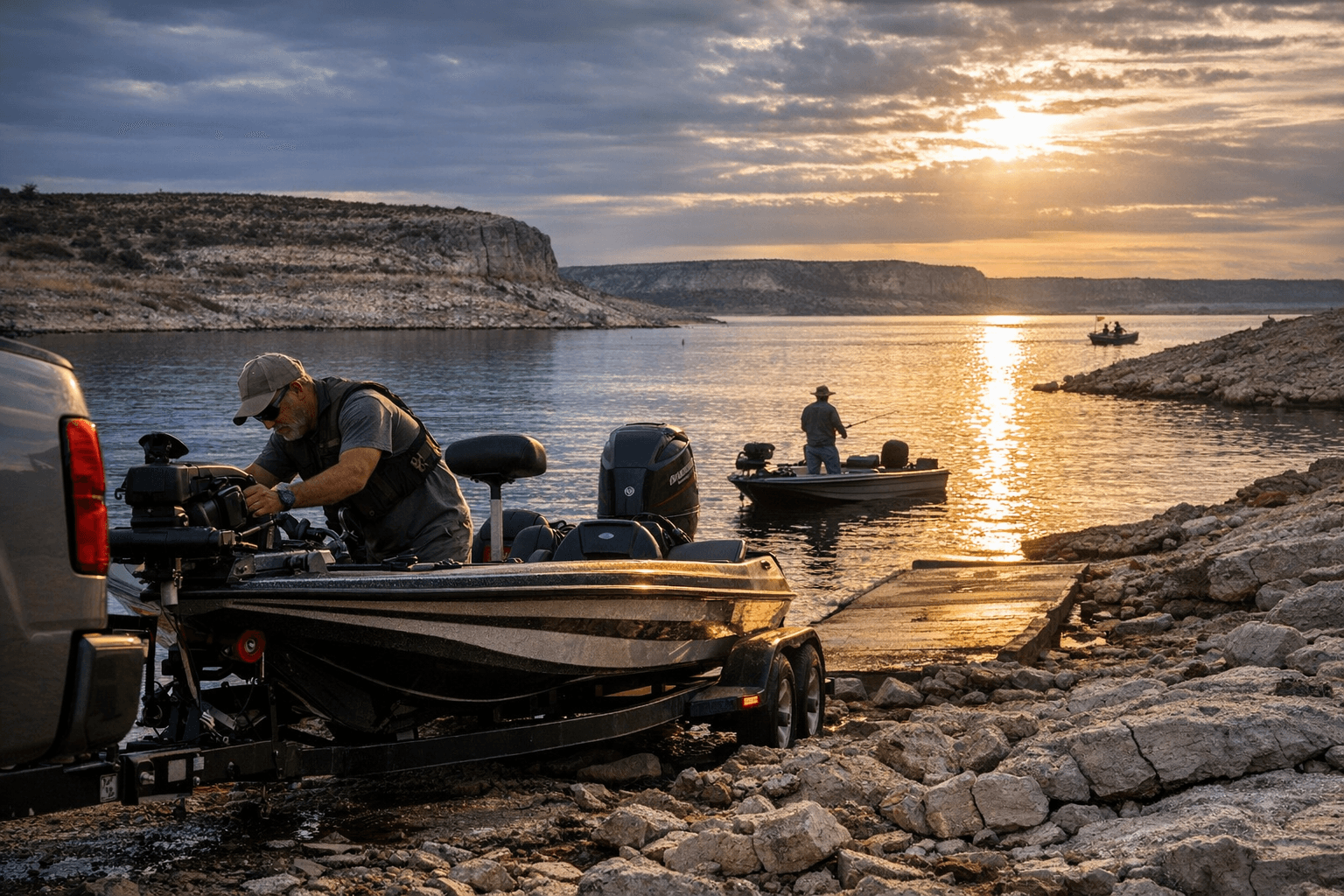
At 31.4% of capacity as of late March 2026, Lake Amistad is carrying less water than most Val Verde County families realize going into the spring boating season. That number, tracked by the International Boundary and Water Commission, puts the reservoir roughly 30 feet below its full conservation level of 1,117 feet above sea level. For anyone loading up a boat trailer this weekend, that gap is not abstract: it determines which ramps you can actually use, how far you'll carry gear across exposed rock to reach the waterline, and, in some cases, whether you can launch at all.
The stakes are real. Val Verde County Sheriff Joe Frank Martinez confirmed an active investigation into a drowning death at Lake Amistad after a man's body was recovered on a Sunday night, a reminder that the reservoir's remote canyon terrain and fast-changing conditions demand more than a casual attitude toward safety planning.
Check Ramp Status Before You Leave the Driveway
The National Park Service maintains a live boat-ramp status page and webcam feeds for Amistad's major access points, and at current lake levels, that page should be your first stop. The primary ramps on the U.S. side are Diablo East, Rough Canyon, Box Canyon, Southwinds Marina, Blackbrush Point, 277 North, 277 South, Spur 406, Spur 454, and the Pecos River ramp. Depending on conditions, any of these can become inaccessible when the water drops far enough to strand concrete aprons above the waterline.
Of these, Diablo East is the busiest and the one most commonly used for bass tournaments. It also has one of the three automated kiosks where you can purchase your lake-use permit on arrival. Rough Canyon and the Pecos ramp have kiosks as well. If you're launching a large vessel or houseboat, call or check the NPS conditions page the night before. Arriving at a ramp only to find 50 yards of exposed caliche between your trailer and the water is a mistake many local boaters have already made this season.
What the Lake-Use Permit Costs and Where to Buy It
Any motorized craft requiring state registration must display a valid NPS lake-use permit to operate on the U.S. side of the reservoir. The fee structure is straightforward: $4 for a single day (24 hours from purchase), $10 for a three-day pass, or $40 for an annual permit good for one year from the month of purchase. For anyone who boats Amistad more than 10 times a year, the annual pass pays for itself quickly.
Permits are available at the Amistad Visitor Information Center seven days a week from 8 a.m. to 5 p.m., or at the automated teller machines at Diablo East, Rough Canyon, and the Pecos ramps. Senior Pass and Access Pass holders may qualify for discounts on some park fees, so bring your federal pass if you have one. The permit must be visible on your vessel while on the water; NPS rangers actively patrol and can issue citations.
Fishing Licenses: Two Countries, Two Sets of Rules
Amistad straddles the international boundary, and the line matters. On the U.S. side, a valid Texas fishing license is required for anyone casting a line. On the Mexican side (the Presa Amistad portion), every person aboard must hold a valid Mexican fishing license, regardless of whether they are actively fishing. As of current guidance from Texas Parks and Wildlife, Mexico boat permits are no longer required for crossing into Mexican waters, but the fishing license requirement remains fully in effect.
Mexican fishing licenses are not available online through Texas channels; they must be purchased locally. Two Del Rio businesses handle this: Amistad Marine, the Ranger boat dealer on Highway 90 West across from Spur 454 (reachable at 830-775-0878), and Fisherman's Headquarters, located at the Chevron at the intersection of Highway 90 West and Highway 277 North (830-774-5670). Do not cross the international boundary on the water without the correct licenses in hand. NPS rangers and Mexican officials both patrol those waters.
The reservoir's premier target species is largemouth bass, with Texas Parks and Wildlife noting strong seasonal patterns that make spring one of the most productive times of year. Catfish, striped bass, and white bass round out the common catches on both sides of the lake.
The Five Mistakes Local Boaters Keep Making
Based on recurring incidents at Amistad, these are the avoidable errors worth knowing before you launch:
- Skipping the ramp-status check and driving out to a ramp that's been closed or rendered unusable by low water
- Failing to display a valid lake-use permit and getting cited by NPS rangers who patrol regularly
- Crossing into Mexican waters without a Mexican fishing license for every person aboard
- Heading into narrow canyon sections during afternoon thunderstorm season without monitoring weather, the NPS specifically warns that storms can form rapidly and canyon terrain provides no shelter from lightning or high winds
- Launching without enough water for the day; Amistad's desert setting and summer heat make dehydration and heat exhaustion serious risks even on short trips
Safety Essentials for Canyon Conditions
Amistad's steep-walled canyons are part of what make it a premier Texas destination. They also concentrate wind, funnel boat wakes, and can leave boaters far from shore without cell coverage if something goes wrong. Life jackets for every passenger are non-negotiable. Bring more water than you think you need, carry sun protection and a means of shade, and file a float plan with someone ashore before you depart. Know your navigation light requirements if you'll be on the water near dusk; the canyon walls can make sunset arrive earlier than expected in some inlets.
NPS rangers stationed at Amistad are the best on-the-water resource for real-time conditions, closures, and safety concerns. Local marinas, including Amistad Marine and Fisherman's Headquarters, can also offer current lake intelligence that no website updates as quickly.
Why Amistad's Health Matters Beyond the Weekend
Amistad is not just a recreation area; it is a primary economic engine for Del Rio and Val Verde County. Marinas, bait shops, rental operations, restaurants, and lodging providers all depend on active boating seasons. Bass tournaments at Diablo East draw regional visitors who spend money locally. When lake levels drop, those ripple effects are felt in hotel occupancy and fuel sales, not just fishing reports.
At 31.4% capacity, Amistad is in a condition that demands extra planning from anyone who uses it. Check the NPS conditions page and webcams the night before you go, buy your permits in advance when possible, know which ramp is viable for your vessel's draft, and carry your Texas and, if applicable, Mexican licenses. The reservoir rewards those who show up prepared, and the canyon views on a clear April morning are worth doing it right.
This article was produced by Prism’s automated news system from verified source data, official records, and press releases, then run through automated quality and moderation checks before publishing. The system is built and supervised by the people who set the standards it runs under. Read our full AI policy.
Did this article answer your question?