Mystery Stone draws visitors to Hidden Mountain with permit rules
The Mystery Stone still draws curious eyes to Hidden Mountain, but a permit, a rough approach road, and a short hike shape the visit as much as the legend.

The Los Lunas Mystery Stone has the kind of pull that turns a county landmark into a half-day outing. People come for the folklore and stay for the logistics: this 80-ton volcanic basalt boulder sits on State Trust Lands at the base of Hidden Mountain, about 16 miles west of Los Lunas, and you need a permit before you go. That mix of myth, archaeology, and land-use rules is exactly what makes the site one of Valencia County’s most talked-about stops.
Why the stone keeps drawing people in
The mystery begins with the carving itself. New Mexico State Land Office materials say the inscription was first documented in 1933 by University of New Mexico archaeology professor Frank Hibben, and the stone is often described as having nine lines of text cut into a flattened basalt face. Some descriptions say the marks include Hebrew characters with a few Greek letters mixed in, which is part of why the site keeps attracting both believers and skeptics.
That tension is the heart of the story. For some visitors, the stone reads like a version of the Ten Commandments written in Hebrew. For others, it is a disputed artifact whose authenticity has been argued over for years. Either way, the site has held Valencia County attention for decades because it sits at the intersection of a real landscape and an unresolved question.
How to visit legally
The first thing to know is simple: this is not a casual roadside pull-off. New Mexico True says a permit is required to access the area because the stone is on State Trust Lands, and the map location is only approximate. If you plan to go, the permit is not optional, and the rules matter as much as the trailhead.
The New Mexico State Land Office says recreational access permits cover non-commercial activities such as hiking, sightseeing, photographing, wildlife viewing, horseback riding, picnicking, and cross-country skiing. A permit is valid for one year and can cover up to 10 family members accompanying the permit holder. It does not authorize access to private land, or to state land that has been withdrawn from recreation or leased for oil, gas, or mining.
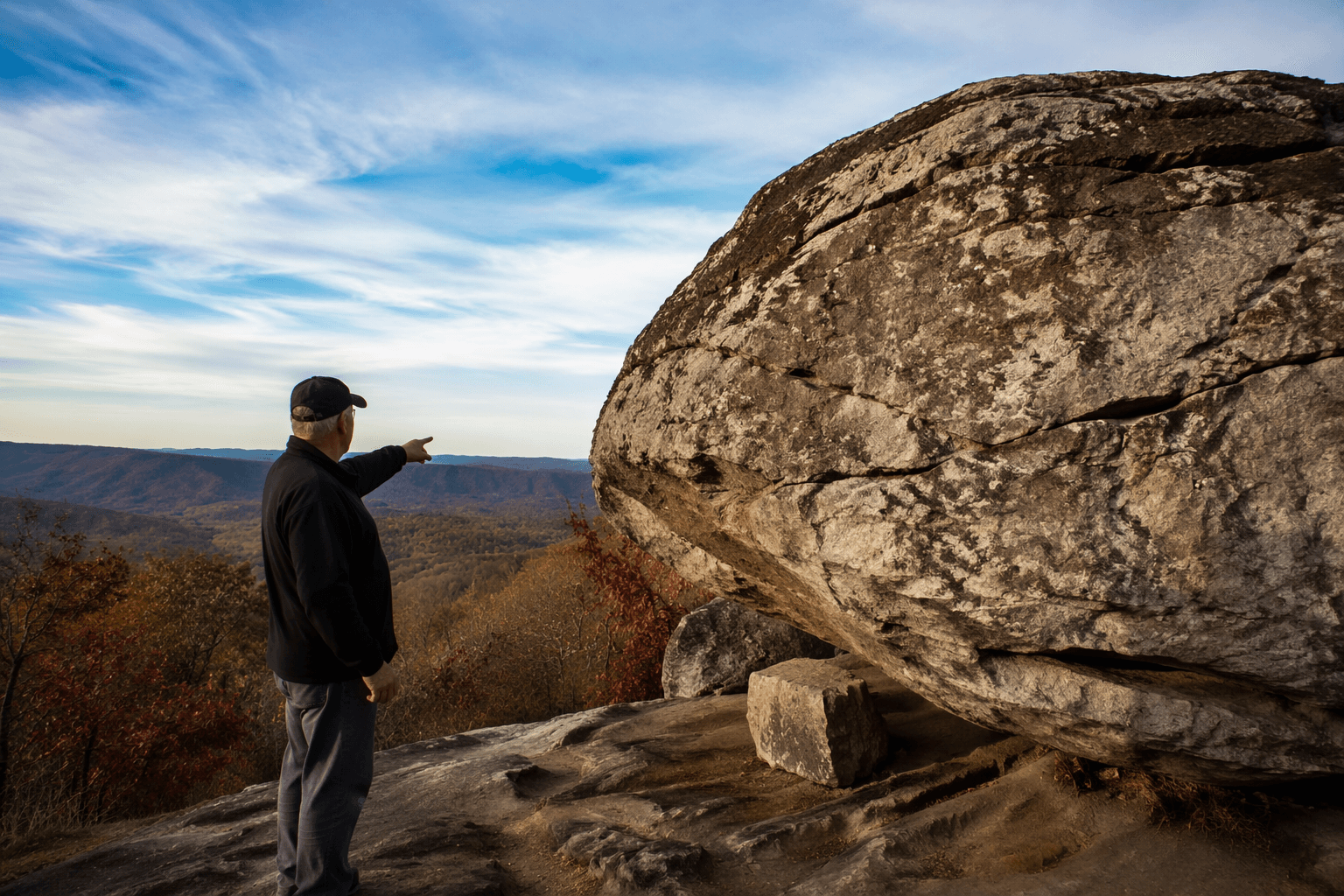
The approach also deserves respect. The parking area is reached from Los Lunas via Highway 6 and a gravel road, and the route crosses railroad tracks plus two small bridges before the trail begins. The walk itself is a little over a mile round-trip, but the State Land Office warns that roads can become impassable, cell coverage may be limited, and visitors should expect high-desert conditions. In practical terms, that means good footwear, water, and a willingness to turn around if the road or weather says no.
What you will actually see on site
The boulder is the center of the visit, not a built-out attraction. The stone sits at the base of Hidden Mountain in a dry, open landscape that feels much more remote than its distance from town suggests. That remoteness is part of its appeal, but it also explains why visitors need to prepare for limited services and changing road conditions.
UNM’s Lobo Life places the stone about 16.8 miles outside Los Lunas and notes that no other similar inscriptions have been found nearby. That detail matters because it underscores how singular the site feels: there is no cluster of matching stones, no museum-style interpretive trail built around it, just the boulder and the surrounding high desert.
The broader landscape is important too. UNM’s Office of Contract Archeology says it conducted surveys at Hidden Mountain, the site of the Decalogue Stone west of Los Lunas, and redocumented two pueblos along with a wide range of historic and Puebloan petroglyphs in the surrounding area. That means the Mystery Stone is not an isolated oddity. It sits inside a cultural landscape with multiple layers of human history, which is part of why archaeologists and heritage visitors continue to study the area with such care.
Folklore, archaeology, and the argument that never really ends
Hibben’s 1933 documentation is the earliest public reference most visitors encounter, but later retellings complicate the picture. Some accounts say he was shown the boulder by a guide who claimed to have known about it since the 1880s. That detail has helped keep the legend alive, but it has also fueled debate over whether the inscription reflects an ancient message, a modern fabrication, or something in between.
The controversy is not just academic. It affects how people interpret the site when they arrive. A visitor who comes expecting a solved puzzle sees one thing; a visitor who comes understanding the dispute sees a place where local folklore, archaeological caution, and land management all overlap. That is why the stone remains more than a curiosity. It is a standing reminder that the history people inherit in Valencia County is often both visible and contested.
Making it part of a Valencia County day out
Los Lunas itself fits the setting. New Mexico tourism materials describe the town as a crossroads of culture and nature, with access to historic sites and outdoor recreation. The Mystery Stone belongs in that same frame, especially if you are building a day around landscapes that carry layered meaning instead of a single stop.
Tomé Hill is another useful comparison point in Valencia County. Long tied to El Camino Real de Tierra Adentro, it shows how this part of New Mexico holds multiple landmarks where history, travel, and place have been braided together for centuries. The Mystery Stone offers a different kind of draw, but it lives in the same county story: people keep coming back because the landscape still asks questions.
For anyone planning the trip, the best approach is straightforward. Get the permit, follow the road instructions closely, expect a short but real hike, and treat the site as both a mystery and a protected place. The stone’s staying power comes from that balance, a landmark that can still surprise you, even before you reach the boulder itself.
This article was produced by Prism’s automated news system from verified source data, official records, and press releases, then run through automated quality and moderation checks before publishing. The system is built and supervised by the people who set the standards it runs under. Read our full AI policy.
Know something we missed? Have a correction or additional information?
Submit a Tip