Valencia County Hospital in Los Lunas to Offer Emergency, Surgical Care
Every emergency from Los Lunas currently means a 25-mile drive north; Valencia County's first hospital could end that run by late 2026.
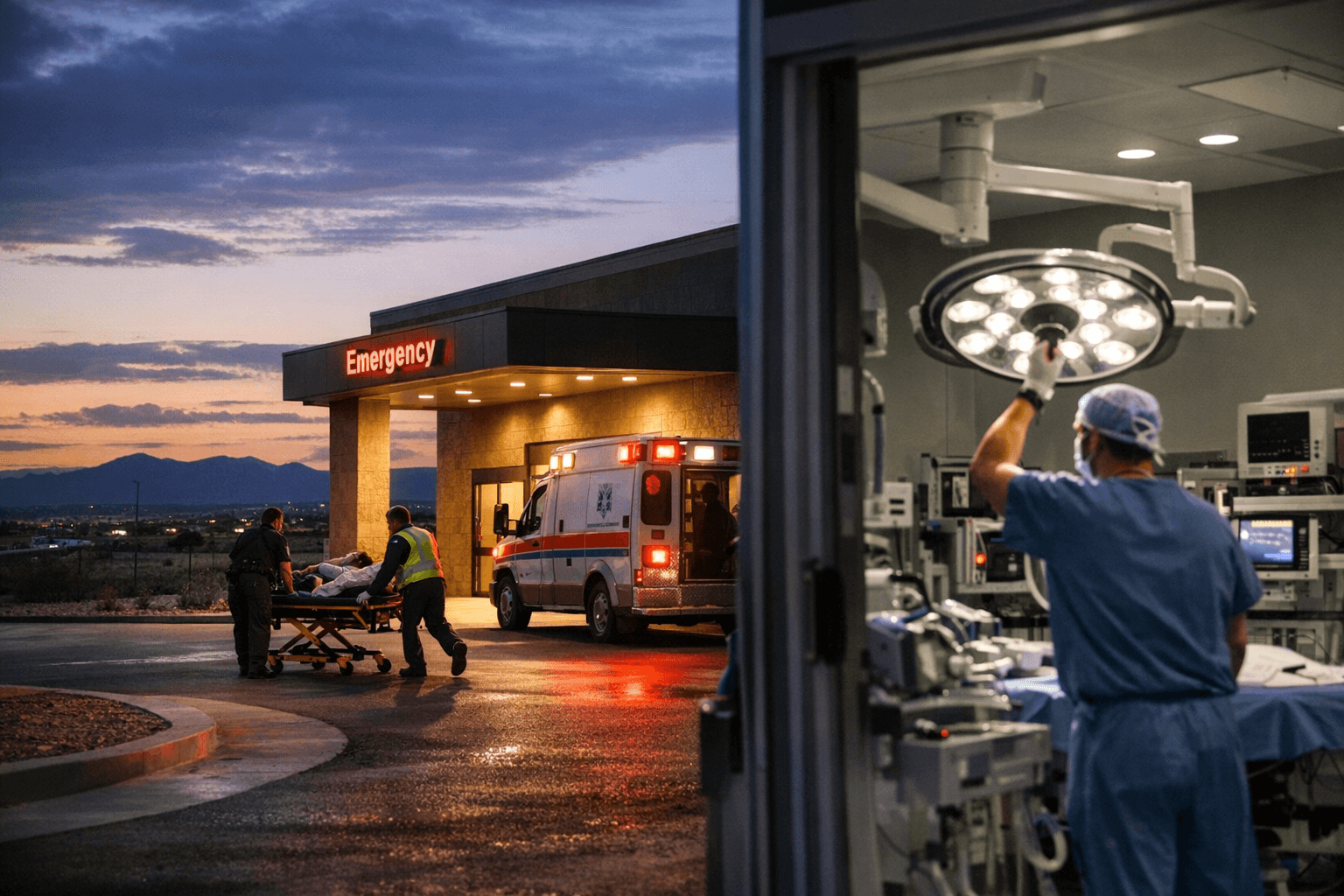
Right now, a heart attack in Peralta or a serious car wreck on I-25 near Belen triggers the same outcome: an ambulance racing 25 miles north to Albuquerque, burning time that cardiologists measure in dead heart muscle and neurologists count in brain cells. Valencia County is the most populous county in New Mexico without a hospital. By late 2026, that distinction ends. Valencia County Hospital: A Lovelace Operation, rising on the northeast corner of Main Street and Sand Sage Road in Los Lunas, will bring a 24/7 emergency department and two operating rooms within reach of a county that has waited nearly two decades for exactly this.
Here is what that actually means for your family's care, answered as directly as possible.
Who is building this, and who will run it?
Valencia County owns the land, building, and equipment. The hospital will be operated by a joint venture of Community Hospital Corporation (CHC) and Lovelace Health System. That operating partnership goes by the name Brazos Health Partners and was awarded the healthcare facilities contract by commissioners voting 4-0 at a special meeting in April 2024. Construction belongs to a design-build team: FBT Architects and Bradbury Stamm were selected for the project, which has been nearly two decades in the making. The 40,000-square-foot, 15-bed hospital will enhance patient care services in the community.
At the March 19, 2026 Valencia County Commission meeting, commissioners unanimously approved the facility's official name: Valencia County Hospital: A Lovelace Operation. County Manager Jhonathan Aragon said the community naming survey drew "quite a few really good responses" and that resident participation in the process was a priority.
What will the hospital offer your family?
The hospital will have its own emergency department and two operating rooms along with 11 in-patient rooms for overnight stays. Patients will have access to MRIs, X-rays and a pharmacy, something patients today have to go to Albuquerque for.
The full list of planned services includes:
- 24/7 emergency department, with ambulance drop-off on the northwest side and a helipad north of the ER for air transport to higher-level trauma centers
- Two operating rooms, with structural space reserved for two additional ORs as patient volume grows
- 11 inpatient rooms in the first phase, with four more in the second phase, reaching the licensed 15-bed capacity
- An imaging department, pharmacy, labs, surgical services and two endoscopy suites
- A critical care unit and space for diagnostics and therapy
Arthur Tatum, president of FBT Architects, noted the site plan already accounts for the future: "This plan and its layout on the site has an 18,000-square-foot addition for the areas of the hospital staff, surgical and some of the other wings, and a 24,000-square-foot medical office building." The current footprint is designed to grow with the county.
What will it NOT provide, at least initially?
Being specific about the hospital's scope matters for planning around it. The approved facility does not include:
- A labor and delivery unit or OB services
- A dedicated behavioral health inpatient ward
- An outpatient dialysis center
- Pediatric specialty care
- A Level I or II trauma designation
For high-risk pregnancies, complex psychiatric crises requiring inpatient admission, kidney dialysis, and pediatric specialty consultations, travel to Albuquerque or referral to UNM Health or Presbyterian remains necessary. This is a small acute-care hospital built for a rural, fast-growing county, not a regional medical center. What it eliminates is the most urgent gap: no local destination at all when seconds count.
How is it paid for?
Construction is being paid for with $50 million from the state legislature, while the county has around $28 million saved up to help operate the facility. The construction dollars come from the Coronavirus Local Fiscal Recovery Fund. One challenge identified earlier was the requirement that the funding be spent by the end of 2025. During the 2023 legislative session, the county convinced the legislature to extend the deadline to 2026 and allow for 5 percent of the $50 million to be used for pre-opening expenses.
The $28 million in county operational savings traces back to the ad valorem property tax that voters approved more than 17 years before a single shovel hit the ground, a commitment residents made specifically and stubbornly for this purpose.
How did it get here, and where does it stand now?
It has been 17 years, five months and 13 days since Valencia County residents threw their support and votes behind an eight-year increase to their property taxes with the goal of bringing a hospital to the county. After nearly two decades of lawsuits, arguing, attempted and failed contracts and hard lessons learned, the Valencia County commission approved a trio of agreements that will hopefully see the long-awaited project started and completed.
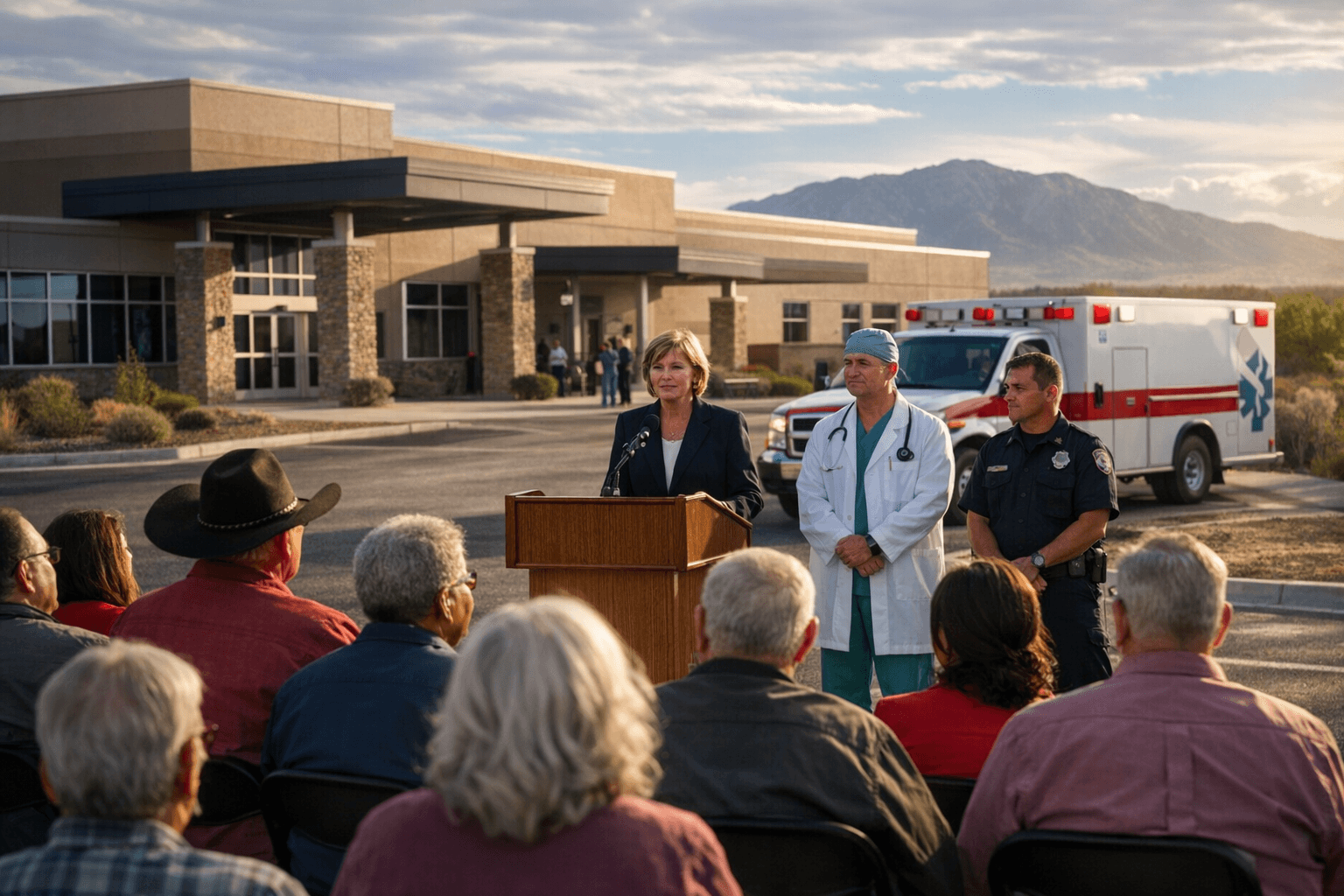
Local and state leaders broke ground on the new facility on November 20, 2024, right off the main I-25 Los Lunas exit. Construction was estimated to take 18 to 19 months.
At the March 4 Valencia County Commission meeting, Dennis Towne, president of Bradbury Stamm, told commissioners the 40,000-square-foot, single-story facility is now fully enclosed and interior finish work is underway. A helipad is being constructed as well, and the village has almost completed an extension of Palmilla Road on the east side of the site.
As of early April 2026, the project is on track. Tyler Nunn said he didn't see any reason the project wouldn't be completed by the anticipated end of June 2026. The companies planning to run the hospital have said they expect to start seeing patients there within a month of construction wrapping up.
12-Month Milestone Tracker: What happens when, and why it matters to you
The path from a finished building to a licensed, staffed hospital involves several sequential gates. Here is what to watch for, and what each milestone means for your family's access to care:
1. April 2026: State Construction Industries Division permit clearance. The New Mexico Construction Industries Division reviews final building systems.
Clearance unlocks the official inspection and equipment installation schedule. Resident benefit: no remaining state construction barriers between the building and its opening date.
2. June 2026 (target): Construction complete. Bradbury Stamm hands the facility to the Lovelace/CHC operations team.
Resident benefit: the physical building that will house Valencia County's first ER transitions from a construction site to a medical facility.
3. July 2026 (projected): Medical equipment commissioning. MRI machines, imaging suites, operating room tables, pharmacy dispensing systems, and lab analyzers are installed and calibrated.
Resident benefit: the imaging that today requires an Albuquerque trip becomes a local appointment.
4. August 2026 (projected): State Health Department and CMS licensing inspections. The New Mexico Department of Health and the Centers for Medicare and Medicaid Services conduct licensing walk-throughs.
Without this clearance, the hospital cannot legally admit patients or bill Medicare and Medicaid. Resident benefit: your federal coverage works at the new facility once CMS approval comes through.
5. Late Summer/Fall 2026 (projected): Staffing complete, ER opens to first patients. Physicians, nurses, and support staff are credentialed and on the floor.
Resident benefit: Valencia County ambulances stop defaulting to Albuquerque for every serious call. County EMS resources stay close to home.
6. Late 2026 to Early 2027 (projected): Full inpatient and surgical operations. All inpatient beds, two operating rooms, and outpatient services running.
Resident benefit: procedures that today require patients to arrange Albuquerque travel, lodging, and childcare can happen at a facility within 10 minutes of most Los Lunas neighborhoods.
How to track progress
Construction projects of this kind move through permitting, state health licensing, equipment procurement, and federal CMS certification before the first patient walks through the door. Valencia County Commission meetings, where construction updates have become a standing agenda item, are the most reliable source of real-time progress. Agendas, contract actions, and design packets are posted in the county's Document Center at co.valencia.nm.us.
Seventeen-plus years of property taxes, a $50 million state appropriation, and a groundbreaking attended by the governor all converged to produce a building that is, at this moment, having its interior finished on Main Street. The next update worth watching is the June completion handoff, because the clock to your county's first local ER starts there.
Know something we missed? Have a correction or additional information?
Submit a Tip