Farm Bureau Leaders Discuss Data Centers, Energy Expansion Impact on Rural Land
Jackson-Vinton Farm Bureau members pushed back on data center and transmission growth that could strip Ohio's farmland tax protections from Vinton County landowners.
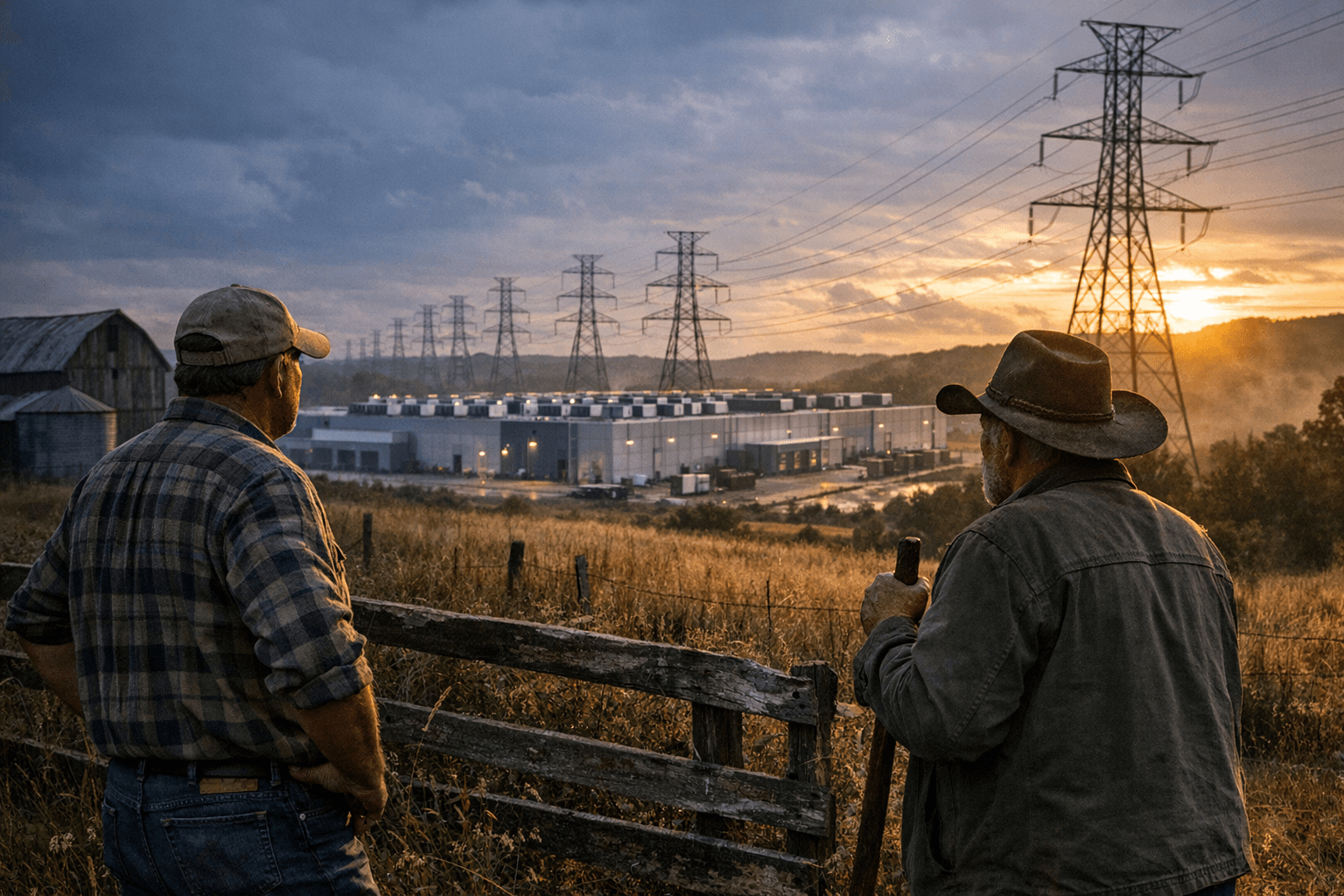
Jackson-Vinton Farm Bureau members joined their counterparts from Pike and Scioto counties Tuesday to press a question that carries direct financial consequences for rural landowners: as data centers and transmission projects expand across the region, what safeguards protect the property-tax status that keeps farm ground affordable to own and operate?
The Ohio Farm Bureau Federation organized the meeting around Dale Arnold, the organization's director of energy, utility and local government policy, who has worked on transmission, solar, wind and pipeline issues for Ohio farmers since 1995. Arnold walked participants through how electric transmission expansion and the surging demand for continuous, large-scale power from data centers intersect with agricultural land use, and how those intersections can trigger the valuation changes that threaten Ohio's Current Agricultural Use Value program, known as CAUV.
CAUV is the mechanism that allows Ohio farmland to be taxed based on its productive agricultural value rather than what a developer might pay for it. When energy infrastructure corridors or data center campuses are sited near or on agricultural parcels, the risk of reclassification, and the tax increases that follow, becomes real and immediate for affected landowners. OFBF has called property taxation one of the biggest challenges facing its members.
The stakes are not abstract in Vinton County. Chicago-based Invenergy has an existing solar project in the county for which commissioners approved a payment-in-lieu-of-taxes rate of $7,450 per megawatt generated; Invenergy estimated the completed facility would produce close to $1 million annually in property tax revenue, with distributions flowing to local schools and townships. A second proposal, the Hamden Energy project from Recurrent Energy, was in its preapplication phase before the Ohio Power Siting Board earlier this year and drew opposition from more than 30 residents at a February public meeting in McArthur. Commissioner Kevin Cozad said at that time the board had not yet decided whether to support it.
Those decisions commissioner votes on PILOT frameworks, Ohio Power Siting Board applications, and transmission right-of-way negotiations are precisely the leverage points the Farm Bureau meeting was designed to help local leaders understand and act on. Members emphasized that protecting the agricultural tax designation is central to keeping parcels in production rather than watching them reclassified at development values that put land out of reach for working farmers.
Arnold's direct involvement signals that OFBF intends the conversation to move from informational to actionable. Follow-up steps are expected to include county-level outreach to property appraisers, briefings for local officials, and possible Farm Bureau recommendations to state lawmakers on PILOT structures and the allocation of transmission costs when new lines are built to serve large industrial loads.
For Vinton County, where the OPSB's state-level authority can override local objections and where multiple energy proposals are already in the pipeline, how those policy conversations resolve will determine whether the next wave of projects broadens the school and township tax base or accelerates the erosion of the agricultural economy that has defined the county's land use for generations.
This article was produced by Prism’s automated news system from verified source data, official records, and press releases, then run through automated quality and moderation checks before publishing. The system is built and supervised by the people who set the standards it runs under. Read our full AI policy.
Did this article answer your question?