Scioto Township Residents Fight Data Center as Zoning Protections Remain Uncertain
Scioto Township trustees told residents fighting a proposed data center that zoning likely won't stop it, leaving Kasey Hall's 200-person coalition without a clear path forward.
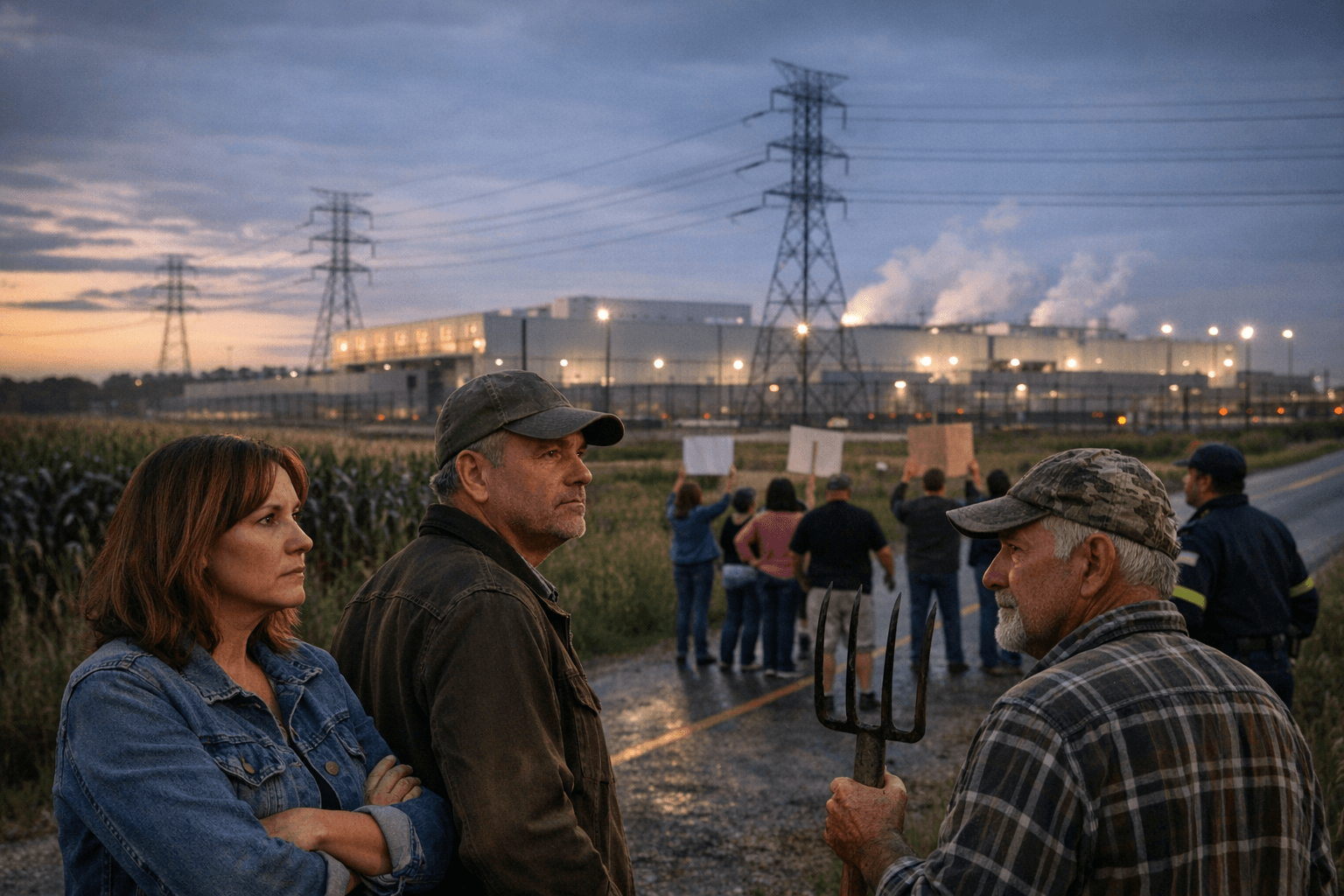
Kasey Hall organized her neighbors to stop a data center from swallowing farmland in Jackson County's Scioto Township, but when that coalition pressed the question of legal protection at a trustees' meeting, officials delivered news the group hadn't planned for: zoning may not be enough to stop the project.
The dispute began when Hall's parents, part of a three-generation farming family, were approached with a financial offer from an unnamed company eyeing a data center site in the township. Hall, who describes herself as someone who typically stays out of public life, made her first-ever Facebook post shortly after the offer arrived, asking community members for help. What started as a gathering of 24 residents quickly grew: in March, more than 200 people packed the Scioto Township Volunteer Fire Department on State Route 776, drawing everyone from Amish farmers to local elected officials for an unplanned referendum on what industrial development means for rural Jackson County.
At the center of the community's opposition are concerns over water consumption, stormwater runoff into local wetlands, the strain a facility of this scale would place on county roads and electrical transmission infrastructure, and whether the few permanent jobs created justify the farmland lost and the tax incentives granted. Teresa Davis pushed those questions directly, appearing alongside her daughters Amy Newman and Grace Moore before the Jackson County Commissioners to demand transparency about who the developer is, how many acres are targeted, and what discussions, if any, have already taken place with county officials.
The trustees' April 3 response on zoning made those questions more urgent. Officials acknowledged that pursuing formal zoning could theoretically serve as a tool, but warned it was not a legal guarantee and carried its own political costs. They cautioned that adopting zoning could trigger what they called "spiraling" regulations reaching into everyday property decisions. For a region where local sentiment already treats zoning as a four-letter word, that warning cuts both ways: the most obvious mechanism to constrain the data center is the same one many residents oppose applying to their own land.
That tension is running statewide. Without township zoning in place, developers proposing large-scale facilities have no obligation to seek local approval at all. Larry Kidd, speaking to the regional jobs picture, acknowledged that data center positions are "six figure jobs," a framing the industry relies on to build political support. Opponents counter that the number of permanent positions a data center generates is modest relative to the transmission upgrades, water system demands, and heavy road wear the construction and operations phases impose on public infrastructure.
No formal application for rezoning or a conditional-use permit has been filed at the township or county level, which means the statutory public-hearing process has not yet been triggered. When a filing does arrive, state law requires formal notice and hearings; any project touching wetlands or requiring stormwater infrastructure would also need Ohio EPA review, including a 401 Water Quality Certification. Those regulatory filings, not zoning, represent the most concrete intervention points still available to the community.
What the trustees made plain April 3 is that waiting on zoning to hold the line is not a reliable strategy. The unnamed company has already put offers in front of landowners across the township, and with no developer disclosure, no parcel filing, and no formal application on record, the community group Hall assembled is fighting a project they cannot yet fully see.
This article was produced by Prism’s automated news system from verified source data, official records, and press releases, then run through automated quality and moderation checks before publishing. The system is built and supervised by the people who set the standards it runs under. Read our full AI policy.
Did this article answer your question?